Best Crackers for Charcuterie Board: A Complete Pairing Guide
Best Crackers for Charcuterie Board: A Complete Pairing Guide
You spent twenty minutes selecting the perfect prosciutto, aged your Manchego recommendation into something special, and found that fig jam everyone raves about. Then you grabbed whatever crackers were on sale at the grocery store. Sound familiar?
Crackers are the most underrated element on a charcuterie board. They're not just a vehicle for cheese — they set the texture, influence the flavor balance, and determine whether your carefully curated meats and cheeses land the way you intended. A delicate bresaola draped over a thick, over-seasoned cracker is a waste of good bresaola. But that same bresaola on a thin, crisp water cracker? That's the bite your guests will remember.
After building hundreds of boards, I've developed strong opinions about which crackers work, which don't, and exactly why. This guide breaks down the best crackers for charcuterie boards by type, with specific pairing recommendations so you can match each cracker to the meats and cheeses it supports best.
What Makes a Great Charcuterie Cracker
Before we get into specific picks, it helps to understand what separates a great charcuterie cracker from a great snack cracker — because they're not the same thing.
A charcuterie cracker has three jobs. First, it provides structural support. It needs to hold a slice of meat, a piece of cheese, maybe a dab of mustard, without crumbling in your hand or going soggy within minutes. Second, it adds textural contrast. The crunch of a cracker against the silkiness of prosciutto or the creaminess of brie is what makes each bite interesting. Third — and this is where most people go wrong — it stays out of the way. The cracker's flavor should complement, not compete.
That last point is critical. A jalapeño-cheddar cracker might be delicious on its own, but it bulldozes over the flavor of a nuanced coppa or a carefully aged Gruyère. The best charcuterie crackers are like good supporting actors: they make the stars shine brighter without stealing the scene.
Here's what to look for:
- Thin and crisp — Thick crackers require too much chewing and overpower delicate toppings. Thin crackers break cleanly and let the meat and cheese dominate.
- Neutral to mild flavor — Salt, a touch of olive oil, maybe some sesame seeds. Nothing that screams louder than your prosciutto.
- Structural integrity — The cracker needs to survive the weight of toppings and the moisture of soft cheeses without going limp.
- Appropriate size — Bite-sized or close to it. Crackers that require breaking create crumbs and awkward partial bites.
The 12 Best Crackers for Charcuterie Boards
I've organized these from most versatile to most specialized. If you're building your first board, start with the top three. If you're an experienced board builder, mix four to five types for variety.
1. Plain Water Crackers
Water crackers are the baseline — the cracker against which all other charcuterie crackers should be measured. Made from flour, water, and salt with minimal fat, they bake up thin, crisp, and almost flavor-neutral. That neutrality is their superpower. A water cracker never fights with what's on top of it.
Carr's Table Water Crackers are the most widely available quality option. Their rectangular shape provides a generous surface area for stacking, and they're sturdy enough to hold soft cheeses without breaking. For something more artisanal, look for brands that use sea salt and olive oil — they add just enough character without crossing into "flavored cracker" territory.
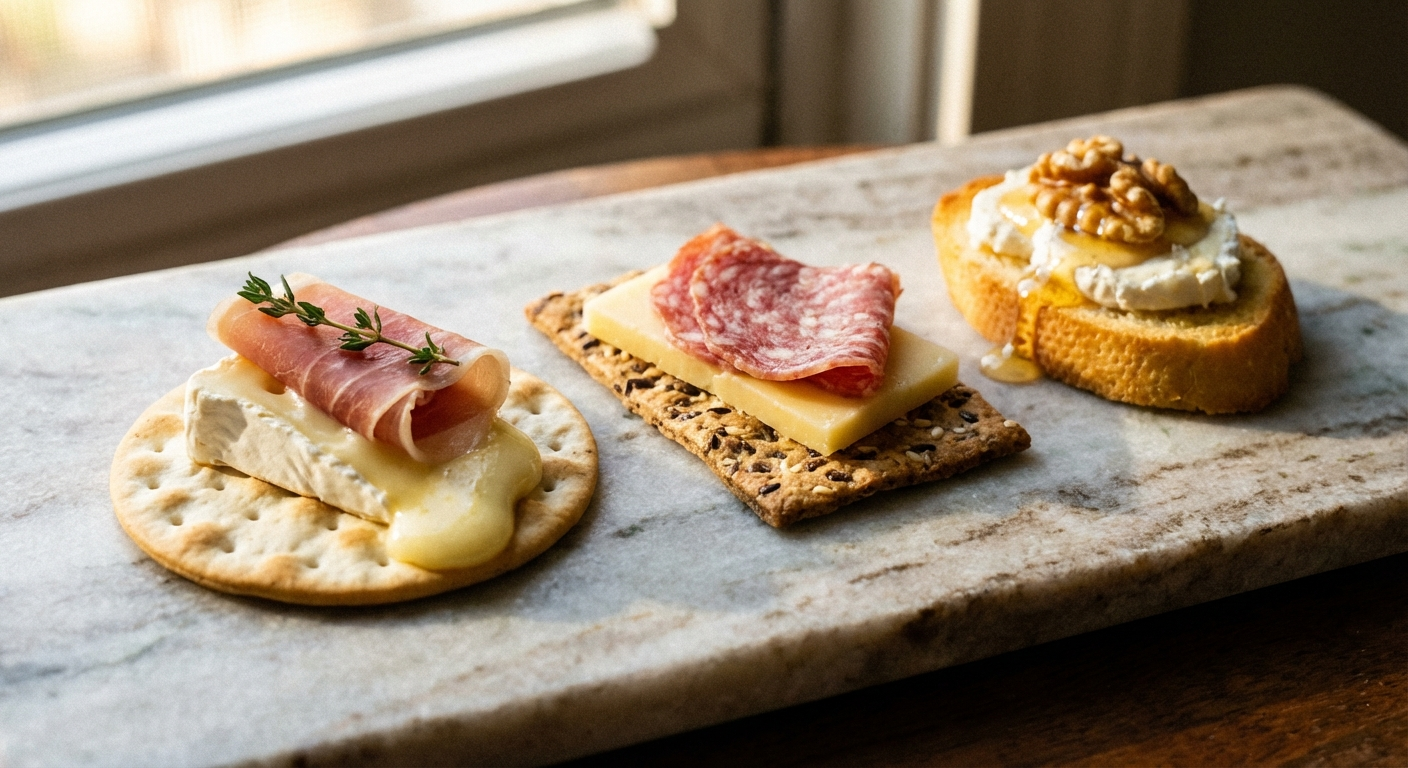
Best pairings: Brie and prosciutto, fresh mozzarella with sopressata, any soft cheese, delicate cured meats like bresaola or lonza.
2. Crostini
Technically bread, not crackers — but crostini belong on every charcuterie board. Thinly sliced baguette rounds brushed with olive oil and baked until golden, crostini offer a toasty, substantial base that holds up to heavy toppings. They're the best choice for spreads like pâté, rillettes, or 'nduja that would slide off a flat cracker.
Make them yourself for the best results: slice a baguette on a bias into quarter-inch rounds, brush both sides lightly with extra-virgin olive oil, sprinkle with flaky salt, and bake at 375°F for 10-12 minutes until golden. They'll stay crisp for hours — far longer than fresh bread.
Best pairings: Pâté, rillettes, 'nduja, burrata with prosciutto, any spread-forward combination.
3. Seeded Crackers
Sesame, flax, poppy, sunflower — seeded crackers add visual interest and a gentle nutty complexity that pairs beautifully with aged cheeses. They're the step up from water crackers when you want the cracker to contribute something without taking over.
Everything-seasoning crackers (with sesame, poppy seeds, dried garlic, and onion flakes) are particularly versatile. They echo the flavors already present in many cured meats without amplifying any single note. Raincoast Crisps are the premium option here, though they're thick enough that they work best with robust cheeses rather than delicate meats.
Best pairings: Aged cheddar, Manchego, Gouda, hard salami, finocchiona, coppa.
4. Grissini (Italian Breadsticks)
Grissini add the one thing crackers can't: height. These thin, crisp Italian breadsticks stand vertically on your board, creating visual drama and an interactive eating experience — snap one, wrap it in prosciutto, dip it in soft cheese. They're the charcuterie board equivalent of an architectural flourish.
Classic plain grissini are best for wrapping with prosciutto or bresaola. Sesame or rosemary varieties work as standalone nibbles between bites of richer items. Avoid cheese-flavored grissini — they're usually too salty to pair well with actual cheese.
Best pairings: Prosciutto (wrapped), bresaola (wrapped), soft goat cheese (dipped), tapenade, honey.
5. Whole Grain Crisps
Whole grain and multigrain crisps bring an earthy, slightly nutty backbone to your board. They're heartier than water crackers, which makes them the right match for strong-flavored meats and cheeses that need a cracker with enough presence to balance their intensity.
Look for thin, crispy varieties rather than thick, bready ones. The best whole grain crisps shatter when you bite them — if they bend, they're too soft for charcuterie use. Brands like Doctor Kracker and Lesley Stowe Raincoast Crisps (the fig and olive variety) sit in the sweet spot between flavor and restraint.
Best pairings: Blue cheese, aged Gouda, soppressata, strong salami, guanciale, smoked meats.
6. Rice Crackers
Rice crackers are the sleeper pick that most people overlook. Light, crisp, and almost neutral in flavor, they're excellent with Asian-influenced boards or whenever you want to minimize the cracker's flavor impact. They're also naturally gluten-free, which makes them essential if you're serving guests with dietary restrictions.
Choose plain or lightly salted rice crackers — avoid the heavily seasoned varieties (soy sauce, wasabi) unless you're intentionally building an Asian-fusion board. The thinner, more delicate rice crackers work best; the thick, puffy ones are too soft.
Best pairings: Fresh cheeses, mild cured meats, duck prosciutto, lardo, delicate pâté.
7. Lavash Crisps
Lavash — the thin Armenian flatbread — bakes into large, irregular shards that look stunning on a board. Break them into pieces of varying sizes and scatter them around the edges. Their slightly blistered surface catches olive oil and herbs in a way that feels artisanal, even when they come from a package.
Lavash crisps are sturdier than they look. They hold up well under mounds of hummus, thick slices of cheese, and heavy charcuterie without snapping prematurely. Their large surface area also makes them ideal for building multi-ingredient bites.
Best pairings: Hummus, tzatziki, feta, capicola, roasted red pepper, olive tapenade.
8. Sourdough Crackers
Sourdough crackers carry a subtle tang that echoes the fermented complexity of cured meats. This shared fermentation character creates a natural harmony — the cracker and the charcuterie speak the same flavor language. They're thicker than water crackers but thinner than bread, hitting a middle ground that works with both soft and hard toppings.
If you can find locally made sourdough crackers at a farmers market, they're usually worth the premium. Commercial options from brands like Rustic Bakery offer a reliable alternative. The tang should be present but gentle — crackers that taste sour are too aggressive.
Best pairings: Aged Comté, Gruyère, pancetta, finocchiona, fermented honey, cornichons on the side.
9. Olive Oil Crackers
A good olive oil cracker tastes like the Mediterranean in miniature. The best versions use real extra-virgin olive oil that you can actually taste — fruity, slightly peppery, with a richness that butter crackers can't match. They bridge the gap between bread and cracker, offering the flavor depth of crostini with the convenience of something from a box.
These crackers pair naturally with Italian-style boards. The olive oil flavor complements rather than competes with classic Italian cured meats, creating combinations that taste cohesive rather than assembled.
Best pairings: Parmigiano-Reggiano, pecorino, mortadella, prosciutto, sun-dried tomatoes, fresh basil.
10. Rye Crisps
Rye crisps bring a distinctive earthiness and slight bitterness that pairs exceptionally well with smoked and cured fish boards or Scandinavian-style charcuterie. They're darker and more assertive than most crackers on this list, so use them intentionally rather than as a default.
Finn Crisp and Wasa are the most reliable commercial options. Choose the thin varieties over the thick — you want a crisp, not a bread substitute. Caraway-flavored rye crisps add an extra dimension that works beautifully with smoked salmon, gravlax, or smoked duck breast.
Best pairings: Smoked salmon, gravlax, cream cheese, dill, pastrami, cured duck, strong mustard.
11. Charcoal Crackers
Black charcoal crackers are the dramatic choice. Made with activated charcoal, they taste essentially neutral — similar to water crackers with a very faint mineral quality — but their jet-black color creates striking visual contrast against pale cheeses and pink-toned meats. They photograph incredibly well, which matters if you're building a board for entertaining.
Don't overdo them. A cluster of charcoal crackers in one section of the board creates a visual anchor; scattering them everywhere looks chaotic. Treat them as an accent, not the primary cracker.
Best pairings: Soft white cheeses (brie, burrata, chèvre), prosciutto, bresaola — anything that creates strong visual contrast.
12. Nut-Based Crackers
Almond flour crackers, pecan crisps, and similar nut-based options have moved from niche health-food territory into mainstream charcuterie use. They're naturally gluten-free, protein-rich, and carry a warm, nutty flavor that complements aged cheeses particularly well.
The texture of nut crackers is different from grain-based options — more dense and snappy rather than light and shattery. This makes them ideal for firm toppings but less suitable for soft, spreadable cheeses that need a flatter, smoother surface.
Best pairings: Aged cheddar, aged Gouda, Comté, hard salami, dried chorizo, honey, dried fruit.
How Many Cracker Types Per Board
The number of cracker types depends on your board size and the number of guests, but there's a general rule: aim for three to five varieties. Fewer than three feels limited; more than five creates decision fatigue and takes up space better used for meats, cheeses, and accompaniments.
Here's how to scale:
- Board for 2-4 people: Three cracker types — one neutral (water crackers), one textured (seeded), one bread-style (crostini or grissini).
- Board for 6-10 people: Four types — add a specialty option like lavash or sourdough crackers.
- Board for 10+ people: Five types — full variety with a visual accent like charcoal crackers.
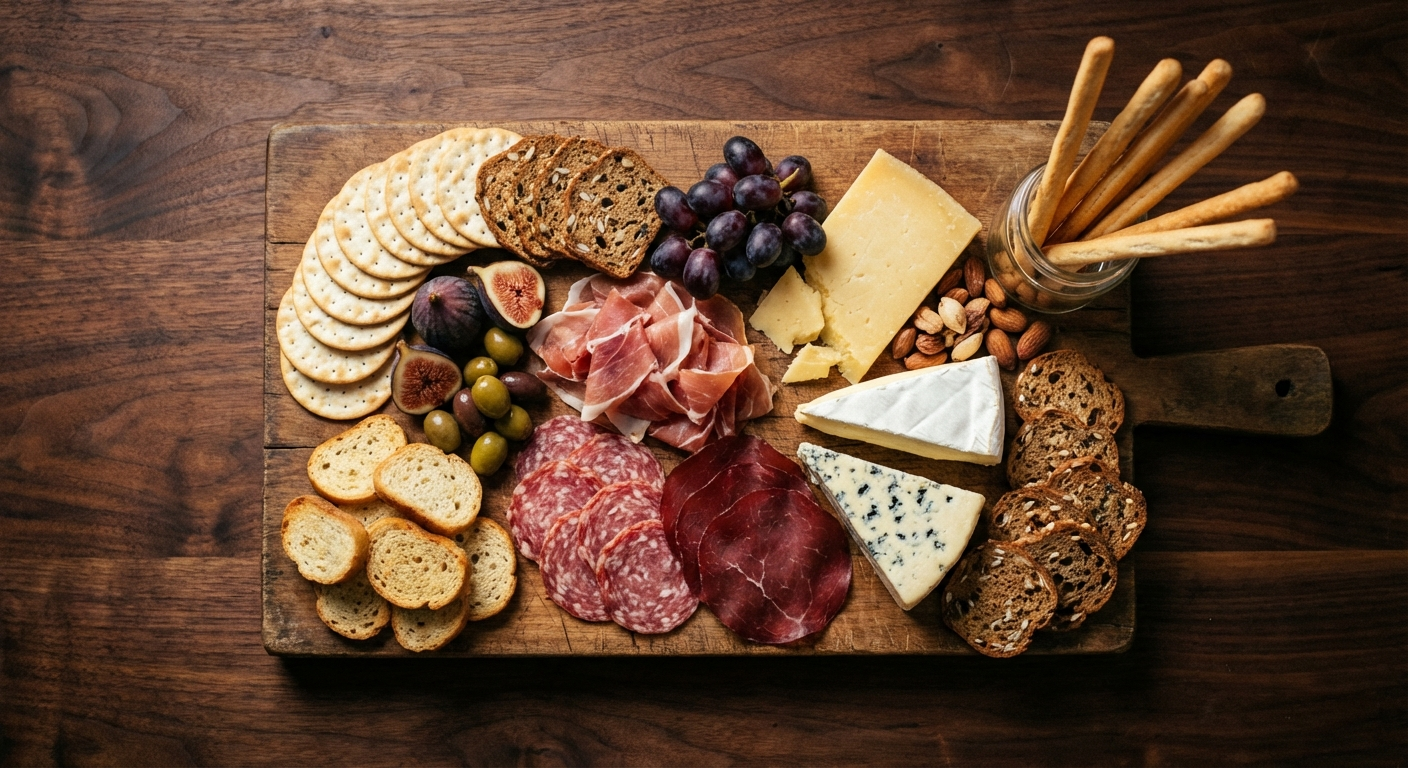
Place each cracker type in its own cluster on the board rather than mixing them together. Clusters look intentional and help guests identify their options at a glance. Fan water crackers in a curved line, stack crostini in a lean, and stand grissini upright in a small jar or cup.
Cracker Quantity Guide
Running out of crackers mid-party is one of the most common board-building mistakes. Guests eat more crackers than you expect because crackers are the easiest thing to grab — they don't require cutting, unwrapping, or committing to a specific flavor.
Plan for 8-10 crackers per person for an appetizer board and 12-15 per person for a board that serves as the main spread. For a board of 8 guests, that means roughly 80 crackers minimum — usually three to four boxes or one to two packages of each type you're serving.
Always have backup crackers in the kitchen. Refilling crackers during a party takes thirty seconds and prevents the board from looking picked-over. Accompaniments like olives, nuts, and fruit also fill gaps, but nothing replaces crackers for functionality.
Pairing Crackers with Specific Cheeses
While the pairing recommendations above give you a starting point, here's a quick-reference matrix for the most common charcuterie cheeses:
- Brie / Camembert (soft, bloomy): Water crackers, crostini, olive oil crackers. The cracker should be mild enough to let the cheese's buttery, mushroomy flavor shine.
- Aged Cheddar (hard, sharp): Seeded crackers, whole grain crisps, nut crackers. Sharp cheddar can handle — and benefits from — a cracker with its own personality.
- Manchego (semi-hard, nutty): Seeded crackers, olive oil crackers, sourdough. The nutty quality of Manchego harmonizes with crackers that have similar warmth.
- Goat Cheese / Chèvre (soft, tangy): Water crackers, crostini, charcoal crackers. Tangy cheese needs a neutral or visually contrasting base.
- Blue Cheese (strong, pungent): Whole grain crisps, rye crisps, nut crackers. Strong cheese needs a cracker robust enough to stand up to its intensity.
- Parmigiano-Reggiano (hard, umami): Olive oil crackers, grissini, water crackers. The Italian classic deserves an Italian-style cracker.
- Gouda (semi-hard to hard, caramel notes): Seeded crackers, whole grain crisps, sourdough. Gouda's sweetness pairs well with earthy, nutty cracker profiles.
Common Mistakes to Avoid
After years of building and critiquing boards, these are the cracker mistakes I see most often:
Choosing flavored crackers that compete with the board. Rosemary-parmesan crackers are delicious on their own. But on a board with actual parmesan and herbs, they create flavor confusion rather than clarity. Save heavily flavored crackers for snacking, not charcuterie.
Using only one type of cracker. A board with three cheeses, four meats, two jams, and one type of cracker misses an opportunity. Different crackers create different experiences with the same toppings — that variety is part of what makes a charcuterie board exciting.
Forgetting about structural strength. Soft, delicate crackers can't hold a thick slice of summer sausage and a wedge of aged Gouda. Match your cracker's strength to your heaviest likely topping.
Ignoring dietary restrictions. Gluten-free guests end up eating only cheese and fruit if you don't include at least one option for them. Rice crackers, nut crackers, or gluten-free seed crisps solve this without compromising the board's quality.
Placing crackers too early. If your board sits out during prep, crackers absorb ambient moisture and go stale. Add crackers last, just before serving. Everything else — meats, cheeses, accompaniments — can be placed ahead of time.
Storing Crackers for Freshness
Stale crackers ruin an otherwise perfect board. Once opened, crackers begin absorbing moisture from the air — especially in humid environments. Here's how to keep them crisp:
- Transfer to airtight containers immediately after opening. The original packaging is designed for shelf life, not resealing.
- Add a silica packet to the container if you have one from another product. It absorbs ambient moisture and extends crispness by days.
- Refresh stale crackers by spreading them on a baking sheet and baking at 300°F for 5-7 minutes. They'll crisp back up and taste almost as good as fresh. This works for water crackers, crostini, and most grain-based crackers.
- Freeze for long-term storage. Most crackers freeze well for up to three months. Thaw at room temperature for 30 minutes, then refresh in the oven if needed.
Making Your Own Charcuterie Crackers
Homemade crackers elevate a board from impressive to unforgettable. They're also surprisingly easy to make, and the results are better than anything you'll find in a store. Here's a simple base recipe that you can customize:
Basic Charcuterie Crackers (makes about 60 crackers):
- 2 cups all-purpose flour
- 1 teaspoon flaky sea salt
- 2 tablespoons extra-virgin olive oil
- ½ cup water
- Optional toppings: sesame seeds, flax seeds, everything seasoning, cracked black pepper
Mix flour and salt. Add olive oil and water, stirring until a shaggy dough forms. Knead briefly until smooth — about 2 minutes. Rest 30 minutes. Roll paper-thin (use a pasta machine if you have one), cut into rectangles or irregular shapes, brush with olive oil, sprinkle with toppings, and bake at 400°F for 8-10 minutes until golden and crisp. Cool completely before serving.
The key is rolling the dough thin enough. If you can't see the outline of your hand through it, it's too thick. Thin dough bakes into shattery, crisp crackers; thick dough bakes into tough flatbread.
Frequently Asked Questions
Can I use regular snack crackers like Ritz or Club? You can, but they're not ideal. Buttery snack crackers compete with cheese flavors, go soft quickly when topped, and look casual on a board you've otherwise put effort into. They work in a pinch, but dedicated charcuterie crackers are worth the small upgrade.
How far in advance can I set out crackers? Crackers stay crisp for about 2 hours in a dry environment. In humid conditions, closer to 1 hour. Always add them last when building your board, and keep extras sealed in the kitchen for refreshing.
Do I need gluten-free crackers? If you're hosting more than a handful of people, yes. One in ten adults avoids gluten, whether for celiac disease, sensitivity, or preference. Rice crackers and nut-based crisps are easy additions that don't compromise the board.
What's the best cracker for soft cheese? Water crackers or crostini. Soft cheese needs a smooth, flat surface to spread on and a cracker sturdy enough to hold the weight without snapping. Seeded crackers have too much texture for spreadable cheeses.
Should crackers be at room temperature? Yes. Cold crackers (straight from an overly air-conditioned kitchen) can feel stale even when they're not. Let them sit at room temperature for at least 15 minutes before serving.
Frequently Asked Questions
What are the best crackers for a charcuterie board?
The most versatile options are plain water crackers, crostini, and seeded crackers. Water crackers work with everything due to their neutral flavor. Crostini are ideal for spreads and pâté. Seeded crackers add subtle complexity that pairs well with aged cheeses and hard salami.
How many types of crackers should be on a charcuterie board?
Aim for three to five types depending on board size. For 2-4 guests, three types is sufficient (one neutral, one textured, one bread-style). For larger gatherings of 10+ people, five types including a visual accent like charcoal crackers creates good variety.
How many crackers per person for a charcuterie board?
Plan for 8-10 crackers per person for an appetizer board and 12-15 per person when the board is the main spread. Always keep backup crackers in the kitchen for refilling — guests eat more crackers than you expect.
Can I make crackers ahead of time?
Yes. Homemade crackers stay crisp for up to a week stored in an airtight container at room temperature. Refresh them in a 300°F oven for 5-7 minutes before serving if they lose any crunch. You can also freeze crackers for up to three months.
What crackers should I avoid on a charcuterie board?
Avoid heavily flavored crackers like jalapeño, ranch, or strong herb varieties — they compete with your meats and cheeses. Also skip thick, soft crackers or sandwich bread, which absorbs moisture and goes soggy quickly. The cracker should support the toppings, not overpower them.
More Charcuterie Guides
What Is Pink Curing Salt? Sodium Nitrite Explained for Home Charcuterie
Pink curing salt is the most essential — and most misunderstood — ingredient in meat curing. This guide explains what it is, why it's pink, how sodium nitrite prevents botulism, proper usage rates, and whether you can cure meat without it.
10 min readHow Long Does Charcuterie Last? Storage Guide for Cured Meats & Cheese
Understanding proper charcuterie storage ensures you enjoy it at peak quality while avoiding food safety risks.
10 min read