How to Make Guanciale at Home: The Complete Italian Curing Guide
How to Make Guanciale at Home: The Complete Italian Curing Guide
If you've ever eaten a properly made carbonara — the real Roman kind, not the cream-laden impostor — you know there's a flavor in there that pancetta can't quite replicate. That flavor comes from guanciale, and once you've tasted the real thing, there's no going back.
Guanciale (pronounced gwan-CHAH-leh) is Italian cured pork jowl. The name comes from guancia, meaning "cheek." Unlike pancetta (belly) or prosciutto (leg), guanciale comes from the pig's face — a cut that's rich in both intramuscular fat and the kind of deep, porky flavor that only comes from muscles the animal actually uses. When rendered in a hot pan, guanciale's fat turns silky and translucent while the meat crisps into something impossibly savory.
I've been making guanciale in my home curing setup for over 20 years, and it remains one of my favorite projects. It's simpler than salami, faster than prosciutto, and produces a result that's genuinely hard to find in stores outside of Italian specialty shops. If you've already made pancetta, guanciale follows the same basic principles with a different cut and a slightly different spice profile.
Guanciale 101: What Makes It Special
Guanciale isn't just "face bacon." The pork jowl has a unique composition that sets it apart from every other cured pork product:
- Fat ratio: Pork jowl is roughly 70% fat, 30% lean meat — far fattier than belly (pancetta) or loin (lonza). This extreme fat content is exactly the point. When you render guanciale, you get an extraordinary amount of flavorful cooking fat that coats pasta like liquid silk.
- Fat quality: Jowl fat is softer and more delicate than back fat or belly fat. It melts at a lower temperature and has a cleaner, sweeter flavor. In Italian cooking, this distinction matters enormously.
- Muscle structure: The cheek muscle is constantly working — the pig uses it for chewing. This gives the lean portions of guanciale a denser, more flavorful texture than belly meat.
- Size: A single jowl typically weighs 1.5-3 pounds, making it a manageable home-curing project that doesn't require the space commitment of a whole pancetta or prosciutto.
In Roman cuisine, guanciale is non-negotiable in three iconic pasta dishes: carbonara, amatriciana, and gricia. Using pancetta or — God forbid — bacon in these dishes is considered heresy by any Roman worth their salt. The flavor profile is simply different, and the dish changes fundamentally when you substitute.
Sourcing Pork Jowls
Finding pork jowls is the biggest hurdle for most home curers. They're not typically in the grocery store meat case. Here's where to look:
Where to Buy
- Local butcher shops: Your best bet. Many butchers receive whole hogs and can set aside jowls if you ask. Call ahead and request them — they're often discarded or sold cheaply since demand is low.
- Farmers' markets: Small-scale hog farmers often sell jowls. Heritage breed jowls (Berkshire, Duroc, Mangalitsa) are exceptional for guanciale.
- Asian and Latin markets: Pork jowls are used in many cuisines. You'll often find them fresh or frozen at international markets at very reasonable prices.
- Online specialty butchers: Several online retailers ship fresh pork jowls. The Meatery is a reliable source for quality pork products.
What to Look For
- Skin-on: Traditional guanciale is made with the skin still attached on one side. The skin helps the jowl hold its shape during drying and adds textural interest. Skin-off works but the finished product will be less traditional.
- Fresh, not frozen if possible: Fresh jowls have better texture for curing. Frozen works fine but pat extremely dry after thawing — excess moisture can interfere with the cure.
- Clean trim: The jowl should be trimmed of any glands, blood spots, or loose bits. If your butcher hasn't done this, you'll need to do it yourself.
- Size: 1.5-3 pounds per jowl is typical. Larger jowls (from bigger hogs or heritage breeds) are easier to work with and produce better results.
- Color: The fat should be white to cream-colored, the lean meat bright pink. Avoid gray or yellowed fat.
Heritage Breeds: Worth the Premium
If you can find jowls from heritage breed pigs — Berkshire, Duroc, Red Wattle, Large Black, or especially Mangalitsa — buy them without hesitation. Heritage breeds carry more intramuscular fat, and the fat itself has better flavor and a silkier texture than commodity pork. Mangalitsa jowls in particular produce guanciale that's almost absurdly rich and buttery.
The Cure: Ingredients and Method
Guanciale's cure is simpler than most cured meats — the jowl's natural fat content does much of the heavy lifting. You want salt for preservation, curing salt for safety, and a restrained spice profile that enhances rather than masks the pork's natural flavor.
Essential Cure Formula (Per 2 lbs / 900g of Pork Jowl)
- Kosher salt: 45g (about 3 tablespoons) — Diamond Crystal preferred
- Curing salt #2 (Prague Powder #2): 5g (about 1 teaspoon)
- Coarsely ground black pepper: 15g (about 3 tablespoons)
- Fresh thyme leaves: 1 tablespoon (or 1 teaspoon dried)
- Bay leaves, crumbled: 2-3 leaves
- Garlic, minced: 2-3 cloves (optional — some purists omit garlic)
Regional Variations
Guanciale recipes vary across Italy:
- Roman style: Salt, black pepper, and nothing else. The purist's approach — lets the pork speak for itself.
- Abruzzese style: Adds dried chili flake (peperoncino) for gentle heat. Excellent in amatriciana.
- Umbrian style: Includes garlic, thyme, and sometimes rosemary. More aromatic, wonderful for cooking.
I typically make the Umbrian style for its versatility, but if you're making guanciale specifically for carbonara, the Roman approach (salt and pepper only) produces the cleanest flavor in the finished dish.
Why Curing Salt #2?
Guanciale is an air-dried product that takes 3-6 weeks to complete. Curing salt #2 contains both sodium nitrite (immediate antimicrobial protection) and sodium nitrate (which slowly converts to nitrite over the drying period, providing ongoing safety). For any product dried longer than 2 weeks, curing salt #2 is the correct choice.
This is not optional. Without curing salt, you cannot safely air-dry pork at home. For more detail on the science, read our complete guide to curing salts.
Step-by-Step: Making Guanciale
Day 1: Prep and Cure
- Trim the jowl: Remove any glands (small, firm lumps usually near the throat end), blood spots, or loose tissue. Leave the skin intact on one side. If there are any ear remnants, trim those off. Weigh the trimmed jowl and record the weight — you'll track weight loss during drying.
- Mix the cure: Combine all cure ingredients in a bowl. The mixture should be aromatic and slightly paste-like from the fresh herbs and garlic.
- Apply generously: Wearing gloves, rub the cure mixture over every surface of the jowl — meat side, fat side, skin side, edges. Pay special attention to the meat side, pressing the cure into the surface. The layer should be thick and even.
- Bag it: Place the cured jowl in a vacuum-seal bag or a gallon zip-lock bag, pressing out as much air as possible. If using a zip-lock, place the bag on a sheet pan to catch any leaks.
- Refrigerate: Place in the coldest part of your refrigerator (36-38°F / 2-3°C). The jowl will cure for 7-10 days.
Days 2-10: The Cure Phase
- Flip daily: Turn the bag over once a day to redistribute the cure and the liquid that accumulates. The salt draws moisture from the meat — this is normal and expected.
- Massage every 2-3 days: Give the jowl a gentle massage through the bag. This helps the cure penetrate evenly and prevents any dry spots.
- Duration: Cure for 7 days minimum, 10 days for thicker jowls. The general rule is 2 days per inch of thickness plus 2 extra days. Most jowls are 1.5-2 inches thick, so 7-10 days is the sweet spot.
After Curing: Rinse and Prep for Drying
- Rinse: Remove the jowl from the bag and rinse under cold running water, washing away all surface cure. Don't soak — just a thorough rinse.
- Pat dry: Dry thoroughly with paper towels. The surface should feel tacky but not wet.
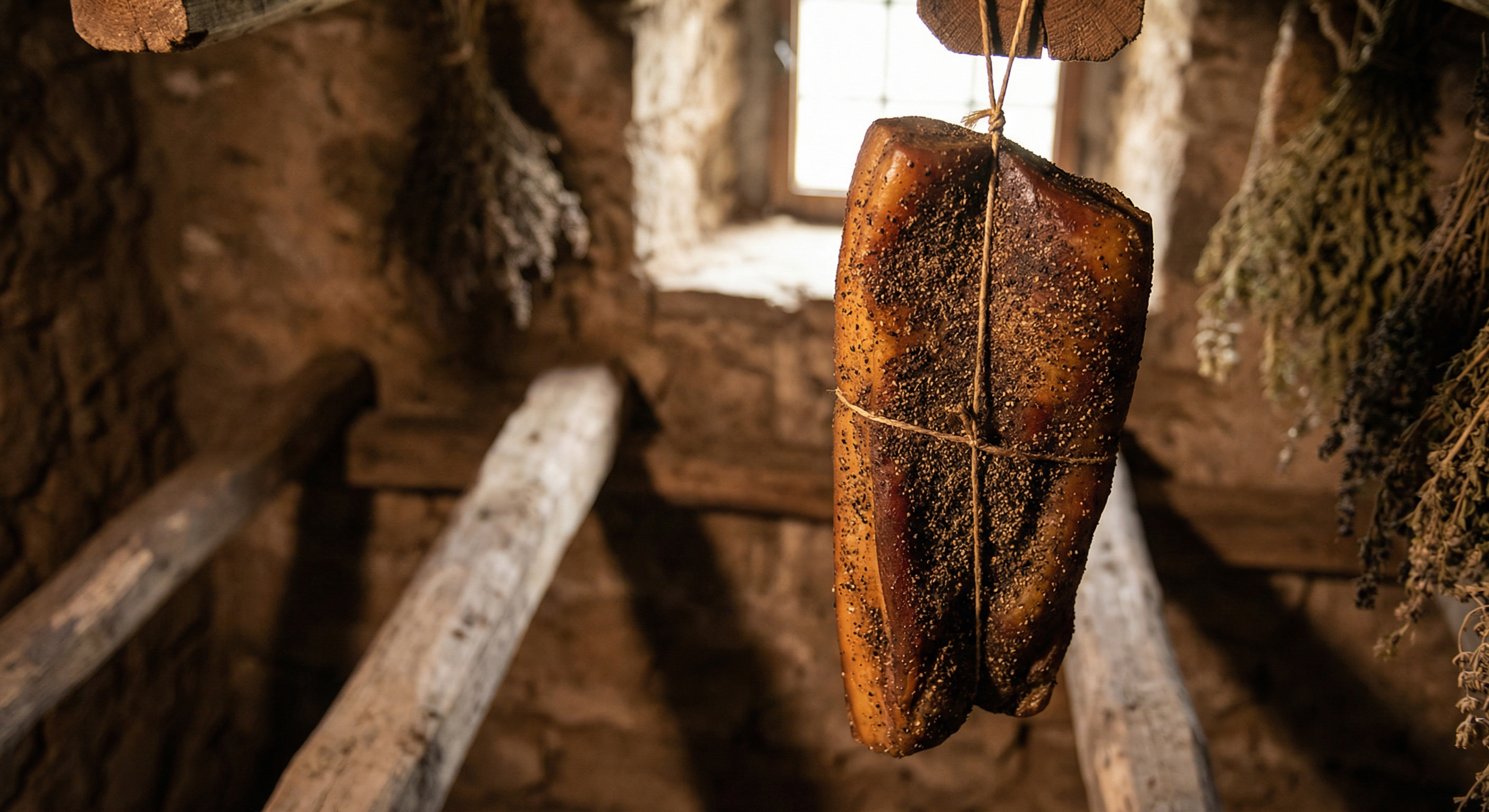
- Apply black pepper: This is traditional and important. Coat the exposed meat surfaces generously with coarsely ground black pepper. The pepper creates a protective crust, adds flavor, and helps deter insects. The skin side doesn't need additional pepper.
- Pierce and tie: Poke a hole through one corner of the jowl (through the skin) and thread butcher's twine through it to create a hanging loop. Alternatively, tie the twine around the jowl if you prefer.
Drying: Where the Magic Happens
The drying phase transforms cured pork jowl into guanciale. Like all whole-muscle cured meats, this requires controlled conditions.
Ideal Conditions
- Temperature: 50-60°F (10-15°C)
- Humidity: 65-75% relative humidity
- Air circulation: Gentle, consistent airflow
- Duration: 3-6 weeks (typically 4 weeks for most jowls)
Curing Chamber Setup
If you've made other cured meats, you likely already have a curing chamber. If not, a modified mini-fridge or wine cooler works perfectly. You'll need a temperature controller, a small humidifier, a hygrometer, and a small USB fan. The total setup cost is around $100-150, and it's endlessly reusable.
For complete chamber setup instructions, see our curing chamber guide.
Monitoring Progress
- Weigh weekly: Record the weight each week. You're targeting 30% weight loss from the starting (post-cure) weight. For a 2-pound starting jowl, that means pulling it when it weighs about 1.4 pounds.
- Check for case hardening: If the outside feels rock-hard while the center is still soft, your humidity is too low. Raise it to 75-80% and wrap the guanciale in cheesecloth to slow external drying.
- Monitor mold: A white, powdery mold bloom is normal and beneficial — it's Penicillium, the same family used in Brie and blue cheese. It protects the surface and contributes to flavor development. Wipe with a vinegar-dampened cloth if it gets excessively thick. Green, black, or slimy mold is a problem — discard the piece.
- Smell test: Guanciale should smell pleasantly porky, peppery, and slightly funky in a good way (think aged cheese). Any sour, ammonia, or putrid smells mean something went wrong — discard it.
When Is It Done?
Guanciale is ready when:
- It has lost approximately 30% of its starting weight
- The exterior is firm and dark, with a peppery crust
- When pressed, the interior yields slightly but doesn't feel soft or squishy
- When sliced, the fat is translucent white and the lean portions are deep ruby-red
- The aroma is complex — peppery, meaty, slightly sweet
Some people prefer their guanciale less dried (around 25% weight loss) for a softer, more luscious texture when rendered. Others let it go to 35-40% for a firmer product that slices more easily. Make a few batches and find your preference.
Cutting and Using Guanciale
How to Cut
Remove the skin before slicing (save it — it's excellent simmered in beans or soups). Cut the guanciale into slabs about 1/4-inch thick, then cut those slabs into lardons (small rectangular strips) about 1/4-inch wide by 1-inch long. These lardons are the classic cut for pasta dishes.
For eating as-is on a charcuterie board, slice paper-thin with a very sharp knife. The fat should be almost translucent.
Cooking with Guanciale
The three essential Roman pasta preparations that rely on guanciale:
Pasta alla Carbonara: Render guanciale lardons slowly in a cold pan, bringing the heat up gradually so the fat renders completely before the meat crisps. Toss with spaghetti, beaten eggs mixed with Pecorino Romano, and a blizzard of black pepper. No cream. Ever.
Pasta all'Amatriciana: Render guanciale lardons, add crushed red pepper and white wine, then San Marzano tomato sauce. Toss with bucatini and finish with Pecorino Romano. The guanciale's rendered fat is the foundation of the entire sauce.
Pasta alla Gricia: The "white amatriciana" — rendered guanciale tossed with rigatoni and Pecorino Romano. Just three ingredients plus pasta water and black pepper. The simplicity demands the best possible guanciale because there's nowhere to hide.
Beyond Pasta
- Wrapped around vegetables: Wrap thin slices around asparagus or green beans and roast until crisp.
- In soups and stews: Render lardons as the fat base for ribollita, minestrone, or bean soups.
- On pizza: Add crispy guanciale bits to pizza bianca with fresh mozzarella.
- With eggs: Render and use the fat to fry eggs. Breakfast will never be the same.
Storage
Whole, uncut guanciale stores beautifully:
- In the curing chamber: Can hang for months. It will continue to dry slowly, becoming firmer and more intensely flavored.
- Refrigerator: Wrapped tightly in parchment paper, then loosely in plastic. Keeps 2-3 months.
- Vacuum-sealed: Refrigerated, keeps 4-6 months. Frozen, keeps up to a year.
- Cut portions: Once cut, wrap tightly and refrigerate. Use within 3-4 weeks.
Guanciale vs. Pancetta vs. Bacon: What's the Difference?
People often ask whether they can substitute these for each other. Here's the honest answer:
| Feature | Guanciale | Pancetta | Bacon |
|---|---|---|---|
| Cut | Pork jowl (cheek) | Pork belly | Pork belly |
| Fat content | ~70% fat | ~50% fat | ~50% fat |
| Curing method | Dry-cured, air-dried | Dry-cured, air-dried (arrotolata) or used fresh (stesa) | Wet or dry-cured, smoked |
| Smoke | Never smoked | Never smoked | Always smoked |
| Flavor | Rich, delicate, clean pork | Savory, herbal, porky | Smoky, salty, assertive |
| Best use | Carbonara, amatriciana, gricia | Cooking base, charcuterie boards | Breakfast, sandwiches, burgers |
Can you substitute pancetta for guanciale? In a pinch, yes — it's the closest substitute. But the dish will taste different. Pancetta's belly fat doesn't have the same silky, melting quality as jowl fat, and the flavor is less concentrated.
Can you substitute bacon? Please don't — at least not in traditional Italian dishes. The smoke flavor completely changes the profile of carbonara or amatriciana. Bacon is wonderful for many things. Carbonara isn't one of them.
Safety Notes
The same safety rules that apply to all home-cured meats apply to guanciale:
- Always use curing salt #2 at the correct ratio. For guanciale, approximately 0.25% of the meat weight.
- Maintain proper temperatures during curing (below 40°F / 4°C) and drying (50-60°F / 10-15°C).
- Achieve target weight loss of ~30%. This reduces water activity below levels that support bacterial growth.
- Keep records: Starting weight, cure dates, weekly drying weights. If something goes wrong, you need to trace where.
- When in doubt, throw it out. Off smells, unusual colors, slimy texture — discard the entire piece. It's not worth the risk.
For a deeper understanding of curing salt science and safety, see our curing salts guide.
Troubleshooting
Case Hardening
Problem: Hard exterior, soft interior.
Cause: Humidity too low — outer surface dried before interior moisture could escape.
Fix: Raise humidity to 75-80%. Wrap in cheesecloth to slow surface drying. In future batches, start with higher humidity and reduce gradually.
Too Salty
Cause: Over-cured (too long) or too much salt in the cure.
Fix: Soak in cold water for 30-60 minutes before using, changing the water every 15 minutes. For future batches, reduce cure time or salt quantity by 10-15%.
Not Enough Flavor
Cause: Under-cured or under-dried.
Fix: Let it hang longer. Guanciale develops more complex flavor as it continues to dry. An extra week can make a significant difference.
White Mold
This is normal. White, powdery Penicillium mold is beneficial — it protects the surface and contributes to flavor. Wipe with a vinegar-dampened cloth if it gets too thick. Only discard if you see green, black, or red mold.
Final Thoughts
Making guanciale at home puts you in a very small club. Most people — even serious home cooks — have never worked with pork jowl, let alone cured one. But the process is straightforward, the time investment is modest compared to other cured meats, and the result is something genuinely special.
The first time you render your own guanciale into a carbonara and taste that rich, clean, porky perfection — fat silky enough to coat every strand of pasta, meat crispy and deeply savory — you'll understand why Roman cooks refuse to substitute. Some ingredients just can't be faked.
Start with a good jowl from a quality source, respect the cure and the drying process, and give it time. Your patience will be rewarded with one of Italy's greatest culinary treasures, made by your own hands.
Frequently Asked Questions
What is guanciale and how is it different from pancetta?
Guanciale is cured pork jowl (cheek), while pancetta is cured pork belly. Guanciale has a higher fat content (~70% vs ~50%), a more delicate fat that renders more smoothly, and a cleaner pork flavor. It is essential for authentic carbonara, amatriciana, and gricia — dishes where pancetta is considered a substitution, not the real thing.
How long does it take to make guanciale at home?
Plan for 4-7 weeks total. The curing phase takes 7-10 days in the refrigerator, followed by 3-6 weeks of drying in a controlled environment (50-60°F, 65-75% humidity). Most jowls hit the target 30% weight loss around the 4-week mark of drying.
Where can I buy pork jowls for guanciale?
Check local butcher shops first — many receive whole hogs and can set aside jowls on request. Farmers markets, Asian and Latin grocery stores, and online specialty butchers are also good sources. Heritage breed jowls (Berkshire, Mangalitsa) make exceptional guanciale.
Can I use curing salt #1 instead of #2 for guanciale?
No. Guanciale is air-dried for 3-6 weeks and requires curing salt #2 (Prague Powder #2), which contains both sodium nitrite and sodium nitrate. The nitrate provides ongoing antimicrobial protection during the long drying period. Curing salt #1 is only for products that are cooked or smoked shortly after curing.
How do I know when guanciale is done drying?
Guanciale is ready when it has lost about 30% of its starting weight, the exterior is firm with a dark peppery crust, and slicing reveals translucent white fat with deep ruby-red lean portions. It should smell pleasantly porky and peppery, with no sour or off odors.
More Charcuterie Guides
What Is Pink Curing Salt? Sodium Nitrite Explained for Home Charcuterie
Pink curing salt is the most essential — and most misunderstood — ingredient in meat curing. This guide explains what it is, why it's pink, how sodium nitrite prevents botulism, proper usage rates, and whether you can cure meat without it.
10 min readHow Long Does Charcuterie Last? Storage Guide for Cured Meats & Cheese
Understanding proper charcuterie storage ensures you enjoy it at peak quality while avoiding food safety risks.
10 min read