How to Make Duck Prosciutto at Home: The Easiest Charcuterie Project
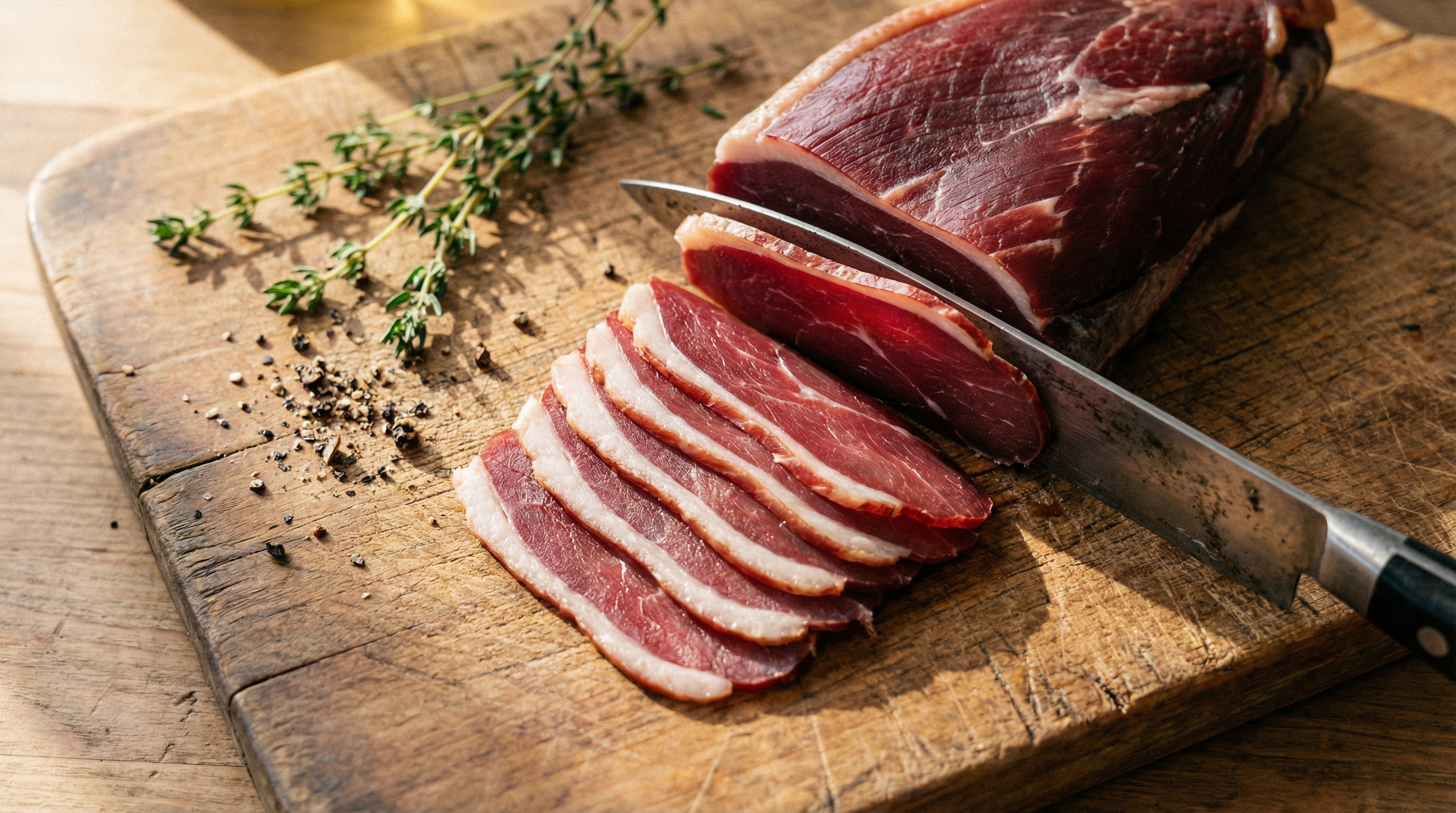
If you’ve ever wanted to try making charcuterie at home but felt intimidated by the idea of fermentation chambers and pH meters, duck prosciutto is where you start. It’s the simplest whole-muscle cure there is — one ingredient (duck breast), one preservative (salt), and about two weeks of time. That’s it. No curing salts required. No specialized equipment. No starter cultures. Just salt and patience.
I’ve taught this to hundreds of students over the years, and it’s always the project that hooks people. When you slice into your first duck prosciutto and see that deep ruby-red interior with the silky fat cap, and you taste that concentrated, savory, slightly gamey flavor — you understand why people have been curing meat for thousands of years. It’s transformative.
This guide covers everything from selecting the right duck breast to slicing your finished prosciutto paper-thin. No shortcuts, no hand-waving.
Why Duck Prosciutto Is the Best Beginner Project
There are three reasons duck prosciutto is the ideal first cure:
- No curing salts needed. Unlike salami or bresaola, duck prosciutto doesn’t require sodium nitrite (Prague Powder #1) or sodium nitrate (Prague Powder #2). The duck breast is a whole muscle — bacteria can’t penetrate the interior — and the salt cure combined with controlled drying makes it safe without additional curing agents.
- It’s fast. Where salami takes 4–8 weeks and bresaola takes 3–4 weeks, duck prosciutto is ready in about 10–14 days total. You’ll see results before your enthusiasm fades.
- Minimal equipment. You need a refrigerator, cheesecloth, and butcher’s twine. That’s it. No curing chamber, no sausage stuffer, no grinder.
If this goes well — and it will — you’ll have the confidence to tackle more complex projects. Consider it your charcuterie apprenticeship.
Selecting Your Duck Breast
The quality of your finished product is directly tied to the quality of your starting ingredient. Duck prosciutto is a minimalist preparation — there’s nowhere to hide a mediocre duck breast behind spices or smoke.
Breed Matters
- Moulard duck breast (magret): This is the gold standard. Moulard ducks are a cross between Muscovy and Pekin breeds, raised for foie gras production. The breast is large (typically 14–20 oz), with a thick, generous fat cap and deep-flavored, dark red meat. If you can find magret, use it. Hudson Valley, D’Artagnan, and Rohan are reliable producers.
- Muscovy duck breast: Another excellent option. Slightly leaner than Moulard but with outstanding flavor — more “gamey” in the best possible way. Muscovy breasts are medium-large, around 10–14 oz.
- Pekin duck breast: The most widely available breed. Pekin breasts are smaller (6–8 oz) with a thinner fat cap. They’ll work, but the finished product will be smaller and less impressive. If Pekin is all you can find, consider curing two breasts side by side.
What to Look For
- Fat cap: You want a thick, even layer of fat across the entire breast. The fat is what makes duck prosciutto special — it melts on your tongue and carries the flavor. Avoid breasts where the fat has been trimmed too aggressively.
- Color: The meat should be deep, dark red. Pale meat usually means a younger or less flavorful bird.
- Freshness: Buy the freshest breast you can find, or use a high-quality frozen product (thaw slowly in the refrigerator over 24 hours).
The Salt Cure
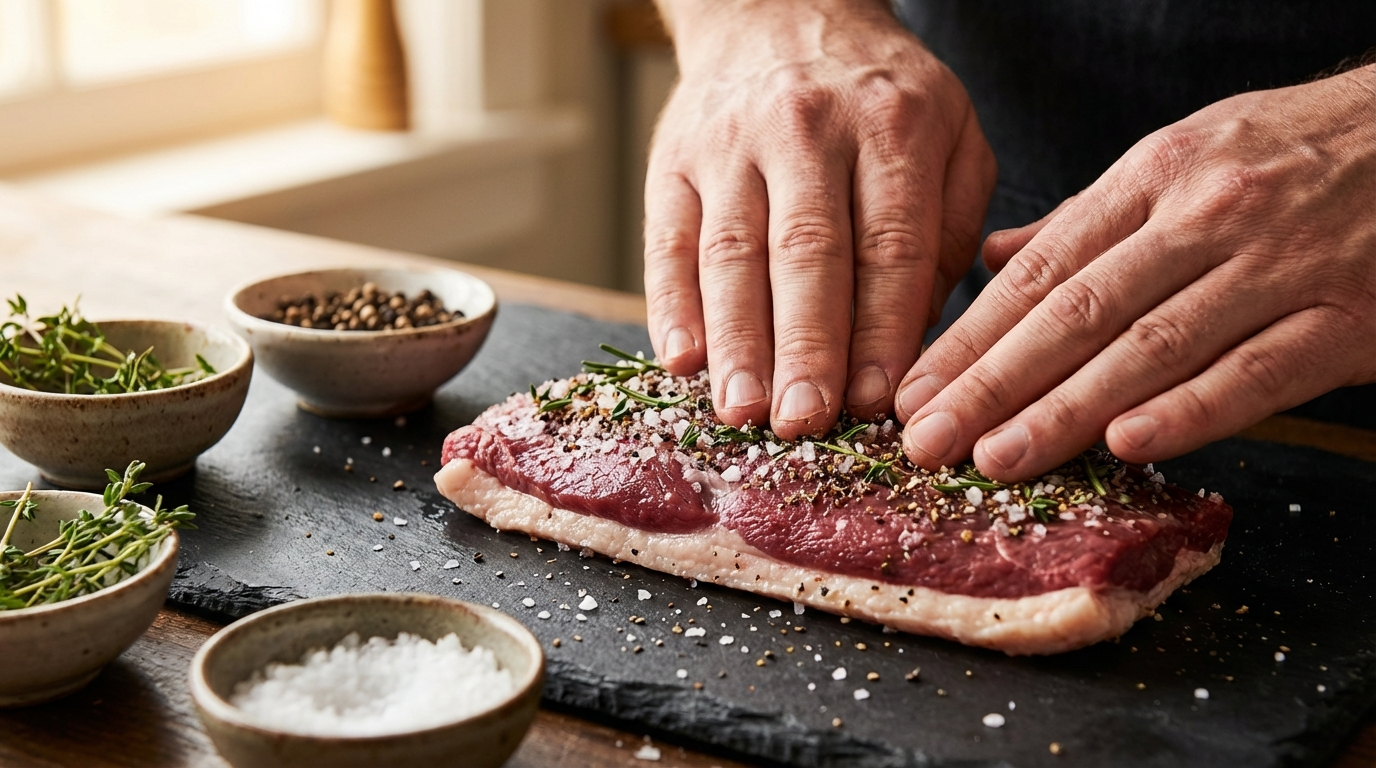
The cure is where preservation happens. Salt draws moisture out of the meat through osmosis, which lowers the water activity to levels that inhibit bacterial growth. For duck prosciutto, we’re doing a simple dry cure — just pack the breast in salt and let physics do the work.
Basic Salt Cure (Purist Method)
The simplest approach: bury the duck breast in kosher salt. That’s it. No sugar, no spices, no herbs. This produces the cleanest, most duck-forward flavor.
- 2–3 cups Diamond Crystal kosher salt (enough to fully cover the breast)
- 1 Moulard or Muscovy duck breast (skin and fat cap on)
Seasoned Cure (My Preferred Method)
I like adding aromatics to the cure. They don’t penetrate deeply into the meat, but they perfume the exterior and the fat cap beautifully.
- 2 cups Diamond Crystal kosher salt
- 1 tablespoon coarsely cracked black pepper
- 2 teaspoons fresh thyme leaves (stripped from stems)
- 1 bay leaf, crumbled
- 1 teaspoon juniper berries, lightly crushed
- Zest of one orange (optional — traditional in some Italian preparations)
Mix the salt and aromatics together in a bowl.
Curing Process
- Score the fat cap. Using a sharp knife, score a crosshatch pattern through the fat, cutting down to but not into the meat. Cuts should be about 1/2 inch apart. This helps the salt penetrate through the fat layer and allows moisture to escape during drying.
- Apply the cure. Spread half the salt mixture in the bottom of a glass or ceramic dish. Place the duck breast fat-side down on the salt. Cover the top and sides completely with the remaining salt. The breast should be completely buried — no meat visible.
- Refrigerate. Cover the dish with plastic wrap and place it in the refrigerator. The breast needs 24–36 hours in the cure. For a thick Moulard magret, lean toward 36 hours. For a thinner Pekin breast, 24 hours is sufficient.
- Flip once. Halfway through the curing time, flip the breast over and repack any salt that’s fallen away. You’ll notice the dish has accumulated liquid — that’s moisture being pulled from the meat. This is exactly what should happen.
Important: Don’t over-cure. Leaving the breast in salt for 48+ hours will make it unpleasantly salty. Set a timer. I’ve seen students forget about their duck breast for three days and end up with something that tastes like a salt lick.
Rinsing and Drying Prep
After the cure, the duck breast needs to be rinsed and prepared for the drying phase.
- Rinse thoroughly. Remove the breast from the salt and rinse it under cold running water for 2–3 minutes. You want to wash off all the surface salt. Don’t worry — plenty of salt has already penetrated into the meat.
- Pat dry. Use paper towels to thoroughly dry the entire surface. Any residual moisture on the surface will interfere with the pellicle formation.
- Optional seasoning. This is where many charcutiers add a final coating of cracked black pepper, herbes de Provence, or smoked paprika to the exterior. I coat the meat side (not the fat side) with coarsely cracked black pepper. It looks beautiful when sliced and adds a gentle heat that complements the duck.
- Wrap in cheesecloth. Cut a piece of cheesecloth large enough to wrap the breast completely, with a couple of extra layers. Roll the breast tightly in the cheesecloth and tie the ends with butcher’s twine. Create a loop of twine at one end for hanging.
The Drying Phase
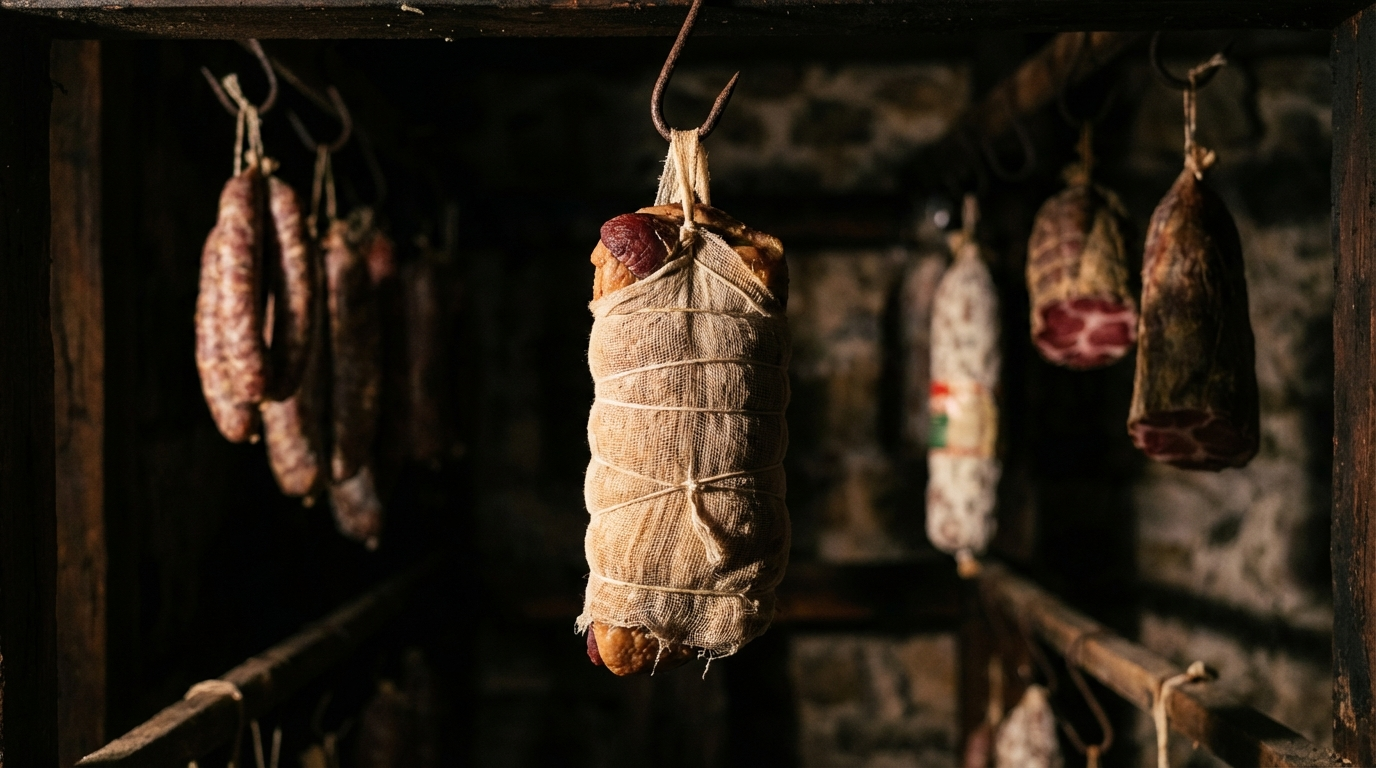
This is where the magic happens. Controlled drying concentrates the flavors while continuing to lower the water activity to safe levels. You’re essentially making the environment inside the meat inhospitable to harmful bacteria.
Where to Hang It
The ideal conditions for drying duck prosciutto are:
- Temperature: 50–60°F (10–15°C). Your regular refrigerator runs about 37°F, which works but is a bit cold — drying will take a few extra days. A wine fridge set to 55°F is perfect. A cool basement, garage, or cellar in winter can also work if temperatures are in range.
- Humidity: 60–70% relative humidity is ideal. Too dry and the exterior will form a hard shell (case hardening) while the interior stays wet. Too humid and you risk mold problems. A regular refrigerator is on the dry side, but the cheesecloth wrap helps buffer this.
- Air circulation: You need air moving around the breast, not stagnant conditions. In a refrigerator, this happens naturally from the fan. In a cellar or garage, a small fan on low works well.
The Refrigerator Method (Easiest)
For your first attempt, just hang it in your regular refrigerator. Yes, it’s colder and drier than ideal, but it works. Thousands of home charcutiers have made excellent duck prosciutto this way. Here’s how:
- Hang the cheesecloth-wrapped breast from a shelf in your refrigerator using the twine loop. You can also place it on a wire rack set over a plate if hanging isn’t practical — just flip it daily so both sides get air exposure.
- Make sure nothing is touching the breast or blocking airflow around it.
- Leave it for 7–10 days. Check it daily by feeling through the cheesecloth.
How to Know When It’s Done
Duck prosciutto is ready when it has lost approximately 30% of its original weight. Weigh the breast before curing and write down the number. When the finished product weighs 70% of that original weight, it’s done.
By feel: the breast should be firm on the outside but still have some give when you press it in the center. It should feel similar to a firm salami — not rock hard, not squishy. If the exterior is hard but the center is still soft, you may have case hardening. This usually means conditions were too dry. The cheesecloth wrap helps prevent this, but if it happens, wrap the breast in a damp towel for a few hours to rehydrate the exterior, then continue drying.
Slicing and Serving
Unwrap the cheesecloth and admire what you’ve made. The exterior should be darkened and firm, with the fat cap slightly translucent. The aroma should be clean, meaty, and concentrated — like a fine prosciutto with a deeper, wilder character.
Slicing Technique
Duck prosciutto should be sliced as thin as humanly possible. Paper-thin. If you can read a newspaper through the slice, you’re in the right neighborhood. Thick slices will be chewy and the fat won’t melt properly on your tongue.
- Best tool: A sharp, long slicing knife. A deli slicer is even better if you have one.
- Temperature: Slice it cold, straight from the refrigerator. Cold meat slices thinner and cleaner. Let the slices come to room temperature on the plate before eating — the fat softens and the flavor blooms.
- Angle: Slice at a slight bias across the breast for wider slices with more surface area.
How to Serve
Duck prosciutto is best enjoyed simply. Some of my favorite presentations:
- On a charcuterie board: Fan the slices alongside other cured meats. Duck prosciutto adds variety and a talking point to any board.
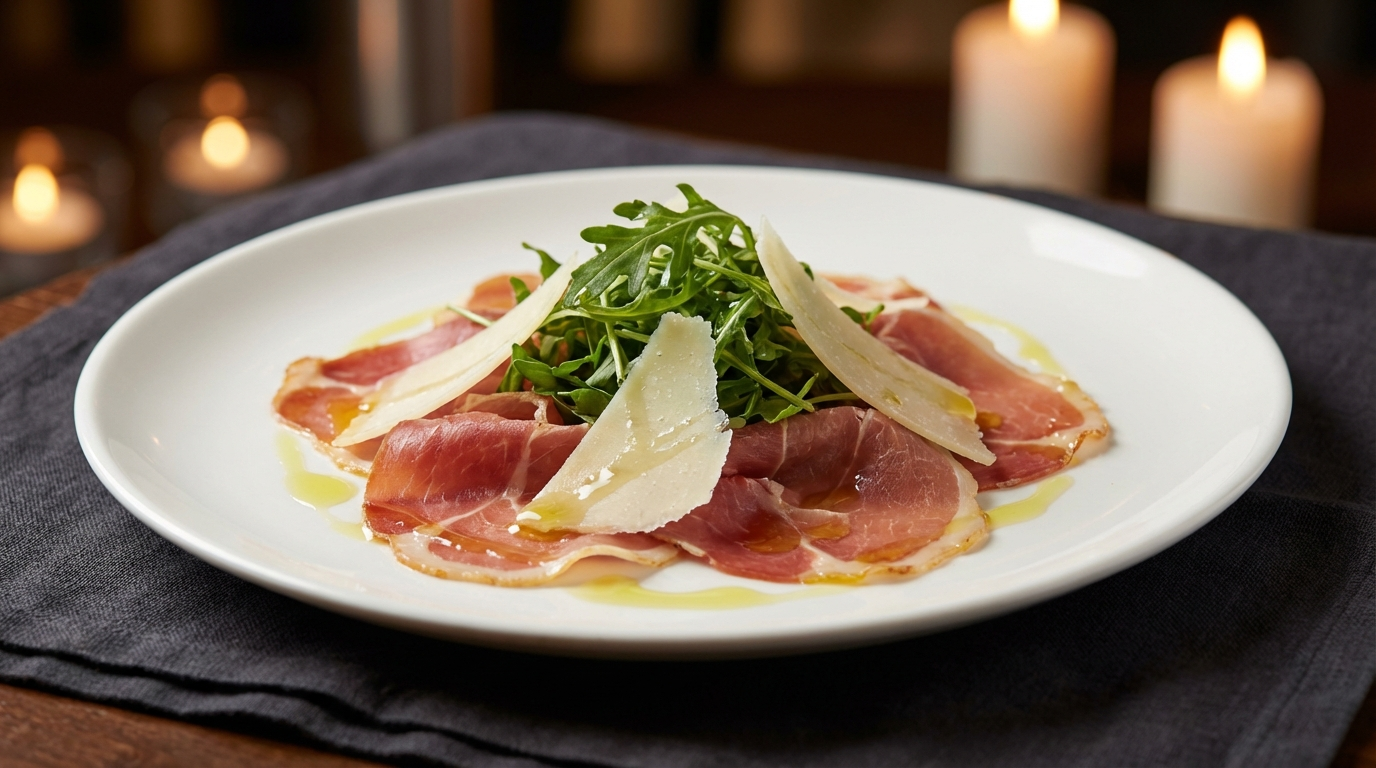
- With arugula salad: Drape slices over peppery arugula with shaved Parmigiano-Reggiano, a squeeze of lemon, and good olive oil. This is a classic Italian pairing and it’s perfect.
- On crostini: Layer thin slices on toasted bread with a smear of fig jam or a drizzle of honey. The sweetness against the salty, gamey duck is incredible.
- Wrapped around melon: Just like prosciutto e melone, but with duck. The sweetness of ripe cantaloupe balances the salt and richness.
- On pizza: Add slices to a flatbread or pizza after it comes out of the oven. The residual heat slightly warms the duck prosciutto without cooking it.
Storage
Wrap the unsliced portion tightly in plastic wrap or beeswax wrap and store it in the refrigerator. It will keep for 3–4 weeks, continuing to dry slowly over time. If it gets too firm for your liking, slice it thinner. Duck prosciutto that has over-dried is still excellent shaved paper-thin or chopped and added to pasta, risotto, or salads.
You can also vacuum-seal portions for longer storage — up to 2 months in the refrigerator or 6 months in the freezer (thaw slowly in the fridge).
Troubleshooting
It’s Too Salty
You over-cured. Next time, reduce the curing time by 6–12 hours. For now, slice it thin and serve with something sweet (fig jam, honey, melon) to balance the salt. Or chop it fine and use it as a seasoning in pasta, salads, or eggs — a little goes a long way.
The Outside Is Hard but the Inside Is Soft
Case hardening. The exterior dried too fast and formed a barrier that trapped moisture inside. This happens when humidity is too low or there’s too much airflow. Wrap the breast in a damp towel and refrigerate for 12–24 hours to equalize the moisture, then continue drying.
There’s White Mold on the Surface
White mold is generally fine — it’s often Penicillium species, the same family that grows on aged cheese and dry-cured salami. Wipe it off with a cloth dampened in vinegar if it bothers you, or leave it. It won’t affect flavor or safety.
There’s Green, Black, or Fuzzy Mold
This is not ideal. Green or black mold can indicate Aspergillus or other undesirable species. If it’s only on the surface and hasn’t penetrated into the meat, wipe it off with vinegar and move the breast to an environment with better airflow. If the mold has penetrated into the meat or the breast smells off, discard it. Safety first.
It Doesn’t Taste “Cured” Enough
It probably needs more drying time. Hang it for another 3–5 days and check again. Duck prosciutto that’s only lost 20% of its weight will taste more like raw duck than cured meat. Target that 30% weight loss.
Frequently Asked Questions
Do you need curing salt for duck prosciutto?
No. Duck prosciutto is a whole-muscle cure, meaning bacteria cannot penetrate the interior of the intact muscle. The combination of salt curing and controlled drying lowers water activity to safe levels without sodium nitrite or nitrate. This is one reason duck prosciutto is ideal for beginners.
How long does duck prosciutto take to make?
About 10-14 days total. The salt cure takes 24-36 hours, and the drying phase takes 7-10 days depending on the size of the breast and your drying conditions. A regular refrigerator works fine but may add a couple of days compared to a dedicated curing environment.
Can you make duck prosciutto in a regular refrigerator?
Yes. While a dedicated curing chamber (50-60°F, 60-70% humidity) is ideal, a regular refrigerator works well for duck prosciutto. Wrap the breast in cheesecloth to buffer the low humidity, and expect drying to take a day or two longer than in warmer conditions.
What does duck prosciutto taste like?
Duck prosciutto tastes like a concentrated, intensely savory version of duck with a silky, melt-on-the-tongue fat cap. It has deeper, more complex flavor than pork prosciutto — slightly gamey, rich, and earthy. The texture is firm but yielding when sliced thin, similar to bresaola.
What is the best duck breast for prosciutto?
Moulard duck breast (magret) is the gold standard — large, thick fat cap, deeply flavored. Muscovy is another excellent choice. Pekin duck works but is smaller with a thinner fat cap, so the finished product will be less impressive. Look for breasts from D'Artagnan, Hudson Valley, or Rohan.
More Charcuterie Guides
What Is Pink Curing Salt? Sodium Nitrite Explained for Home Charcuterie
Pink curing salt is the most essential — and most misunderstood — ingredient in meat curing. This guide explains what it is, why it's pink, how sodium nitrite prevents botulism, proper usage rates, and whether you can cure meat without it.
10 min readHow Long Does Charcuterie Last? Storage Guide for Cured Meats & Cheese
Understanding proper charcuterie storage ensures you enjoy it at peak quality while avoiding food safety risks.
10 min read