What Is Pink Curing Salt? Sodium Nitrite Explained for Home Charcuterie
What Is Pink Curing Salt? Sodium Nitrite Explained for Home Charcuterie
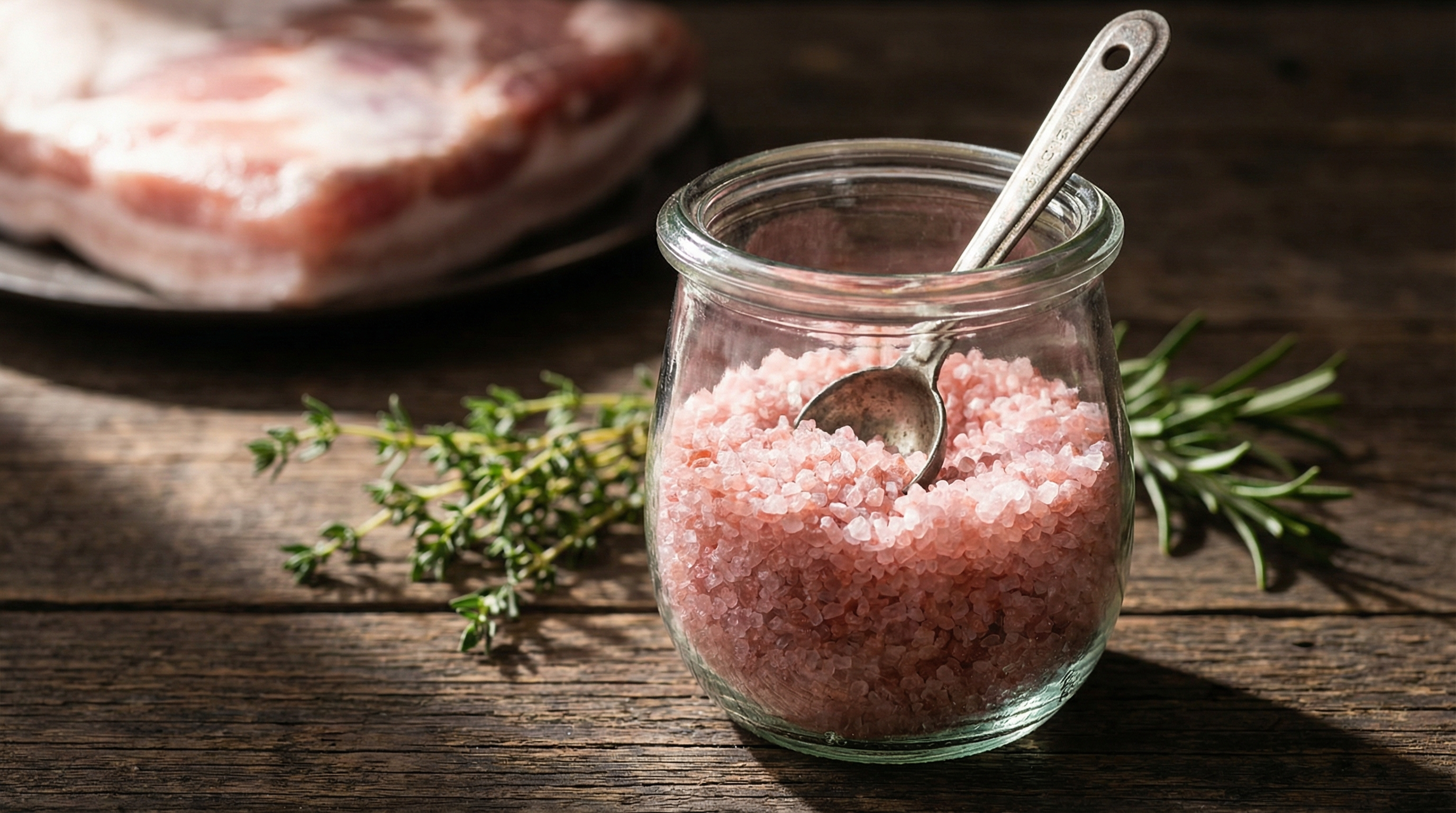
The first time I saw "pink curing salt" on a recipe ingredient list, I made the same mistake most beginners make: I assumed it was Himalayan pink salt. I almost added a full tablespoon to my first bacon cure. That error would have been dangerous — pink curing salt is a precisely measured chemical mixture, not a natural salt. Understanding the difference between decorative pink salts and functional curing salts is the first lesson every charcuterie maker needs to learn.
Pink curing salt is a blend of regular table salt (93.75%) and sodium nitrite (6.25%), dyed pink as a safety marker. It prevents botulism, preserves the characteristic pink color of cured meats, and develops the distinctive "cured" flavor in bacon, ham, salami, and prosciutto. Without it, most cured meat projects would be unsafe. With it — used correctly — home charcuterie becomes both safe and predictable.
The Chemistry of Pink Curing Salt
Pink curing salt goes by many names: Prague powder #1, InstaCure #1, DQ Curing Salt, pink salt #1. They all refer to the same product: 93.75% sodium chloride (table salt) mixed with 6.25% sodium nitrite, plus a small amount of pink or red dye.
Why Sodium Nitrite?
Sodium nitrite is the active ingredient that makes cured meat safe. When it contacts meat tissue, it breaks down into nitric oxide, which performs three critical functions:
- Inhibits Clostridium botulinum — The bacterium that produces botulinum toxin cannot reproduce in the presence of sodium nitrite. According to the USDA Food Safety and Inspection Service, nitrite is the only proven method to prevent botulism in cured, uncooked meats.
- Preserves color — Nitric oxide binds with myoglobin (the protein that makes meat red) to form nitrosomyoglobin, which stays stable and pink even after cooking. Without it, bacon and ham would turn gray.
- Develops flavor — The characteristic "hammy" or "cured" flavor comes from nitrite's chemical reactions during the curing process. Salt alone cannot replicate this taste.
Research from food science journals confirms that sodium nitrite at 100-200 parts per million (ppm) prevents botulism without posing health risks when used correctly. The 6.25% concentration in pink curing salt delivers approximately 156 ppm when used at the standard rate of 1 teaspoon per 5 pounds of meat — the level established by decades of USDA testing and commercial use.
Why Is It Dyed Pink?
The pink or red dye serves one purpose: safety identification. Curing salt looks nearly identical to table salt. The pink color ensures no one accidentally uses it as regular salt or adds it to food at unsafe levels.
This is not cosmetic. Sodium nitrite is safe at curing concentrations (0.1-0.2% of meat weight) but toxic in higher amounts. A tablespoon of pure sodium nitrite could cause serious harm; a tablespoon of pink curing salt diluted in 5 pounds of meat is perfectly safe. The dye prevents confusion.
Some brands use red dye, others pink. The color variation is purely aesthetic — the chemistry is identical.
Pink Curing Salt vs. Himalayan Pink Salt
This confusion costs beginners money and ruins cures. Let me be clear:
| Feature | Pink Curing Salt | Himalayan Pink Salt |
|---|---|---|
| Composition | 93.75% NaCl + 6.25% sodium nitrite | 100% natural mineral salt |
| Purpose | Prevents botulism, cures meat | General seasoning |
| Color Source | Added dye (safety marker) | Natural iron oxide minerals |
| Usage Rate | 1 tsp per 5 lbs meat (precise) | Season to taste |
| Can Substitute? | NO — dangerous | NO — won't cure meat |
Using Himalayan salt in a cure recipe that calls for pink curing salt will not preserve the meat or prevent botulism. Using pink curing salt as table salt could cause illness. These products are not interchangeable.
When Do You Need Pink Curing Salt?
Not every preserved meat requires curing salt. The determining factors are time, temperature, and moisture content.
Always Use Pink Curing Salt For:
- Bacon — Cured 5-7 days, smoked, sliced, often stored before cooking
- Ham — Wet or dry cured, then cooked and stored
- Salami and fermented sausages — Aged uncooked at room temperature
- Prosciutto, coppa, bresaola — Whole-muscle cuts dried for months
- Pastrami and corned beef — Cured in brine, then cooked
- Smoked sausages — Hot dogs, kielbasa, summer sausage
- Jerky — Dried at low temperatures over many hours
The common thread: these products spend significant time at temperatures where C. botulinum could grow (40°F to 140°F), and they're either not cooked to safe internal temperatures or are cooked and then stored. This is where sodium nitrite is essential.
You Don't Need Curing Salt For:
- Fresh sausage — Made and cooked immediately (bratwurst, Italian sausage)
- Smoked meats cooked hot and fast — Ribs, brisket, pulled pork brought to 190°F+ within hours
- Salt-cured fish — Gravlax and similar products stored refrigerated and consumed within days (though some recipes use it)
- Dry-aged beef — Whole primals aged in controlled refrigeration without pathogens
If you're cooking meat to safe internal temperature immediately after seasoning, curing salt isn't necessary. But if there's a window of time where the meat sits in the danger zone uncooked, use it.
How to Use Pink Curing Salt Safely
Precision matters. Too little curing salt won't protect against botulism. Too much could pose health risks (though you'd need to drastically exceed recommended amounts). The standard formula exists for a reason.
Standard Usage Rate
1 teaspoon (6 grams) per 5 pounds (2.27 kg) of meat
This rate applies to both dry cures and wet brines. In practice:
- Dry cure: Mix 1 tsp curing salt with other dry ingredients (salt, sugar, spices), rub onto 5 lbs meat
- Wet brine: Dissolve 1 tsp curing salt in water with salt and sugar, submerge 5 lbs meat
Scale proportionally. If you're curing 2.5 pounds of pork belly for bacon, use ½ teaspoon curing salt. If you're curing 10 pounds, use 2 teaspoons. The ratio stays constant: 0.2 teaspoons per pound, or 1.2 grams per kilogram.
Critical Safety Rules
- Measure by weight, not volume — A gram scale is essential. "Teaspoons" vary by how you scoop. 6 grams per 2.27 kg is precise.
- Never exceed the usage rate — More is not safer. The USDA maximum is 200 ppm sodium nitrite; the standard rate delivers ~156 ppm. Doubling the cure doesn't improve safety, it introduces risk.
- Store separately and labeled — Keep pink curing salt in its original container or a clearly marked jar far from table salt and other seasonings.
- Do not use in fresh preparations — Pink curing salt is only for curing projects. It has no place in fresh sausage, burgers, or everyday cooking.
- Follow recipe cure times — The nitrite needs time to penetrate the meat. Bacon cures for 5-7 days not because it's traditional, but because that's how long it takes for the salt to fully distribute.
Pink Curing Salt #1 vs. #2
So far I've discussed pink salt #1 (Prague powder #1). There's also pink salt #2 (Prague powder #2), which adds sodium nitrate to the mix. This is critical to understand before you start buying ingredients.
Decision Flowchart
- Will the meat be cooked or consumed within 2-4 weeks? → Use pink salt #1
- Will the meat be air-dried uncooked for months? → Use pink salt #2
Examples:
- Bacon, ham, pastrami, jerky → Pink salt #1
- Salami, prosciutto, coppa, bresaola → Pink salt #2
Pink salt #2 contains both sodium nitrite (fast-acting, dissipates within weeks) and sodium nitrate (slow-release, converts to nitrite over months). The nitrate provides long-term protection during extended drying periods. For a detailed comparison of when to use each type, see our complete curing salts guide.
Where to Buy Pink Curing Salt
Pink curing salt is not typically sold in grocery stores due to safety regulations around its handling and consumer confusion. You'll find it at:
- Butcher supply stores — Professional suppliers for sausage makers and charcutiers
- Online retailers — Amazon, specialty spice shops, brewing/curing supply sites
- Homebrew shops — Many brewing supply stores also carry curing salts
Look for these brand names:
- Hoosier Hill Farm Prague Powder #1
- Weston InstaCure #1
- The Sausage Maker DQ Curing Salt #1
- Butcher & Packer Prague Powder
A small 1-pound bag costs $8-12 and will last a home charcuterie maker for dozens of projects. Store it in a cool, dry place and it keeps indefinitely.
Can You Cure Meat Without Pink Curing Salt?
Technically yes — historically yes — safely? Not for most home environments.
Before sodium nitrite was synthesized, people preserved meat with salt alone (salt pork, country ham) or relied on celery powder/juice, which naturally contains nitrate. Some traditional curing methods skip nitrite entirely, relying on heavy salting and immediate refrigeration.
However, these methods require specific conditions:
- Very high salt concentrations — 8-10% salt by weight, which produces extremely salty (often inedibly so) results
- Consistent refrigeration — No room temperature exposure during curing or storage
- Fast consumption — Days, not weeks or months
Even then, you're relying on salt's ability to draw out moisture and lower water activity (Aw) to inhibit bacterial growth. This works for some applications but provides no direct defense against botulism spores.
Modern food scientists developed sodium nitrite curing specifically because historical methods — while functional in pre-refrigeration times — had high failure rates. According to the CDC, improperly cured meats remain one of the primary sources of foodborne botulism.
If you're making bacon, salami, or any product that will sit uncooked at room temperature or in slow-smoke conditions, use pink curing salt. The risk isn't worth the pride of going "all natural."
Common Myths About Pink Curing Salt
Myth 1: "Nitrites are carcinogenic"
This claim stems from studies showing that very high-heat cooking (500°F+ direct flame) of nitrite-cured meats can form nitrosamines, some of which are carcinogenic. However, the risk is dose-dependent and context-specific.
Current research, including studies compiled by the National Institutes of Health, indicates that nitrite at curing levels (100-200 ppm) poses minimal risk — especially compared to the very real danger of botulism in uncured meat. Additionally, vegetables like spinach and celery naturally contain far higher nitrate levels than cured meats provide.
The consensus among food safety experts: properly measured sodium nitrite in cured meat is safe.
Myth 2: "You can substitute celery powder"
Celery powder contains naturally occurring nitrate, which bacteria convert to nitrite. Some "uncured" or "nitrite-free" commercial products use celery powder as a workaround to legal definitions (they're still using nitrite chemistry, just from a different source).
The problem for home curing: celery powder's nitrate content varies wildly. You can't reliably measure the active nitrite level without lab testing. Pink curing salt delivers a precise, repeatable 6.25% sodium nitrite. Celery powder might give you 0.05% or 0.5% — you don't know.
If you want predictable, safe results, use formulated curing salt.
Myth 3: "More curing salt = safer meat"
No. The USDA established maximum limits (156-200 ppm for most products) because that's the level that prevents botulism without introducing other risks. Exceeding the standard rate doesn't improve safety and can make the meat unsafe for a different reason (sodium nitrite toxicity).
Think of it like iodine in table salt: you need a specific amount for health. Too little is a deficiency; too much is poisoning. Use the formula.
Pink Curing Salt in Practice: A Bacon Example
Let's apply everything to a real project: curing 5 pounds of pork belly for bacon.
Ingredients
- 5 lbs pork belly, skin removed
- 1 tsp (6g) pink curing salt #1
- ¼ cup (60g) kosher salt
- ¼ cup (50g) brown sugar
- 1 tbsp black pepper, coarsely ground
- Optional: garlic powder, bay leaves, maple syrup
Process
- Weigh the pork belly — Verify it's 5 lbs (2.27 kg). If it's 4.5 lbs, adjust curing salt to 0.9 tsp. Precision matters.
- Mix the cure — Combine pink curing salt, kosher salt, sugar, and spices in a bowl. Mix thoroughly so the curing salt distributes evenly.
- Apply the cure — Rub the mixture all over the pork belly, covering every surface. Place in a large zip-top bag or covered container.
- Refrigerate 5-7 days — Flip the belly daily. Liquid will accumulate (that's normal — it's moisture drawn out by the salt). The meat will firm up as the cure penetrates.
- Rinse and dry — After 7 days, rinse off the cure under cold water, pat dry, and let the belly rest uncovered in the fridge overnight (this forms a pellicle for smoke adhesion).
- Smoke or roast — Smoke at 200°F until internal temp hits 150°F (about 2 hours), or roast at 200°F for 90 minutes. You now have bacon.
- Slice and store — Let cool, slice, and refrigerate up to 2 weeks or freeze up to 6 months.
The pink curing salt in this recipe is working invisibly: preventing botulism during the 7-day cure, keeping the bacon pink after cooking, and giving it that unmistakable cured pork flavor. Without it, you'd have seasoned roasted pork belly — delicious, but not bacon.
Final Thoughts: Respect the Chemistry
In my 20+ years of making charcuterie, I've seen beginners treat pink curing salt two ways: either with paranoia (refusing to use it because "chemicals are bad") or with carelessness (eyeballing measurements because "it's just salt"). Both approaches miss the point.
Pink curing salt is a precision tool. It's neither dangerous nor casual. It's the result of a century of food science solving the problem of how to preserve meat safely at home. Use it correctly — with a scale, at the right rate, in the right applications — and it's one of the safest, most effective ingredients in your kitchen.
Botulism is real. Pink curing salt prevents it. That's the entire story.
For detailed comparisons of different curing salts and when to use each type, read our complete curing salts guide. If you're ready to start curing, check out how to cure meat at home or try your first batch of homemade bacon.
More Charcuterie Guides
How Long Does Charcuterie Last? Storage Guide for Cured Meats & Cheese
Understanding proper charcuterie storage ensures you enjoy it at peak quality while avoiding food safety risks.
10 min readUnknown
10 min readWhat Is Lardo? The Italian Cured Fat That Changes Everything
Lardo is cured pork fatback seasoned with herbs, spices, and salt, then aged for months until it develops a silky texture and complex flavor.