What Is Charcuterie? The Complete Guide to Cured Meats and Boards
What Is Charcuterie? The Complete Guide to Cured Meats and Boards
The word "charcuterie" shows up everywhere now — restaurant menus, grocery store aisles, social media feeds filled with stunning boards. But what does it actually mean? Most people use it to describe a pretty arrangement of meats and cheeses on a wooden board. That's only part of the story.
Charcuterie is one of the oldest culinary traditions in the world, rooted in the practical need to preserve meat before refrigeration existed. Understanding what it really means opens up a deeper appreciation for the craft behind every slice of prosciutto, every round of salami, and every bite of pâté on your next board.
The Origin of the Word
Charcuterie comes from the French words chair (flesh) and cuit (cooked). A charcutier was a craftsperson who specialized in preparing and preserving pork products. In medieval France, charcutiers operated under strict guild regulations — they were the only tradespeople allowed to sell cooked or cured pork.
The tradition predates France by thousands of years. Ancient Romans cured meats with salt and smoke. Chinese cultures developed preservation techniques independently. But the French formalized it into the disciplined craft we recognize today, complete with specific techniques, regional specialties, and generations of accumulated knowledge passed from master to apprentice.
Charcuterie as a Craft: The Core Techniques
At its heart, charcuterie is about transforming raw meat into something that lasts longer, tastes more complex, and develops flavors impossible to achieve through cooking alone. Every technique falls into a handful of categories.
Salt Curing
Salt draws moisture out of meat, creating an environment where harmful bacteria cannot survive. This is the foundation of almost every charcuterie technique. There are two primary approaches:
- Dry curing — Salt (and often sugar, herbs, and spices) is rubbed directly onto the meat's surface. The salt penetrates slowly over days or weeks. Prosciutto, pancetta, and guanciale are all dry-cured.
- Wet curing (brining) — Meat is submerged in a saltwater solution. This produces a more even cure and works well for larger cuts. Many hams and corned beef use wet curing.
The amount of salt, the temperature, and the duration all affect the final product. Too little salt and the meat spoils. Too much and it becomes inedibly salty. Getting it right is where craft meets science.
Smoking
Smoke serves two purposes: flavor and preservation. The phenols and aldehydes in wood smoke have antimicrobial properties that help protect the meat's surface, while depositing the distinctive smoky taste people love.
- Cold smoking (60–90°F / 15–32°C) — Flavors the meat without cooking it. Used for bacon, some salamis, and smoked salmon. The meat remains essentially raw.
- Hot smoking (126–275°F / 52–135°C) — Cooks and flavors simultaneously. Think smoked sausages and some hams.
Different woods produce different flavor profiles. Hickory gives a strong, bacon-like smoke. Apple and cherry wood produce sweeter, milder results. Oak sits in the middle — balanced and versatile.
Fermentation and Drying
This is where charcuterie becomes truly fascinating. Fermented sausages like salami rely on beneficial bacteria (usually Lactobacillus) to lower the meat's pH, creating an acidic environment that prevents spoilage. The sausage is then hung to dry for weeks or months, losing 30–40% of its original weight as moisture evaporates.
The result is a shelf-stable product with concentrated, complex flavors — tangy, funky, savory, and deeply satisfying. The white mold that develops on the outside of aged salami isn't a defect. It's a beneficial mold (Penicillium nalgiovense) that protects the sausage and contributes to its flavor.
Confits, Pâtés, and Terrines
Not all charcuterie involves drying or curing. The French tradition also includes:
- Confit — Meat (traditionally duck or goose) slow-cooked and preserved in its own fat. The fat creates an airtight seal that prevents spoilage.
- Pâté — A mixture of ground meat, fat, liver, and seasonings, baked in a mold. Ranges from rustic country-style to refined and silky.
- Terrine — Similar to pâté but typically coarser in texture and baked in a specific rectangular mold (also called a terrine).
- Rillettes — Meat slow-cooked until it falls apart, then shredded and packed into its own fat. Think of it as a rustic, spreadable version of confit.
These preparations round out the charcuterie tradition beyond simple sliced meats.
The Modern Charcuterie Board
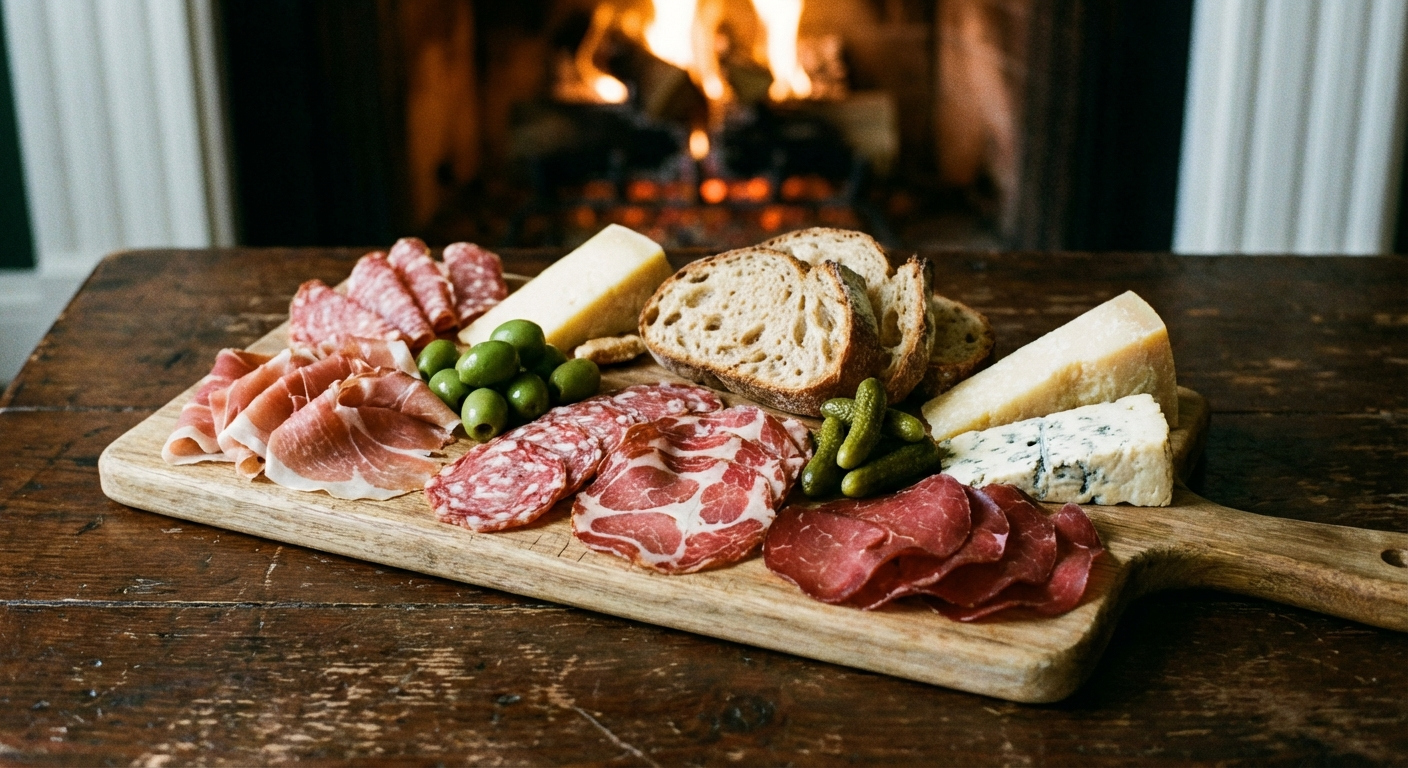
The explosion of "charcuterie boards" over the past decade has expanded the word's meaning in popular culture. Today, when most people say charcuterie, they're referring to an arranged platter of cured meats and accompaniments. Here's what makes a great one.
The Meats
A well-built board includes variety in flavor, texture, and style:
- Something mild and silky — Prosciutto, coppa, or bresaola. Thinly sliced, delicate, and approachable.
- Something bold and savory — Soppressata, finocchiona (fennel salami), or spicy capicola. Punchy flavors that stand up to wine and cheese.
- Something spreadable — Nduja (spicy spreadable salami), pâté, or rillettes. Adds a different texture and lets guests interact with the board.
Three to four varieties is the sweet spot for most boards. Fewer feels sparse, and more can overwhelm.
The Accompaniments
Great accompaniments create contrast and balance:
- Cheese — Mix soft (brie, burrata), semi-firm (manchego, gruyère), and hard (aged parmesan, pecorino). Aim for 2–3 cheeses.
- Pickled and briny — Cornichons, olives, pickled onions, or peppadew peppers. The acidity cuts through the richness of cured meats and cheese.
- Sweet — Fig jam, honey, dried apricots, or fresh grapes. Sweetness balances saltiness.
- Crunchy — Crackers, crostini, breadsticks, or Marcona almonds. Texture contrast matters.
- Fresh — Fresh herbs, cherry tomatoes, or sliced radishes. Adds color and brightness.
Building the Board
Start with the largest items — ramekins of jam or olives, cheese wedges — and place them first to anchor the layout. Fan the sliced meats around them in loose folds and rosettes. Fill gaps with smaller items like nuts, dried fruit, and crackers. The goal is abundance without chaos.
A good board looks generous but intentional. Leave enough space for guests to actually reach in and grab things without destroying the arrangement.
Charcuterie Around the World
While France gets the credit for naming and formalizing it, nearly every food culture developed its own version of charcuterie.
Italy (Salumi)
Italian salumi is arguably the most influential charcuterie tradition worldwide. Regional specialties are fiercely protected:
- Prosciutto di Parma — From Emilia-Romagna, aged 12–36 months, made only from heritage breed pigs fed whey from Parmigiano-Reggiano production.
- Nduja — From Calabria, a spreadable, fiery salami made with Calabrian chili peppers.
- Guanciale — Cured pork jowl from central Italy, essential for authentic carbonara and amatriciana.
Spain (Embutidos)
Spain's embutidos tradition centers on the pig, particularly the prized cerdo ibérico:
- Jamón Ibérico de Bellota — From acorn-fed Iberian pigs, often considered the finest cured meat in the world. Aged 24–48 months.
- Chorizo — Seasoned with smoked paprika (pimentón), giving it a distinctive red color and smoky flavor.
- Lomo — Cured pork loin, lean and elegant.
Germany (Wurst)
German charcuterie leans heavily on sausage-making (Wurst). The country recognizes over 1,500 distinct sausage varieties, from fresh bratwurst to dry-cured landjäger.
Eastern Europe
Countries like Hungary, Poland, and Romania developed robust smoking and curing traditions, producing distinctive items like Hungarian kolbász (paprika-spiced sausage) and Polish kielbasa.
Asia
Chinese lap cheong (dried sausage) and various cured duck preparations represent an entirely independent evolution of meat preservation, using techniques like soy-based curing and air-drying in cool winter air.
Getting Started at Home
You don't need a cave in Tuscany to make charcuterie. Several techniques are accessible to beginners with basic kitchen equipment.
Beginner-Friendly Projects
- Duck breast prosciutto — Cure a duck breast in salt and sugar for 24 hours, then hang to dry for 7–10 days. Simple, fast, and impressive.
- Bacon — Cure pork belly with salt, sugar, and spices for 7 days, then cold or hot smoke it. Homemade bacon is a revelation.
- Rillettes — Slow-cook pork shoulder in its own fat until falling apart, shred, season, and pack into jars. No special equipment needed.
Essential Equipment
For basic curing:
- A kitchen scale (precision matters)
- Curing salt (#1 for short cures, #2 for dry-cured items)
- A dedicated curing refrigerator or a cool basement/garage
- Butcher's twine for hanging
For sausage making, add a meat grinder and sausage stuffer. For smoking, a basic smoker or even a kettle grill with wood chips works.
Safety First
Curing meat at home requires understanding food safety. The key rules:
- Use curing salt in the correct amounts — Curing salt (sodium nitrite/nitrate) prevents botulism. Follow recipes exactly.
- Control temperature and humidity — Most curing happens between 50–60°F (10–15°C) with 65–80% humidity.
- Learn to recognize problems — Green or black mold (bad) vs. white mold (good). Off smells mean something went wrong.
- Start with trusted recipes — Don't freelance until you understand the science. Books like Charcuterie by Michael Ruhlman or Salumi by Michael Ruhlman and Brian Polcyn are excellent starting points.
Why Charcuterie Matters
In an age of industrial food production, charcuterie represents something valuable: patience, craft, and connection to tradition. Every piece of well-made salami or prosciutto carries centuries of accumulated knowledge about how to transform simple ingredients into something extraordinary.
Whether you're building your first board for a dinner party or curing your own bresaola in the basement, understanding what charcuterie really means — beyond the Instagram-worthy platters — gives you a deeper appreciation for one of humanity's greatest culinary achievements.
The tradition that started as a practical necessity has evolved into an art form. And the best part? You get to eat the art.
Frequently Asked Questions
What does charcuterie mean?
Charcuterie comes from the French words chair (flesh) and cuit (cooked). It originally referred to the craft of preparing and preserving pork products. Today it encompasses all cured, smoked, and preserved meat preparations, as well as the boards and platters used to serve them.
What is typically on a charcuterie board?
A well-built charcuterie board includes 3-4 cured meats (like prosciutto, salami, and coppa), 2-3 cheeses, pickled items (cornichons, olives), something sweet (fig jam, honey), crackers or bread, and fresh elements like herbs or fruit.
Is charcuterie the same as a cheese board?
No. Charcuterie specifically refers to cured and preserved meats. A cheese board focuses on cheese varieties. Modern "charcuterie boards" typically combine both, but traditional charcuterie is about the meat craft, not cheese.
Can you make charcuterie at home?
Yes. Beginner-friendly projects include duck breast prosciutto (7-10 days), homemade bacon (7 days cure plus smoking), and rillettes (slow-cooked shredded meat in fat). You need a kitchen scale, curing salt, and a cool space for drying.
How long has charcuterie been around?
Meat preservation dates back thousands of years — ancient Romans cured meats with salt and smoke, and Chinese cultures developed independent techniques. The French formalized it into a regulated craft in the medieval period, creating the tradition we recognize today.
More Charcuterie Guides
What Is Pink Curing Salt? Sodium Nitrite Explained for Home Charcuterie
Pink curing salt is the most essential — and most misunderstood — ingredient in meat curing. This guide explains what it is, why it's pink, how sodium nitrite prevents botulism, proper usage rates, and whether you can cure meat without it.
10 min readHow Long Does Charcuterie Last? Storage Guide for Cured Meats & Cheese
Understanding proper charcuterie storage ensures you enjoy it at peak quality while avoiding food safety risks.
10 min read