Stick Burner vs Pellet Smoker: Complete Competition Pitmaster Comparison
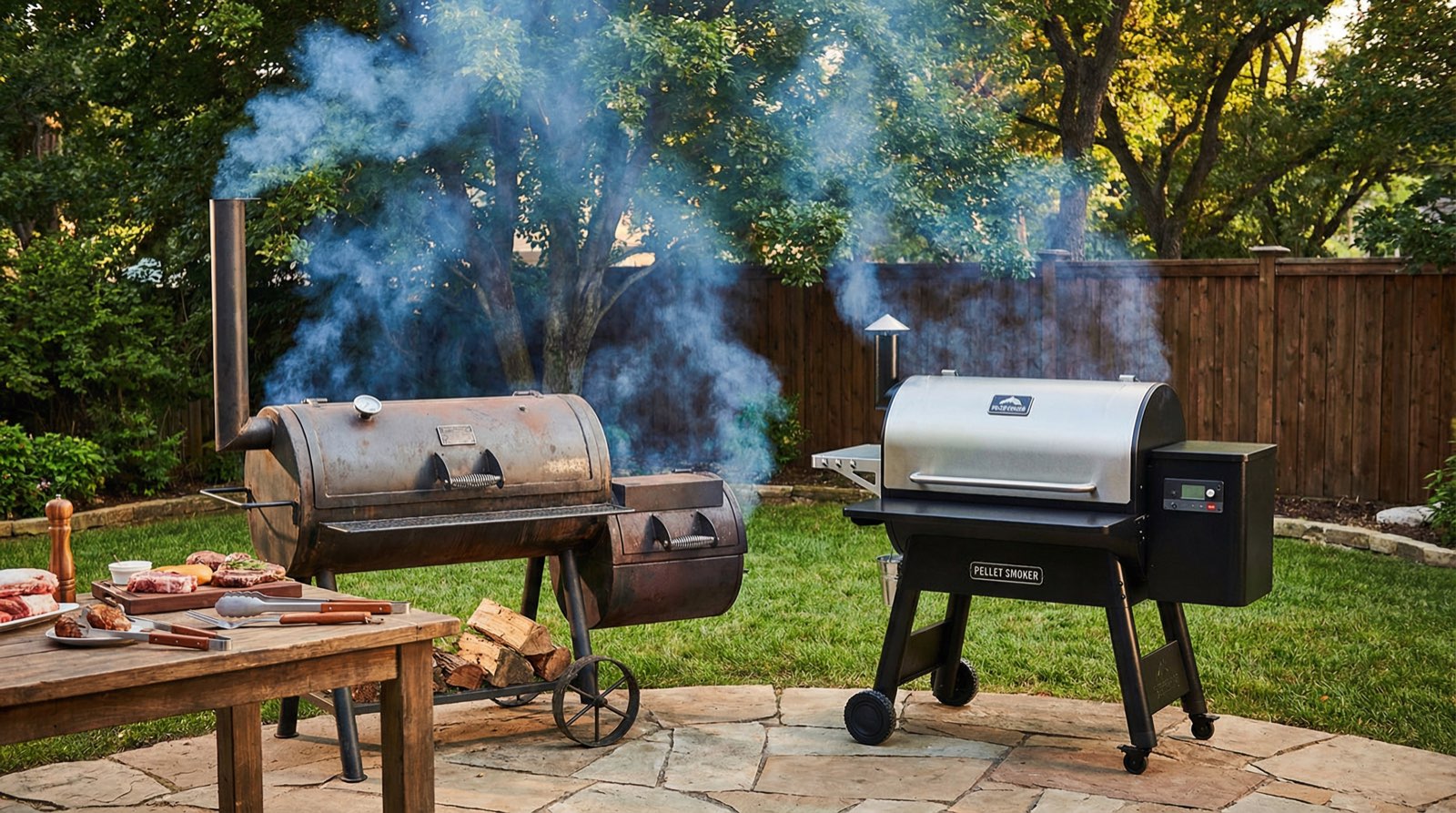
I've logged thousands of hours behind both stick burners and pellet smokers. I compete with a custom offset, but I cook weeknight dinners on a pellet grill. People ask me constantly which one's better, and my answer is always the same: better for what?
This isn't a religious debate. Both smokers have legitimate strengths and weaknesses. Your choice should depend on your priorities—flavor purity, convenience, budget, learning curve, and how much time you want to invest in the craft. Let me break down exactly what each smoker does well and where each one struggles.
What Defines Each Type
Stick Burner (Offset Smoker)
A stick burner is a traditional offset smoker fueled by wood logs or wood chunks. The fire burns in a firebox attached to the side of the main cooking chamber. Heat and smoke travel horizontally through the chamber and exit through a chimney. You control temperature by managing fire size, airflow, and wood selection.
Classic examples: Oklahoma Joe's Highland, Yoder Wichita, custom welded offsets, Lang BBQ Smokers.
Pellet Smoker
A pellet smoker (pellet grill) uses compressed wood pellets as fuel, fed automatically by an auger into a fire pot. A digital controller monitors temperature and adjusts pellet feed rate to maintain your set temperature. A small fan circulates heat and smoke. Think of it as a wood-fired convection oven.
Popular brands: Traeger, Rec Tec, Camp Chef, Pit Boss, Grilla Grills, Yoder (pellet models).
Temperature Control and Consistency
Pellet Smokers: Set-It-and-Forget-It Precision
Pellet smokers win this category hands down. Set your target temperature on the PID controller, and the smoker maintains it within ±5-10°F for the entire cook. The auger automatically feeds pellets based on temperature readings, adjusting for weather, meat load, and ambient conditions.
Advantages:
- Rock-solid temperature stability over 12+ hour cooks
- No fire management required—sleep through overnight cooks
- Consistent results batch to batch
- Weather-resistant (within reason—extreme cold affects all smokers)
- Beginner-friendly learning curve
Limitations:
- You can't manually adjust fire character or smoke intensity
- Some models struggle maintaining low temps (below 180°F) or high temps (above 400°F)
- Temperature swings during startup and pellet transitions
- Requires electricity—no power means no cook
Real-world experience: I've run 14-hour brisket cooks on my Rec Tec without touching the controller once. Temperature held 250°F ±7°F the entire time. That's impossible with a stick burner unless you're running a high-end automated system.
Stick Burners: Manual Control and Skill Development
Stick burners demand attention and skill. You're managing fire size, wood type, airflow through intake and exhaust dampers, and dealing with weather variables. Temperature swings of 25-50°F are normal, especially during wood additions.
Advantages:
- Complete control over fire character—adjust smoke intensity, flame vs. coals ratio
- No electricity required—cook anywhere
- Can run extremely high temps for searing (600°F+) or low temps for cold smoking
- Direct connection to the craft—you're actively cooking, not monitoring
- Temperature swings can create complex flavor layers (controversial but true)
Limitations:
- Requires fire tending every 30-60 minutes depending on fire size
- Significant learning curve—months to master temperature management
- Weather sensitivity—wind, rain, extreme cold all affect performance
- Overnight cooks mean setting alarms or staying awake
- Inconsistent results until you dial in your technique
Real-world experience: On my offset, I check temps every 30-45 minutes and add splits as needed. In windy conditions, I'm out there every 20 minutes. You can't leave a stick burner unattended for more than an hour without risk. That's the trade-off for traditional smoke flavor.
Smoke Flavor and Quality
This is where the debate gets heated. Let me give you the honest assessment.
Stick Burners: Pure, Intense Smoke
Stick burners produce smoke from burning logs—the traditional method used by BBQ legends. The flavor is more intense, more complex, and (many argue) more authentic. You're getting smoke from all stages of combustion: ignition, flame, and coals.
Flavor characteristics:
- Deeper smoke penetration due to longer exposure and thicker smoke
- More pronounced smoke ring (visual indicator judges love)
- Complex flavor layers from different wood species and combustion stages
- Ability to create very light smoke (for chicken) or heavy smoke (for brisket)
The catch: Bad fire management creates bitter, acrid smoke from incomplete combustion. Thick white smoke deposits creosote that tastes like a tire fire. Mastering thin blue smoke takes time and attention.
Pellet Smokers: Clean, Consistent Smoke
Pellet smokers produce lighter, cleaner smoke. Pellets burn more completely and at lower temperatures than logs, creating less intense smoke flavor. This is by design—pellets are dried to 5-8% moisture content and compressed for efficient, clean combustion.
Flavor characteristics:
- Mild, clean smoke flavor that won't overpower delicate meats
- Consistent smoke profile batch to batch
- Nearly impossible to over-smoke meat
- Good smoke ring development (though lighter than stick burners)
The catch: You can't dial up smoke intensity significantly. Some pitmasters find pellet smoke "thin" or "not BBQ enough." The flavor is there but more subtle.
The Honest Truth About Flavor Difference
In blind taste tests with experienced BBQ judges, stick burner vs. pellet smoker products are distinguishable, but the gap is smaller than purists claim. Stick burners produce 15-20% more intense smoke flavor—noticeable but not night-and-day.
For competition BBQ, the edge matters. For backyard cooking, most guests can't tell the difference if technique is solid. I've served pellet-smoked brisket to BBQ snobs who raved about the "amazing stick burner flavor." Technique matters more than equipment for 90% of cooks.
Fuel Cost and Availability
Stick Burners: Variable Cost, Local Sourcing
Fuel costs depend heavily on your wood source. Buying seasoned splits at retail runs $400-800 per cord. Many pitmasters source wood free or cheap from tree services, farms, or by cutting themselves.
Cost breakdown (typical brisket cook):
- 12-hour cook uses approximately 20-30 lbs of wood
- Retail pricing: $1.50-3.00 per cook
- Free/cheap wood: $0.50-1.00 per cook
Wood selection matters: Different species (oak, hickory, cherry, apple, mesquite) produce different flavors. You can blend woods or switch mid-cook for complexity. This flexibility is a major advantage.
Pellet Smokers: Predictable Cost, Retail Availability
Pellets are sold in 20-40 lb bags at hardware stores, BBQ shops, and online. Quality varies significantly by brand—cheap pellets contain fillers and produce more ash.
Cost breakdown (typical brisket cook):
- 12-hour cook uses approximately 15-20 lbs of pellets
- Premium pellets (Lumberjack, Bear Mountain): $1.00-1.50 per lb = $15-30 per cook
- Budget pellets (store brands): $0.60-0.90 per lb = $9-18 per cook
Convenience factor: Pellets are available year-round at most retailers. No seasoning, splitting, or storage space required. You can keep 200 lbs of pellets in a corner of the garage.
Winner: Stick Burners (if you source wood) or Pellets (if you value convenience)
If you have access to cheap or free wood, stick burners are significantly cheaper to run. If you're buying fuel retail, pellets and wood splits cost roughly the same per cook, but pellets offer far more convenience.
Learning Curve and Time Investment
Pellet Smokers: Beginner-Friendly
You can produce excellent BBQ on your first pellet smoker cook. Set temp to 250°F, load meat, walk away. The smoker handles fire management automatically. Most beginners see 80-90% of their potential results within 5 cooks.
Time to competence:
- First successful cook: Day 1
- Consistent quality: 3-5 cooks
- Advanced techniques (wrapping, spritzing, bark development): 10-20 cooks
This makes pellet smokers ideal for busy people, beginners, or anyone who values results over process.
Stick Burners: Steep Learning Curve
Expect 20-30 cooks before you're consistently hitting good results. Fire management, temperature control, and smoke quality all require hands-on experience. You will burn briskets. You will serve dry pork. You will produce bitter bark from bad smoke.
Time to competence:
- First edible cook: 1-3 attempts
- Consistent quality: 20-30 cooks (6+ months of regular use)
- Advanced techniques (fire character, smoke layering, temperature surfing): 50+ cooks (1-2 years)
But here's the thing: that learning process is rewarding for many pitmasters. You're developing a skill, understanding combustion, feeling connected to traditional BBQ culture. For some, that journey is the entire point.
Build Quality and Durability
Stick Burners: Buy Once, Cry Once
Quality stick burners are built like tanks. Heavy-gauge steel (1/4" or thicker), welded construction, minimal moving parts. A well-made offset will outlive you with basic maintenance.
Pros:
- No electronics to fail
- Simple mechanical components (dampers, hinges)
- Repairable with basic welding skills
- Develops patina and character over decades
Cons:
- Cheap offsets (under $500) are thin metal that warps and leaks
- Requires seasoning and rust prevention
- Heavy—250-400 lbs for quality units
The reality: A $2000 Lang or custom offset will last 30+ years. A $300 Oklahoma Joe's from the hardware store will need modifications and careful maintenance to last 5-10 years. You get what you pay for.
Pellet Smokers: Technology-Dependent Longevity
Pellet smokers contain multiple components that can fail: auger motor, controller board, igniter rod, fan, temperature probes. Build quality varies dramatically by brand and price point.
Pros:
- Stainless steel models (Rec Tec, MAK) are highly durable
- Modular design means failed components can be replaced
- Powder-coated steel resists rust better than raw steel
Cons:
- Controller boards fail after 5-10 years (replaceable but $150-300)
- Augers jam from wet pellets or debris
- Igniters burn out every 2-5 years depending on use
- Some budget models use thin steel that warps
The reality: A quality pellet smoker (Rec Tec, Yoder, MAK) will last 10-15 years with component replacements. Budget models (under $500) may only last 3-5 years before major issues arise.
Versatility and Cooking Range
Pellet Smokers: Multi-Purpose Outdoor Cooker
Modern pellet grills function as smokers, grills, roasters, and even pizza ovens. Temperature range typically spans 180°F to 500°F (some models hit 600°F+).
What you can cook:
- Low-and-slow BBQ: brisket, ribs, pork butt
- Hot-and-fast: burgers, steaks, chicken (with GrillGrates for better sear)
- Baking: pizza, bread, desserts
- Roasting: whole turkeys, prime rib
- Cold smoking: cheese, salmon (with smoke tube accessory)
For many people, a pellet grill replaces both a smoker and a gas grill, consolidating equipment.
Stick Burners: Specialized Smoking Excellence
Offsets excel at low-and-slow smoking (225-300°F range). They can handle high heat (400-600°F) by opening vents fully and loading more wood, but this isn't their strength. You wouldn't use an offset for weeknight burgers.
What you can cook:
- Traditional BBQ: brisket, ribs, pork butt, whole hogs
- Whole animals: lamb, goat, pigs
- Large batch cooking: multiple briskets, 10+ racks of ribs
- Cold smoking: with minimal fire and long smoke exposure
Stick burners are purpose-built tools. They do one thing incredibly well rather than many things adequately.
Cost Comparison
Entry-Level ($500-1000)
Stick Burners: Oklahoma Joe's Highland, Old Country BBQ Pits Pecos—thin steel requiring modification (gasket seals, tuning plates), but functional. Expect to invest another $100-200 in mods.
Pellet Smokers: Pit Boss, Camp Chef models—decent controllers, thinner construction, but reliable for casual use. 3-5 year lifespan typical.
Mid-Range ($1000-2500)
Stick Burners: Lang 36" Patio, Yoder Wichita, quality custom builds—thick steel, excellent heat retention, will last decades.
Pellet Smokers: Rec Tec RT-700, Grilla Silverback, Camp Chef Woodwind—stainless steel, WiFi controllers, excellent build quality, 10+ year lifespan.
Premium ($2500+)
Stick Burners: Custom reverse flow, insulated Pitmaker Vault, Lone Star Grillz—heirloom quality, perfect heat distribution, multi-generational durability.
Pellet Smokers: Yoder YS640s, MAK 2 Star, Memphis Grills—commercial-grade components, WiFi, dual-wall insulation, industry-leading warranties.
Maintenance Requirements
Stick Burners: Simple but Regular
- After each cook: Brush grates, remove ash from firebox
- Monthly: Deep clean fire box, check for rust spots, re-season as needed
- Annually: Touch up paint, oil hinges and moving parts
- Time investment: 15-30 minutes per cook cleanup
Pellet Smokers: More Components, More Maintenance
- After each cook: Brush grates, vacuum ash from fire pot
- Every 3-5 cooks: Full ash cleanout (remove heat diffuser, vacuum thoroughly)
- Every 20-30 cooks: Clean grease trap, check auger for jams, inspect igniter
- Annually: Deep clean, check all gaskets, inspect wiring
- Time investment: 20-40 minutes per cook cleanup, plus deeper maintenance sessions
Pellet smokers produce more ash than stick burners due to complete combustion of smaller fuel pieces. Neglecting ash cleanup leads to auger jams and failed ignitions.
The Verdict: Which Should You Buy?
Choose a Stick Burner If You:
- Value traditional BBQ methods and smoke flavor purity
- Enjoy the process of fire management and skill development
- Have time to tend the fire every 30-60 minutes
- Want maximum smoke flavor and competition-quality results
- Have access to cheap or free wood
- Don't mind a significant learning curve
- Want equipment that lasts 20+ years
- Cook primarily traditional BBQ (brisket, ribs, pork)
Choose a Pellet Smoker If You:
- Prioritize convenience and consistent results
- Want to sleep through overnight cooks
- Are new to smoking and want early success
- Value multi-purpose cooking (smoking, grilling, roasting)
- Have limited time for fire management
- Want WiFi monitoring and control
- Cook a variety of foods beyond traditional BBQ
- Don't have reliable wood sources
The Hybrid Approach (What I Do)
I own both. My custom offset is for competition cooks, whole briskets, and when I want the meditation of fire tending. My Rec Tec pellet grill handles weeknight chicken, burgers, and overnight cooks when I need sleep.
If you can only buy one smoker, ask yourself: do I value the journey or the destination? Stick burners are about the craft. Pellet smokers are about the results. Both produce excellent BBQ in the right hands.
Common Myths Debunked
Myth: Pellet smokers don't produce real BBQ
Reality: Pellet smokers use real wood and produce real smoke. The flavor is lighter but authentic. Gatekeeping what qualifies as "real BBQ" based on equipment is nonsense.
Myth: Stick burners always taste better
Reality: Bad technique on a stick burner (thick white smoke, temperature swings) produces worse BBQ than good technique on a pellet smoker. Equipment matters less than skill.
Myth: You can't compete with pellet smokers
Reality: Teams have won KCBS competitions using pellet grills. It's less common but absolutely possible. Judges taste the food, not the equipment.
Myth: Stick burners are too hard for beginners
Reality: They're harder, yes, but not impossible. If you're willing to learn and accept early failures, stick burners are accessible. Plenty of people started on offsets and never looked back.
Myth: Pellet smokers are "set it and forget it"
Reality: While more automated, you still need to monitor internal temps, manage wrapping, apply glazes, and ensure proper bark formation. Technique still matters.
Final Thoughts
Twenty years into this craft, I respect both tools. Stick burners connect you to BBQ's roots—fire, smoke, and time. There's a primal satisfaction in managing a fire and creating something legendary from logs and meat. It's meditation, it's craft, it's tradition.
Pellet smokers democratize great BBQ. They let busy people with families produce competition-quality food without sacrificing weekends to fire tending. They make consistently excellent BBQ accessible to anyone willing to learn basic technique.
Your choice isn't about which smoker is objectively better. It's about which aligns with your life, your goals, and what you want from the BBQ experience. Either way, you'll eat well.
Now quit reading and start cooking.
Frequently Asked Questions
Which produces better smoke flavor: stick burner or pellet smoker?
Stick burners produce more intense, complex smoke flavor due to burning whole logs at various combustion stages. Pellet smokers create lighter, cleaner smoke from compressed pellets. The difference is noticeable to experienced tasters (15-20% more intense smoke from stick burners) but not dramatic. Technique matters more than equipment—bad fire management on a stick burner produces bitter smoke, while good technique on a pellet smoker creates excellent flavor. For competition BBQ, stick burners have an edge. For backyard cooking, most guests can't tell the difference.
Are pellet smokers easier to use than stick burners?
Yes, significantly. Pellet smokers have digital controllers that automatically maintain temperature within ±5-10°F by adjusting pellet feed rate. You can set the temp and walk away for 12+ hours. Stick burners require manual fire management every 30-60 minutes, monitoring airflow, adding wood, and adjusting dampers. Beginners achieve excellent results on pellet smokers within 3-5 cooks, while stick burners require 20-30 cooks (6+ months) to produce consistent quality. Pellet smokers let you sleep through overnight cooks; stick burners require setting alarms or staying awake.
How much does it cost to run a stick burner vs pellet smoker?
For a typical 12-hour brisket cook: stick burners use 20-30 lbs of wood ($1.50-3.00 if purchased retail, $0.50-1.00 if sourced free/cheap from tree services); pellet smokers use 15-20 lbs of pellets ($9-30 depending on pellet quality). If you buy fuel retail, costs are similar. If you source free wood, stick burners are significantly cheaper. However, pellets offer year-round availability and require no seasoning or storage space. Pellet smokers also require electricity ($1-2 per cook), while stick burners need none.
How long do stick burners and pellet smokers last?
Quality stick burners (Lang, custom welded offsets) last 30+ years with minimal maintenance due to heavy-gauge steel and simple mechanical construction. Budget offsets (under $500) last 5-10 years. Pellet smokers contain electronics that fail over time: quality models (Rec Tec, Yoder) last 10-15 years with component replacements (controllers, igniters, augers); budget models last 3-5 years. Stick burners are "buy once, cry once" investments, while pellet smokers are technology-dependent with periodic part replacement needs.
Can you use a pellet smoker for high-heat grilling?
Yes, but with limitations. Most pellet grills reach 400-500°F (some hit 600°F+), making them capable of grilling burgers, steaks, and chicken. However, they don't produce the intense direct heat of a charcoal or gas grill. Adding GrillGrates improves searing performance. Pellet grills function well as all-in-one units for smoking, roasting, and medium-heat grilling, replacing both a smoker and gas grill for many people. For professional-quality searing, a dedicated high-heat grill is superior.
Do you need electricity to run a pellet smoker?
Yes, pellet smokers require electricity to power the auger motor, controller, igniter, and fan. This makes them unsuitable for off-grid locations without a generator. Power consumption is modest (150-300 watts during operation, higher during ignition), adding $1-2 per cook to operating costs. Stick burners require no electricity and can be used anywhere. This makes stick burners more versatile for camping, hunting cabins, or remote cooking situations.
Which is better for competition BBQ?
Stick burners dominate professional competition BBQ circuits due to superior smoke flavor intensity and smoke ring development. However, teams have won KCBS competitions using pellet grills, proving both are capable of championship-quality BBQ. Stick burners offer 15-20% more intense smoke flavor and better bark development, which matters in judging. Pellet smokers provide more consistent temperature control, reducing variables. For most backyard cooks, the difference is negligible. Choose based on whether you value traditional methods (stick burner) or convenience with excellent results (pellet smoker).
More Charcuterie Guides
What Is Pink Curing Salt? Sodium Nitrite Explained for Home Charcuterie
Pink curing salt is the most essential — and most misunderstood — ingredient in meat curing. This guide explains what it is, why it's pink, how sodium nitrite prevents botulism, proper usage rates, and whether you can cure meat without it.
10 min readHow Long Does Charcuterie Last? Storage Guide for Cured Meats & Cheese
Understanding proper charcuterie storage ensures you enjoy it at peak quality while avoiding food safety risks.
10 min read