Pellet Smoker vs Stick Burner: An Honest Comparison
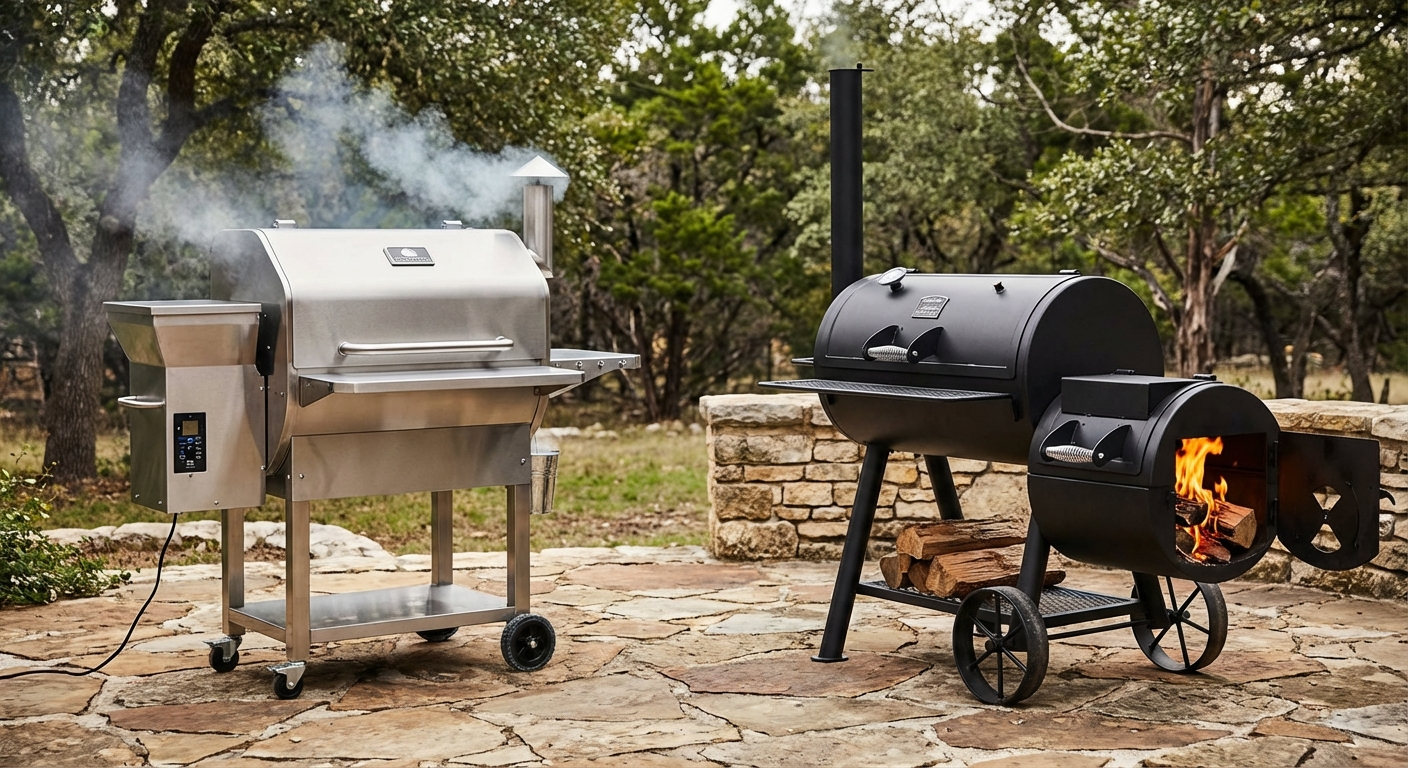
This is the most heated debate in BBQ right now, and I'm going to give you my honest opinion. I've cooked on offset stick burners for 30 years. I also own a Rec Tec pellet grill that I use regularly. I'm not a purist who thinks there's only one way to make good BBQ, and I'm not a gear snob who looks down on anyone's equipment. Both have their place.
Let me compare them honestly — flavor, convenience, cost, and learning curve — so you can make an informed decision.
Stick Burners (Offset Smokers)
An offset smoker burns split logs as its primary fuel and heat source. Wood burns in the firebox, and heat and smoke travel through the cook chamber. The pitmaster manages the fire manually — adding wood, adjusting dampers, monitoring temperatures. It's hands-on cooking. Read my full offset smoker guide for details.
Advantages
- Maximum smoke flavor: Nothing matches the flavor of food cooked over a real wood fire. The combustion of full-sized wood splits produces a depth and complexity of smoke flavor that pellet grills can't fully replicate. This is the big one.
- Higher heat ceiling: Need to sear steaks at 700°F in the firebox? Cook hot-and-fast brisket at 325°F? An offset can do it. The heat range is enormous.
- No electricity needed: Pure wood and fire. Cook anywhere — no outlets required.
- The craft experience: There's something deeply satisfying about managing a live fire for 14 hours. You learn about combustion, wood science, and patience in a way that no automated cooker teaches. Many pitmasters love the process as much as the product.
- Durability: A well-built offset (thick steel) will last decades with minimal maintenance. There are no electronics, augers, fans, or controllers to break.
Disadvantages
- Steep learning curve: Fire management takes practice — real practice, not YouTube videos. Expect your first 5-10 cooks to be inconsistent as you learn your smoker.
- Constant attention: You're feeding the fire every 45-60 minutes during an overnight brisket cook. You can't set it and go to bed. This is a feature for some people and a dealbreaker for others.
- Temperature swings: Even with good technique, offset temps fluctuate more than pellet grills. Cheap offsets with thin steel are especially bad.
- Cost of entry for quality: A good offset (1/4-inch steel minimum) starts around $800 and competition-grade units run $2,000-$5,000+. The cheap $200-400 offsets at big box stores are mostly frustrating to use.
- Wood sourcing: You need a reliable supply of properly seasoned hardwood. This is easy in Texas (post oak is everywhere) but can be challenging in other regions.
Pellet Grills
A pellet grill burns compressed wood pellets fed by an electric auger into a burn pot. A controller (digital PID controller on modern units) monitors temperature and adjusts the auger speed and fan to maintain your set temperature. It's automated — you set a temperature and the controller does the work.
Advantages
- Set-it-and-forget-it convenience: Set your temperature, put the meat on, and walk away. The controller maintains temp within 5-10°F. You can run overnight cooks and actually sleep.
- Consistent results: Temperature stability means more predictable outcomes, which is especially valuable for beginners. Your tenth cook will be nearly identical to your second.
- Versatility: Most pellet grills can smoke at 180°F, grill at 450°F+, roast, bake, and even do pizza. Some models have direct-flame access for searing.
- Lower learning curve: If you can set an oven temperature, you can use a pellet grill. The fire management is handled by electronics.
- WiFi connectivity: Many modern pellet grills have WiFi/Bluetooth apps that let you monitor and adjust temperature from your phone.
- Pellet availability: Wood pellets are available at most hardware stores and ship easily online. No need to source and season split wood.
Disadvantages
- Less smoke flavor: This is the honest truth. Pellet grills produce less smoke than stick burners. The efficient combustion in the burn pot is great for temperature control but produces less of the smoke compounds that create deep BBQ flavor. Many pellet grill owners use smoke tubes to supplement.
- Requires electricity: No power, no cooking. This limits portability and means you're down during power outages.
- Mechanical complexity: Augers jam, controllers fail, igniters burn out, fans die. Every pellet grill owner will deal with a maintenance issue eventually. An offset has zero moving parts.
- Weaker smoke ring: Due to the combustion efficiency, pellet grills produce less nitrogen dioxide, resulting in a thinner smoke ring. This is cosmetic, not flavor-related, but some people care.
- Pellet quality varies wildly: Cheap pellets may contain filler wood, bark, and binding agents. Stick with reputable brands (Lumberjack, Bear Mountain, B&B) and avoid bottom-shelf pellets.
- Temperature ceiling: Most pellet grills top out around 450-500°F, which isn't hot enough for a true sear. Some newer models with direct-flame access help, but it's not the same as an 800°F cast iron grate over hardwood coals.
The Flavor Difference — My Honest Take
Here's what I tell people straight up: side by side, the same brisket cooked on my offset with post oak tastes noticeably better than one cooked on my pellet grill. The smoke depth is deeper, the bark is more complex, and there's a richness that the pellet grill doesn't quite match.
But — and this is important — the pellet grill brisket is still really good. It's not bad BBQ. It's in the top 15-20% of brisket I've ever eaten, easily. The gap between a pellet grill and a stick burner is much smaller than the gap between either of them and no smoker at all.
Most people who eat my pellet grill brisket think it's incredible. The only people who notice the difference are pitmasters who've spent years on stick burners and have a calibrated palate for smoke flavor. For a backyard cook feeding friends and family? A pellet grill produces outstanding BBQ that will impress everyone at the table.
Who Should Buy Which
Buy a Stick Burner If:
- Maximum smoke flavor is your top priority
- You enjoy the process of tending fire — it's meditative, not tedious, to you
- You have access to quality seasoned wood
- You're willing to invest time learning fire management (and accept some bad cooks early on)
- You want to compete in BBQ competitions (most champions cook on stick burners or gravity feeds)
- You're buying one cooker for the next 20+ years
Buy a Pellet Grill If:
- Convenience matters — you want to smoke on a weeknight without staying up all night
- You're new to smoking and want consistent results while you learn
- You value versatility — smoking, grilling, roasting in one unit
- You don't have access to quality split wood
- You want to set it and sleep during overnight cooks
- You cook for your family regularly and need reliability over maximum flavor
The Third Option: Get Both
I know plenty of serious BBQ people who own both — an offset for weekend cooks when they have time to tend fire, and a pellet grill for weeknight smokes when they need to be hands-off. That's what I do. No shame in it.
My Bottom Line
Don't let anyone tell you that pellet grills aren't "real BBQ." That's gatekeeping, and it's bad for the BBQ community. A pellet grill produces smoked food with real smoke from real wood. Is it identical to a stick burner? No. Is it good? Yes — often very good.
And don't let anyone tell you that offset smokers are obsolete or that "nobody needs to babysit a fire anymore." There's a reason the best BBQ restaurants in the world still cook on offsets — the flavor ceiling is higher, period.
Pick the tool that matches your life, your budget, and your goals. Then cook on it until you know it inside and out. That's what matters more than which brand name is on the lid. Whatever smoker you choose, pairing it with quality beef from The Meatery will elevate your results on any platform.
Frequently Asked Questions
Do pellet grills produce less smoke flavor than stick burners?
Yes, honestly. The efficient combustion in pellet grills produces less smoke compounds than the less-efficient burning of full wood splits in an offset. The gap is noticeable to experienced pitmasters but most people will still find pellet grill BBQ very flavorful and impressive.
Can you compete in BBQ with a pellet grill?
Yes, pellet grills are allowed in most competitions. Some teams have won with them. However, the majority of top competition teams use offset stick burners or gravity feed smokers. If competing at the highest level is your goal, a stick burner gives you a flavor advantage.
What's a good pellet grill for beginners?
Rec Tec and Grilla Grills offer excellent value in the $500-800 range with good PID controllers. Traeger is the most well-known brand. For premium, Green Mountain Grills and Camp Chef are solid. Buy a model with a reliable PID controller — that's more important than brand name.
How much does a good offset smoker cost?
A quality offset starts around $500-800 (Oklahoma Joe Highland/Longhorn). Mid-range options like Old Country BBQ Pits and Lone Star Grillz run $1,000-2,500. Competition-grade units from Yoder, Jambo, and Moberg start at $2,500+. Avoid sub-$300 thin-steel offsets — they're frustrating to use.
More Charcuterie Guides
What Is Pink Curing Salt? Sodium Nitrite Explained for Home Charcuterie
Pink curing salt is the most essential — and most misunderstood — ingredient in meat curing. This guide explains what it is, why it's pink, how sodium nitrite prevents botulism, proper usage rates, and whether you can cure meat without it.
10 min readHow Long Does Charcuterie Last? Storage Guide for Cured Meats & Cheese
Understanding proper charcuterie storage ensures you enjoy it at peak quality while avoiding food safety risks.
10 min read