How to Make Andouille Sausage at Home: Cajun Smokehouse Style
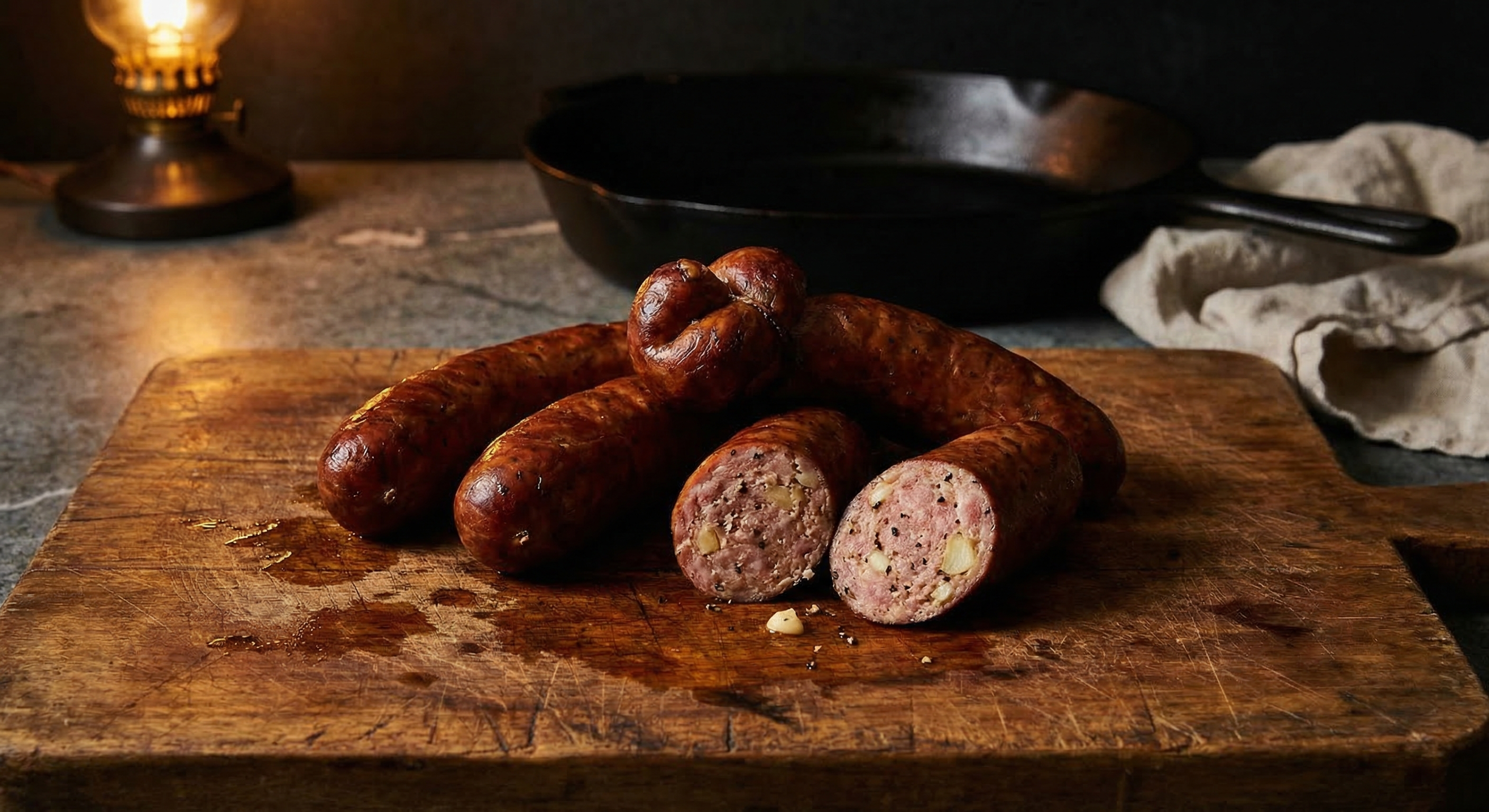
How to Make Andouille Sausage at Home: Cajun Smokehouse Style
Andouille is the sausage that makes Louisiana cooking taste like Louisiana cooking. Without it, gumbo is just soup. Jambalaya is just rice. Red beans and rice is just beans and rice. The deep, smoky, peppery punch of real andouille is what separates Cajun cuisine from everything else — and the stuff you find vacuum-sealed at the grocery store is a pale shadow of what comes out of a smokehouse in LaPlace or Vacherie.
The good news: authentic andouille is one of the more approachable smoked sausages to make at home. The grind is coarse (no need for emulsification or precise fat distribution), the seasoning is straightforward (garlic, pepper, more garlic, more pepper), and the smoking process is forgiving. If you've ever made any kind of sausage — even simple homemade chorizo or summer sausage — you can handle andouille.
This guide covers the full process from raw pork to finished smoked sausage, including the specific techniques that make Louisiana andouille different from every other smoked sausage on the planet.
What Makes Andouille Different from Other Smoked Sausages
Before we get into the recipe, you need to understand what sets andouille apart. It's not just “smoked sausage with Cajun seasoning.” Real andouille has structural and flavor characteristics that make it unique in the sausage world.
The grind is enormous. Most sausages use a fine or medium grind — meat pushed through a 4.5mm or 6mm plate. Andouille uses a coarse grind through a 10mm or even 13mm plate, and many traditional recipes don't grind the meat at all. Instead, the pork is hand-chopped into rough cubes, giving the sausage a chunky, almost rustic texture you can see and feel in every bite. This isn't laziness — it's the whole point. The coarse texture creates pockets of fat that render differently during cooking, giving andouille its distinctive mouthfeel.
The smoke is the star. Where Italian salami gets its character from fermentation and Spanish chorizo from pimentón, andouille gets almost everything from smoke. Traditional andouille is smoked for 8 to 12 hours over pecan wood (sometimes sugarcane or hickory), often double-smoked for even deeper flavor. The casing turns dark mahogany, almost black in some cases, and the smoke penetrates deep into the coarse meat.
The seasoning is restrained but aggressive. Andouille seasoning is built on a narrow foundation: garlic, black pepper, cayenne, and thyme. That's roughly it. No fennel seeds, no wine, no complex spice blends. The simplicity of the seasoning lets the smoke and pork do the talking. But within that narrow range, the quantities are generous — more garlic and more pepper than you'd think reasonable.
It's a cooking sausage, not a cured meat. Unlike salami or bresaola, andouille isn't meant to be eaten as-is from the charcuterie board. It's a workhorse ingredient — sliced into coins for gumbo, diced for jambalaya, split and grilled for po'boys. The heavy smoke and assertive seasoning are calibrated to punch through rich, heavily-spiced dishes rather than to stand alone.
Essential Ingredients for Homemade Andouille
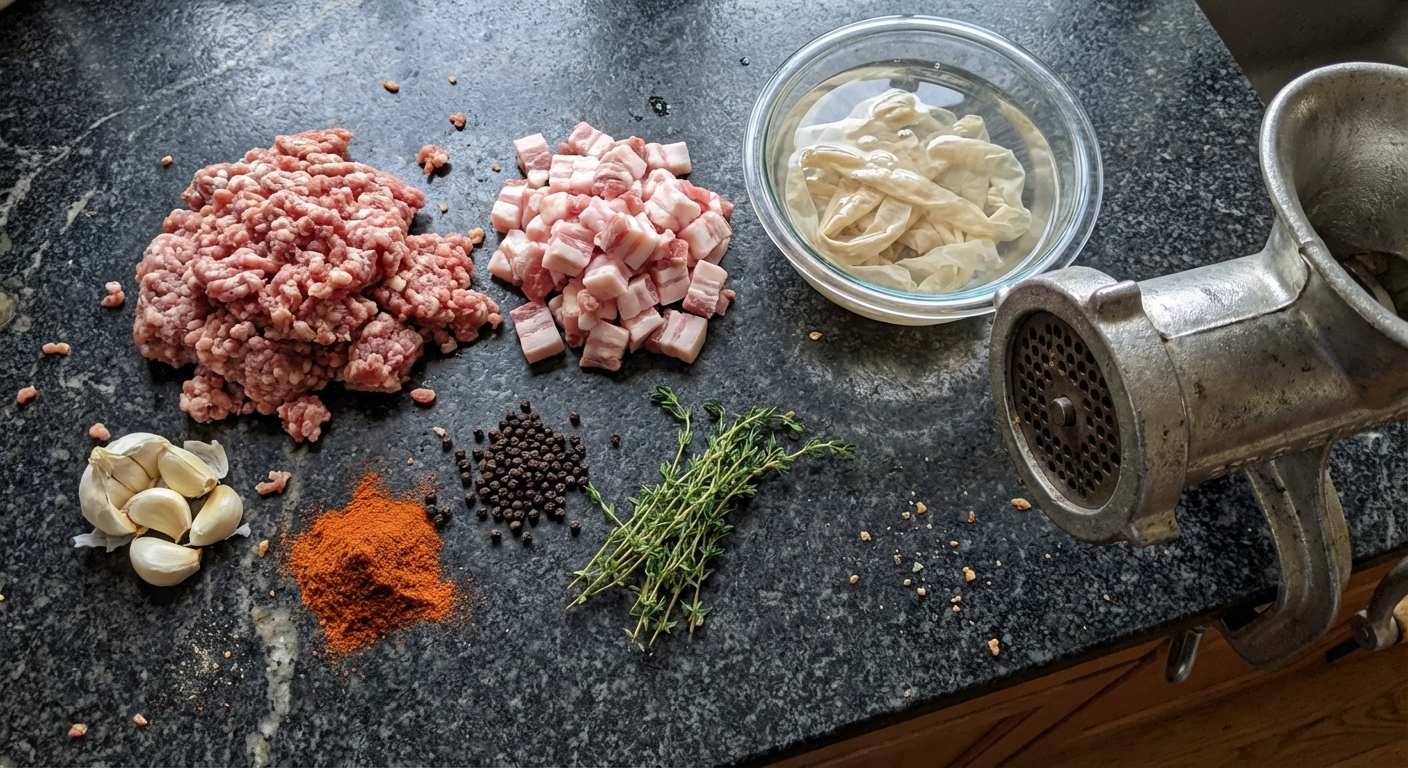
The ingredient list for andouille is short, which means quality matters for every item. Here's what you need for a 5-pound batch (roughly 2.25 kg), which yields about 12-15 links:
Meat
- 5 lbs (2.25 kg) pork shoulder (Boston butt): The standard sausage-making cut. You want roughly 75% lean to 25% fat. Pork shoulder naturally falls in this range. Buy bone-in if the price is better and remove the bone yourself — the trimmings around the bone are perfect for sausage.
- Optional: 0.5 lb (225g) pork back fat: Only if your shoulder is unusually lean. Most pork shoulders have enough intramuscular fat. If you can see thick white seams running through the meat, you don't need extra fat.
Seasonings
- 1 oz (28g) kosher salt: About 1.2% of total meat weight. Diamond Crystal is standard; if using Morton's kosher, reduce by 25% (Morton's is denser).
- 1 oz (28g) fresh garlic, minced fine: That's about 8-10 cloves. This sounds like a lot. It's not. Traditional andouille from the German Coast of Louisiana uses even more. The garlic mellows dramatically during smoking.
- 1 tablespoon (7g) coarse black pepper: Freshly cracked, not pre-ground. You want visible pepper flakes in the finished sausage.
- 2 teaspoons (5g) cayenne pepper: This gives andouille its background heat. Adjust to taste — 2 teaspoons is medium heat. Go to 1 tablespoon if you want it Louisiana-hot.
- 1 teaspoon (2g) dried thyme: Rubbed, not ground. Thyme is the one herb that defines andouille's flavor profile.
- 1 teaspoon (3g) smoked paprika: Optional but adds color and a slight smokiness to the raw sausage before it hits the smoker.
- 1/2 teaspoon (1g) white pepper: A sharper, more penetrating heat than black pepper. Traditional in many LaPlace recipes.
- 1/4 teaspoon (0.5g) allspice: Just a whisper. You shouldn't be able to identify it in the finished sausage, but it rounds out the pepper notes.
Curing Salt
- 1 teaspoon (6.25g) curing salt #1 (Prague Powder #1): Since andouille is smoked at low temperatures for extended periods, curing salt is essential for safety. It prevents botulism growth in the danger zone between 40°F and 140°F. Use Cure #1 (sodium nitrite only), not Cure #2 — andouille isn't dry-cured, so you don't need the slow-release nitrate.
Casings
- Natural hog casings, 35-38mm: The standard size for andouille. Soak in lukewarm water for at least 30 minutes before stuffing. Rinse the inside by running water through each casing. Natural casings give better smoke penetration and snap than collagen.
Liquid
- 1/4 cup (60ml) ice-cold water: Helps distribute seasonings and keeps the mixture cold during mixing. Some recipes use cold beer or ice-cold stock — both work fine, though the differences are subtle after 10 hours of smoking.
Equipment You Need
Andouille doesn't require exotic equipment, but you need a few specific items:
- Meat grinder with a coarse (10mm or 3/8-inch) plate: A KitchenAid attachment works for small batches. A dedicated grinder (like a LEM #8 or #12) is better for 5+ pound batches. The key is the coarse plate — if you only have a fine plate, this is the wrong recipe for it.
- Sausage stuffer: A vertical stuffer (5-lb capacity or larger) makes life much easier than trying to use a grinder attachment for stuffing. Grinder stuffing attachments compress the meat too much and create air pockets.
- Smoker: Any smoker that can hold 175-200°F for 8+ hours. Offset stick burners, Weber Smokey Mountains, drum smokers, or pellet grills all work. You need the ability to add wood for smoke — pecan is traditional, hickory and oak are acceptable substitutes.
- Instant-read thermometer: To verify internal temperature of 155-160°F. A leave-in probe thermometer is even better so you don't have to keep opening the smoker.
- Large mixing bowl or tub: Big enough to hand-mix 5 pounds of meat and seasonings without making a mess.
Step-by-Step: Making the Andouille
Step 1: Prep and Cube the Pork (Day Before or Morning Of)
Cut the pork shoulder into strips that will fit your grinder's feed tube, roughly 1-inch by 1-inch by 4-6 inches. Remove any sinew, silver skin, or glands, but leave the fat. Spread the strips on a sheet pan lined with parchment and freeze for 30-45 minutes until the edges are firm but the centers aren't frozen solid. Partially frozen meat grinds cleaner — the fat stays in distinct pieces rather than smearing into a paste.
While the meat firms up, mix all your dry seasonings (salt, cure, garlic, black pepper, cayenne, thyme, paprika, white pepper, allspice) in a small bowl. Having everything pre-mixed means you can season the ground meat quickly before it warms up.
Step 2: Grind Coarse
Run the partially frozen pork through the grinder using the coarse (10mm) plate. Grind directly into your large mixing bowl. If your grinder has a tendency to smear fat (you'll see a white paste building up around the plate), stop, disassemble, and re-freeze the components for 15 minutes.
For an even more traditional texture, some andouille makers skip the grinder entirely and hand-chop the pork into 1/4-inch to 1/2-inch cubes with a sharp chef's knife. This takes longer but gives the most authentic rustic texture. If hand-chopping, keep the pork very cold and work in small batches.
Step 3: Season and Mix
Scatter the pre-mixed seasoning blend evenly over the ground pork. Add the ice-cold water. Mix thoroughly by hand — not gently, but aggressively. You want to work the mixture until the seasonings are evenly distributed and the meat starts to feel tacky and sticky, which means the myosin proteins are binding. This takes about 2-3 minutes of vigorous hand-mixing. The mixture should stick to your hand when you turn it upside down.
Cover and refrigerate for at least 4 hours, ideally overnight. This rest lets the cure distribute fully and the flavors marry. The garlic in particular needs time to permeate the meat.
Step 4: Stuff the Casings
Load the sausage mixture into your stuffer. Thread a pre-soaked hog casing onto the stuffing tube, leaving about 3 inches of empty casing hanging off the end (you'll tie this off). Stuff at a steady pace, filling the casings firmly but not drum-tight — overstuffed sausages burst during smoking as the meat expands slightly with heat.
Twist into links every 8-10 inches, alternating the direction of your twist (clockwise, then counter-clockwise) to keep them from unraveling. If you see air pockets, prick them with a sausage pricker or a clean needle. Air pockets trap moisture during smoking and can cause the casing to separate from the meat.
Once stuffed, lay the links on a sheet pan and refrigerate uncovered for 2-4 hours. This dries the casing surface (called pellicle formation), which helps smoke adhere. A tacky, slightly dried casing takes smoke better than a wet one — the same principle behind cold smoking techniques.
Smoking the Andouille: The Critical Step
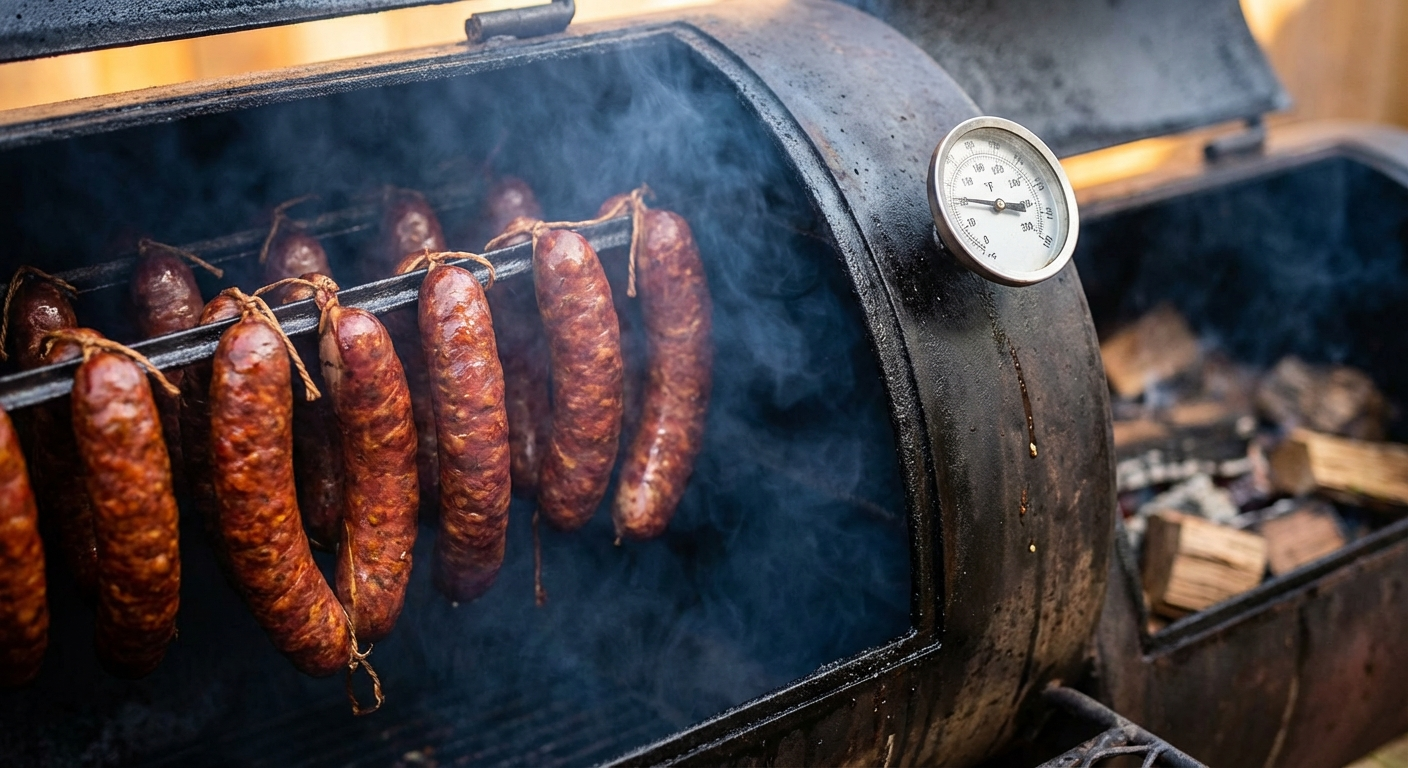
This is where andouille earns its identity. The smoking process is what separates homemade andouille from every other pork sausage in your repertoire.
Smoker Setup
Preheat your smoker to 175°F (80°C). Yes, that's low — lower than most barbecue. Andouille is not hot-smoked the way you'd smoke a brisket. The goal is maximum smoke absorption with gradual temperature increase. If your smoker can't hold below 200°F, that's okay, but try to stay as close to 175°F as possible for the first 3-4 hours.
Wood choice matters. Pecan is the traditional smoking wood for Louisiana andouille — it produces a sweet, nutty smoke that's less aggressive than hickory but more complex than fruit woods. If you can't find pecan, use a 50/50 blend of hickory and apple. Avoid mesquite (too bitter for the long smoke time) and cherry (too mild to stand up to the heavy seasoning).
The Smoke Schedule
Hours 1-3 (175°F, heavy smoke): This is your primary smoke absorption window. The casings are still moist and porous, pulling in maximum smoke flavor. Keep the smoke thick — you want a steady stream of thin blue smoke (not billowing white smoke, which deposits creosote and tastes bitter). Add wood chunks every 30-45 minutes.
Hours 3-6 (185-190°F, moderate smoke): Bump the temperature slightly. The casings are starting to set and absorb less smoke, so you can reduce wood additions to every hour. The internal temperature of the sausages should be climbing through 120-140°F during this phase.
Hours 6-8+ (190-200°F, light smoke): Final push to bring the internal temperature to 155°F. You can stop adding wood at this point — there's enough smoke flavor built up. Focus on getting the internal temperature right without overcooking.
Target internal temperature: 155-160°F (68-71°C). Use your instant-read thermometer to check the thickest part of the thickest sausage. At this temperature, the pork is fully cooked and safe, but still juicy. Going above 165°F will start to dry out the sausage — the fat renders too aggressively and you lose the succulent texture.
The Ice Bath
When the sausages hit 155°F internal, remove them from the smoker and immediately plunge them into an ice water bath for 10-15 minutes. This stops the carryover cooking (which could push internal temps to 170°F+) and sets the casing so it develops that iconic “snap” when you bite into it. The rapid cooling also prevents the fat from continuing to render inside the casing.
Pat the sausages dry after the ice bath and let them rest at room temperature for 30 minutes before refrigerating. They'll develop a slightly tacky surface — that's good. It means the smoke has properly bonded with the casing.
Double-Smoking: The LaPlace Secret
In LaPlace, Louisiana — the self-proclaimed “Andouille Capital of the World” — many smokehouse operators smoke their andouille twice. The sausages go through the full smoke cycle described above, then rest overnight in the refrigerator, and go back into the smoker the next day for another 3-4 hours at 175-185°F.
Double-smoking creates an incredibly deep, almost bacon-like smokiness that single-smoked andouille can't match. The overnight rest allows moisture to redistribute from the center of the sausage to the surface, and the second smoke session drives it back in — along with another layer of wood flavor. The casing gets noticeably darker, sometimes nearly black.
Is it necessary? No. Single-smoked andouille is excellent and perfectly authentic. But if you're making a batch specifically for gumbo or jambalaya where the andouille needs to compete with a heavy roux, trinity, and a mountain of spices, double-smoking gives you that extra gear.
Storing Your Andouille
Properly smoked andouille stores well:
- Refrigerator: 2 weeks in vacuum-sealed bags, 7-10 days in zip-top bags with air pressed out.
- Freezer: 6 months vacuum-sealed, 3 months in freezer bags. Freeze individual links or pre-slice into coins for easy portioning.
- Vacuum sealing tip: If freezing, portion the sausages into recipe-sized quantities before sealing. One link per bag for po'boys and grilling; 3-4 coins-worth per bag for gumbo and jambalaya.
To thaw, move from freezer to refrigerator overnight. Don't microwave-thaw andouille — the uneven heating renders fat in spots and dries out others.
How to Use Andouille: Classic Cajun Recipes
Andouille is a cooking ingredient, not a snacking sausage. Here's where it shines:
- Gumbo: Slice into 1/4-inch coins and add during the last 45 minutes of cooking. The smoke infuses the roux-based broth with an unmistakable depth. Use about 1 lb of andouille per 6-8 servings of gumbo.
- Jambalaya: Dice into 1/2-inch pieces and brown in the pot before adding rice. The rendered fat becomes part of the cooking liquid, flavoring every grain of rice. Andouille and chicken is the classic Creole combination.
- Red beans and rice: Add 2-3 whole links to the pot with the beans and let them simmer for the full cooking time (2-3 hours). The beans absorb smoke flavor from the sausage. Remove, slice, and serve on top of the finished beans.
- Po'boys: Split a link lengthwise, grill cut-side down until charred, and serve on French bread with creole mustard, pickles, and shredded lettuce.
- Breakfast: Slice into coins and pan-fry until crispy on both sides. Serve alongside eggs, grits, and toast. The rendered andouille fat is incredible for frying eggs in.
Troubleshooting Common Issues
Even experienced sausage makers hit snags. Here are the most common problems with andouille and how to fix them:
- Casing wrinkled and separated from meat: You under-stuffed. The casings need to be snug (though not bursting). Next batch, stuff more firmly and accept that you might lose a link or two to blowouts — it's better than having wrinkled sausages.
- Sausage is dry and crumbly: Internal temperature went too high. Pull at 155°F and ice bath immediately. Also check your fat ratio — if you trimmed too much fat from the shoulder, the sausage has no internal moisture reservoir.
- Bitter or acrid smoke flavor: You had dirty smoke. White billowing smoke from smoldering, oxygen-starved wood deposits creosote on the casing. You want thin blue smoke from clean-burning wood with good airflow. Open your intake vents more.
- Not enough smoke flavor: Either your smoker is too leaky (smoke escapes before contacting the meat) or you didn't form a proper pellicle. Make sure the casings are tacky-dry before they go in the smoker, and keep the smoke heavy for the first 3 hours.
- Fat pooling at the bottom of links: Your hanging method let gravity pull rendered fat downward. If smoking on racks instead of hanging, rotate the sausages 180° every 2 hours. If hanging, ensure the links are short enough that the weight doesn't squeeze fat downward.
- Gray spots inside when sliced: Cure wasn't distributed evenly. Mix longer and more aggressively in Step 3. The overnight rest also helps — don't skip it.
Andouille vs Store-Bought: Is It Worth Making?
Here's the honest calculation. A 5-pound batch of homemade andouille costs roughly $20-25 in ingredients (pork shoulder at $3-4/lb, plus casings and spices). The same amount of quality andouille from a Louisiana smokehouse costs $50-70 shipped. Grocery store andouille runs $8-12 per pound but tastes nothing like the real thing — it's typically fine-ground, lightly smoked, and loaded with fillers.
The time investment is real: about 30 minutes of active prep, 4-12 hours of passive smoking, plus overnight curing time. But you're making 12-15 links that freeze beautifully and last 6 months. One batch sets you up for gumbo and jambalaya season.
The biggest advantage isn't cost — it's control. You decide the grind size, the heat level, the smoke intensity, and the garlic ratio. After one batch, you'll never go back to the plastic-wrapped stuff at the grocery store. Andouille is a sausage that rewards the maker who respects the simplicity of its ingredients and the patience of its smoking process.
Frequently Asked Questions
What is the best wood for smoking andouille sausage?
Pecan is the traditional and best wood for smoking andouille sausage. It produces a sweet, nutty smoke that complements pork without overpowering it. Hickory mixed with apple wood is a good substitute if pecan is unavailable. Avoid mesquite, which turns bitter during the long smoking times andouille requires.
Can I make andouille sausage without a smoker?
You can approximate the smoke flavor using liquid smoke (1-2 teaspoons per 5 lbs of meat mixed into the seasoning) and then oven-roasting at 200 degrees F until the internal temperature reaches 155 degrees F. It will not taste exactly like smoked andouille, but it will be significantly better than store-bought. A stovetop smoker or kettle grill with indirect heat and wood chips also works well.
How long does homemade andouille sausage last?
Refrigerated in vacuum-sealed bags, homemade andouille lasts about 2 weeks. In the freezer, vacuum-sealed andouille holds its quality for 6 months. In zip-top bags, expect 7-10 days refrigerated or 3 months frozen. Always thaw in the refrigerator overnight rather than at room temperature.
What is the difference between andouille and kielbasa?
Andouille is a Cajun smoked sausage made with coarse-ground pork, heavy garlic, cayenne pepper, and pecan wood smoke. Kielbasa is a Polish smoked sausage with a finer grind, garlic and marjoram seasoning, and typically milder flavor. Andouille is spicier, smokier, and has a much chunkier texture than kielbasa.
Do I need curing salt for andouille sausage?
Yes. Because andouille is smoked at low temperatures (175-200 degrees F) for many hours, the meat spends extended time in the bacterial danger zone between 40 degrees F and 140 degrees F. Curing salt number 1 (Prague Powder number 1) prevents botulism growth during this period. Do not skip it for safety reasons.
More Charcuterie Guides
What Is Pink Curing Salt? Sodium Nitrite Explained for Home Charcuterie
Pink curing salt is the most essential — and most misunderstood — ingredient in meat curing. This guide explains what it is, why it's pink, how sodium nitrite prevents botulism, proper usage rates, and whether you can cure meat without it.
10 min readHow Long Does Charcuterie Last? Storage Guide for Cured Meats & Cheese
Understanding proper charcuterie storage ensures you enjoy it at peak quality while avoiding food safety risks.
10 min read