Hot Smoking vs Cold Smoking: Methods, Equipment & Safety
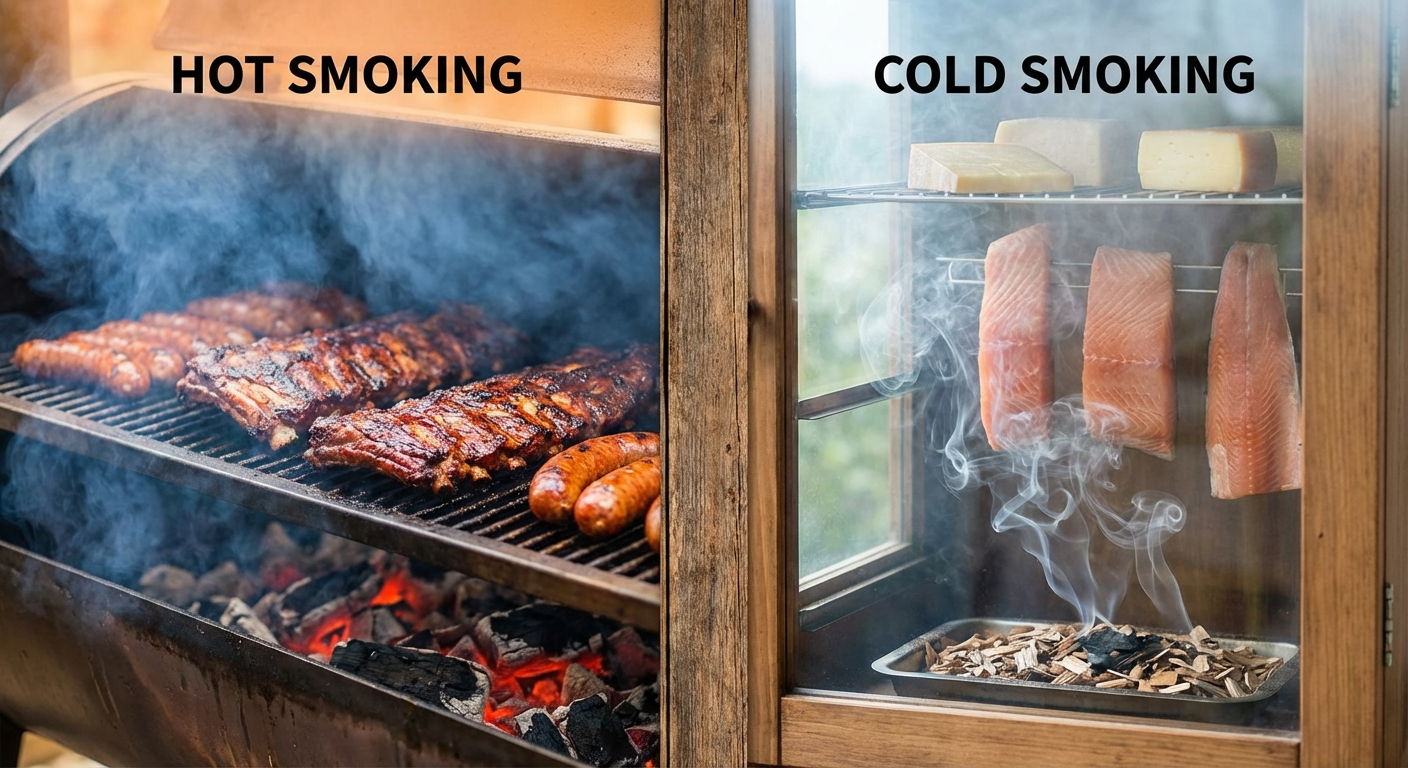
When most people say "smoking," they mean hot smoking — what I do with brisket, ribs, and pork shoulder. But there's a whole other world of cold smoking that's been used for centuries to preserve and flavor food. The two methods share the word "smoking" and not much else.
Let me break down both, because understanding the difference matters for both flavor and — more importantly — food safety.
Hot Smoking
Hot smoking is cooking and smoking at the same time. The food is exposed to both heat and smoke, bringing it to a safe internal temperature while adding smoke flavor. This is traditional American BBQ.
Temperature Range
Hot smoking happens between 200°F and 300°F (most BBQ is done at 225-275°F). At these temperatures, the meat is actively cooking — proteins denature, collagen converts to gelatin, fat renders, and the Maillard reaction creates bark on the surface.
How It Works
In a hot smoker (offset, pellet grill, kamado, drum smoker, etc.), wood burns in the same space as the food or in a connected firebox. The heat cooks the meat while smoke compounds deposit on the surface. The wet, cool surface of raw meat attracts smoke particles — as the surface dries and heats up, smoke adhesion decreases, which is why most smoke absorption happens in the first few hours.
Foods for Hot Smoking
- Brisket, pork shoulder, ribs — the classic BBQ meats
- Whole chickens and turkeys
- Sausages (hot-smoked sausage is fully cooked)
- Salmon (hot-smoked salmon is opaque and flaky)
- Nuts, peppers, and vegetables
Safety
Hot smoking is straightforward from a safety standpoint. The food reaches internal temperatures well above the danger zone (40-140°F). As long as you cook to proper internal temps — 165°F for poultry, 145°F for whole cuts of pork and beef, 203°F for pulled pork and brisket — you're safe.
Cold Smoking
Cold smoking is a completely different animal. You're adding smoke flavor to food without cooking it. The food stays in the danger zone temperature-wise, which means you need to understand the process and the risks.
Temperature Range
Cold smoking happens between 68°F and 86°F. At these temperatures, the food is not cooking — it's simply being exposed to smoke. The internal temperature of the food stays below 90°F throughout the process.
How It Works
The smoke is generated away from the food and piped or channeled to the smoking chamber. This separates heat production from smoke exposure. Common cold smoke generators include:
- Tube smokers: Perforated metal tubes filled with wood pellets that smolder. Place one in a grill or smokehouse that isn't heated.
- Maze smokers: A tray with a labyrinth pattern filled with sawdust. The sawdust smolders slowly through the maze, producing smoke for 6-10 hours.
- External smoke generators: A separate firebox connected to the food chamber by a pipe. The pipe allows smoke to cool before reaching the food.
Foods for Cold Smoking
- Cheese: The most popular and safest cold-smoked food. Since cheese is already a preserved product, there's minimal safety risk. Cold-smoke for 2-4 hours and refrigerate for 1-2 weeks before eating to mellow the smoke flavor.
- Salmon (lox): Cold-smoked salmon is silky, translucent, and completely different from hot-smoked. Requires proper curing with salt first.
- Bacon: Traditional bacon is cured and then cold-smoked. The cure provides the safety; the smoke provides the flavor. (Most commercial bacon is liquid-smoke flavored, not actually smoked.)
- Sausages: Many European sausages (like some salamis) are cold-smoked after curing.
- Butter, salt, spices: These are fun experiments — cold-smoked butter on a steak is incredible.
Safety — This Is Critical
Cold smoking keeps food in the temperature danger zone for extended periods. Without proper preparation, this can create conditions for dangerous bacteria, including Clostridium botulinum (botulism), Listeria, and Salmonella. Here are the non-negotiable safety rules:
- Cure first, then smoke. Any meat or fish that will be cold-smoked must be properly cured with salt and/or curing salt (sodium nitrite) first. The cure inhibits bacterial growth during the smoking process. This is not optional.
- Control temperature. Keep the smoking environment below 90°F. If ambient temperatures are warm, cold smoke in the early morning, evening, or during cooler months.
- Keep it clean. Sanitize all equipment. Bacteria love moist, protein-rich environments at room temperature — which is exactly what cold smoking creates.
- Time limits. Don't cold smoke for longer than necessary. Most items need 4-12 hours. Longer isn't better — it just increases risk.
- Refrigerate immediately. After cold smoking, get the food into the refrigerator promptly.
- Start with safe foods. If you're new to cold smoking, start with cheese or salt. These are low-risk. Work up to fish and meat only after you understand curing.
Can You Cold Smoke on a Regular Smoker?
Sort of. If you use a tube smoker or maze smoker inside your regular grill without lighting any other fuel, you can cold smoke. The pellet smolder produces smoke but minimal heat. This works great for cheese. Just make sure the ambient temperature isn't too warm — pick a cool day.
Some people disconnect the firebox on an offset and use it as the smoke generator, piping smoke through to the cook chamber. This works but it's a bit of an engineering project.
My Cold Smoking Experiments
I primarily hot smoke — that's my bread and butter. But I do cold-smoke these items regularly:
- Cheddar cheese: 3 hours of cold smoke with apple wood, then vacuum-sealed and aged 2 weeks in the fridge. Outstanding.
- Salt: Spread kosher salt in a foil pan and cold smoke for 4-6 hours. Smoked salt on a steak is something else.
- Butter: 2 hours of cold smoke. Use within a week. Melt it over a grilled steak or smoked corn.
- Bacon: I cure pork belly with a salt-sugar-nitrite cure for 7 days, rinse and dry, then cold smoke for 8-10 hours with hickory. It's real bacon — nothing like the store-bought stuff.
The Bottom Line
Hot smoking is cooking. Cold smoking is flavoring. If you're a BBQ enthusiast, you're already doing hot smoking every time you fire up your pit. Cold smoking is a separate craft that's worth exploring, but approach it with respect for the food safety requirements. Start with cheese, learn the principles, and work your way up. For the hot smoking side, start with quality beef from The Meatery — premium meat plus clean smoke equals extraordinary results.
Frequently Asked Questions
What temperature is cold smoking vs hot smoking?
Hot smoking happens at 200-300°F (most BBQ is 225-275°F) — the food is cooking and smoking simultaneously. Cold smoking happens at 68-86°F — the food is being flavored but not cooked. The temperature difference is critical for both results and food safety.
Is cold smoking dangerous?
Cold smoking can be dangerous if done improperly because food stays in the temperature danger zone (40-140°F) for extended periods. Meat and fish MUST be properly cured with salt and curing salt before cold smoking. Start with low-risk foods like cheese and salt before attempting meat.
What's the easiest thing to cold smoke?
Cheese is the easiest and safest cold-smoked food. Use a tube smoker or maze smoker in your grill without additional heat. Smoke cheddar for 2-4 hours with mild wood (apple or cherry), then vacuum seal and refrigerate for 1-2 weeks before eating to let the flavor mellow.
Do I need special equipment for cold smoking?
You need a smoke source that produces smoke without significant heat. A tube smoker ($15-25) filled with pellets works in any grill. A maze smoker uses sawdust. For meat and fish, an external smoke generator connected to a chamber by a pipe keeps smoke cool. You don't need an expensive dedicated cold smoker.
More Charcuterie Guides
What Is Pink Curing Salt? Sodium Nitrite Explained for Home Charcuterie
Pink curing salt is the most essential — and most misunderstood — ingredient in meat curing. This guide explains what it is, why it's pink, how sodium nitrite prevents botulism, proper usage rates, and whether you can cure meat without it.
10 min readHow Long Does Charcuterie Last? Storage Guide for Cured Meats & Cheese
Understanding proper charcuterie storage ensures you enjoy it at peak quality while avoiding food safety risks.
10 min read