Charcuterie Board for Two: The Perfect Date Night Spread
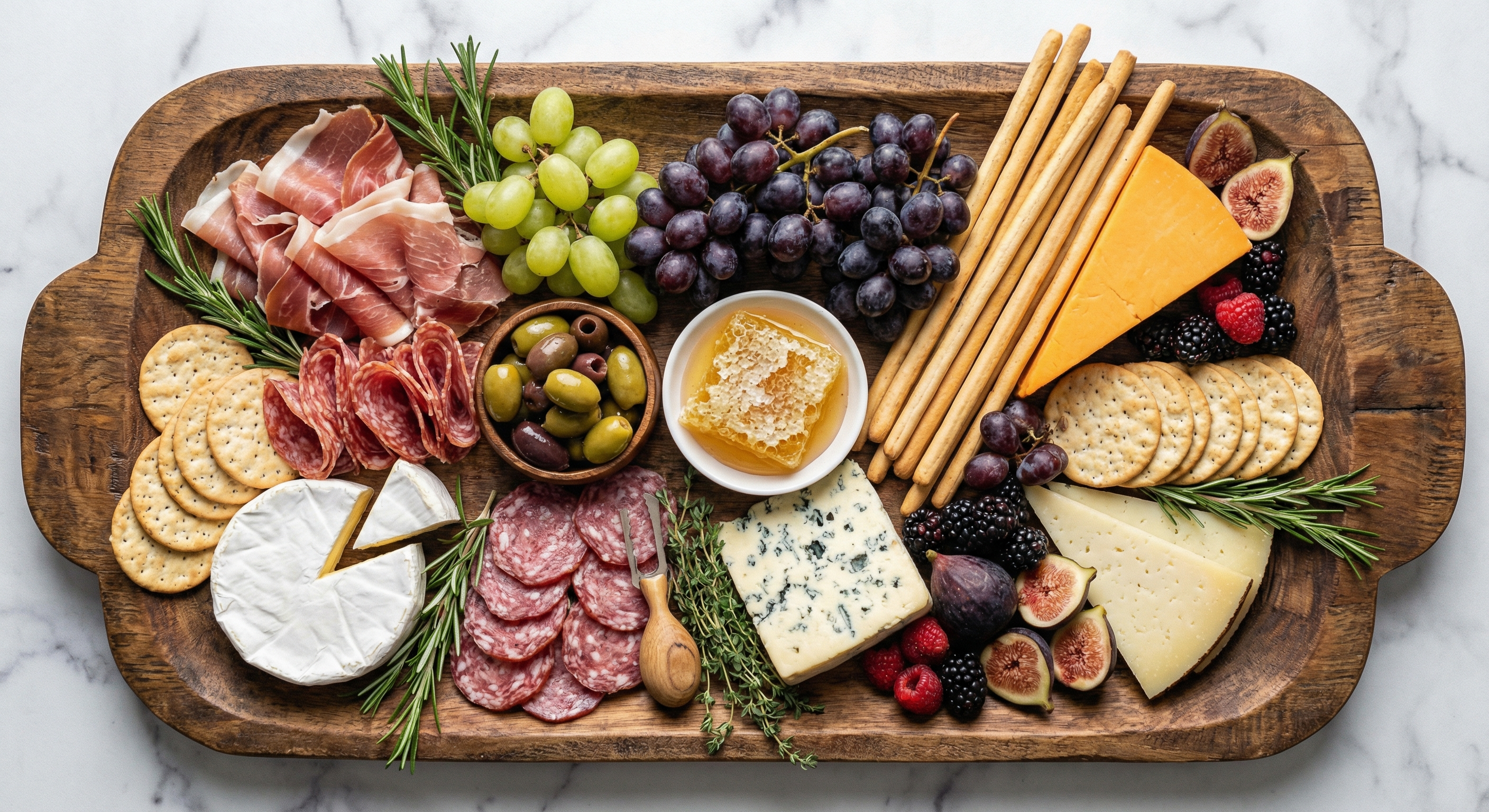
A charcuterie board for two is one of the simplest ways to turn an ordinary evening into something special. No cooking required, no recipes to follow—just smart shopping, thoughtful pairing, and a little arrangement know-how.
The challenge with a smaller board isn’t complexity. It’s restraint. When you’re feeding a crowd, variety covers mistakes. When it’s just two people, every item needs to earn its spot.
This guide gives you the exact portions, pairings, and layout strategy for a charcuterie board that feels indulgent without generating a week of leftovers.
How Much Food for Two People
The biggest mistake people make with a charcuterie board for two is buying like they’re feeding ten. Here’s what you actually need:
- Cured meats: 3–4 oz total (2–3 varieties)
- Cheese: 3–4 oz total (2–3 varieties)
- Crackers/bread: 8–12 pieces
- Fresh fruit: 1 small cluster of grapes or a handful of berries
- Accompaniments: 2–3 small bowls (olives, honey, mustard)
That’s roughly one small deli counter visit. Total cost: $15–25 depending on quality.
The Right Board Size
Skip the massive wooden slab. For two people, you want a board that’s 8–12 inches across. A small cutting board, a slate tile, or even a large plate works perfectly. The goal is a board that looks full—negative space kills the visual impact of a small spread.
The Best Meats for a Board for Two
With only 2–3 meat selections, each one needs to bring something different to the table.
The Perfect Three-Meat Lineup
1. Prosciutto di Parma — Silky, delicate, melt-in-your-mouth. The crowd-pleaser that everyone reaches for first. Fold or ruffle 3–4 thin slices.
2. Soppressata — A firm, peppery salami that provides textural contrast to the prosciutto. Cut 5–6 thin rounds.
3. Coppa (Capicola) — Sits between prosciutto and salami in both texture and flavor. Rich, slightly spicy, with beautiful fat marbling. 3–4 slices.
Two-Meat Alternative
If you want to keep it simpler: Prosciutto + a hard salami (like finocchiona or soppressata) gives you the essential soft-and-firm contrast.
Pro tip: Buy from the deli counter, not pre-packaged. Ask for paper-thin prosciutto and slightly thicker salami. It costs about the same and tastes dramatically better.
Cheese Pairings That Actually Work
Cheese pairing for two follows one rule: contrast textures and milk types.
The Ideal Three-Cheese Selection
Aged Manchego (hard, sheep’s milk) — Nutty, crystalline texture pairs beautifully with soppressata.
Brie or Camembert (soft, cow’s milk) — Creamy and mild, spreads on crackers beautifully.
Honey goat cheese (semi-soft, goat’s milk) — Tangy sweetness bridges meats and fruit.
If You Only Pick Two
Go with one soft (Brie) and one hard (Manchego or aged cheddar). The texture difference keeps things interesting.
Portions: Cut hard cheeses into bite-sized pieces or thin wedges. Leave soft cheese as a small wheel or half-wheel that you can cut into as you eat.
Building the Board: Layout Strategy
Arrangement matters more on a small board because everything is visible at once. Here’s the step-by-step:
Step 1: Place Your Anchors
Put cheese pieces at different points on the board first. They’re the largest items and create the visual structure. For a two-person board, place them at opposite ends or in a diagonal.
Step 2: Add the Meats
Fold or ruffle prosciutto into loose rosettes near one cheese. Fan salami rounds in a slight overlap near the other. Coppa can cascade between them.
Step 3: Fill with Crackers
Tuck crackers into gaps. Use two types if possible—a plain water cracker and something with seeds or herbs. Stand some upright against the cheese for height.
Step 4: Add Fresh Elements
Grapes, berries, or fig halves fill remaining gaps. A small cluster of grapes draped over the board edge looks effortlessly elegant.
Step 5: Finish with Accompaniments
Place 1–2 small bowls (ramekins work great) with:
- Honey — drizzle over Brie or goat cheese
- Whole grain mustard — pairs with salami and hard cheese
- Marcona almonds — scattered in open spaces add crunch
Wine Pairing for Two
A charcuterie board for two practically demands a bottle of wine. Match the weight of the board:
- Light meats + soft cheese: Pinot Noir, Beaujolais, or a dry rosé
- Spicier salami + aged cheese: Chianti, Tempranillo, or a bold Côtes du Rhône
- Don’t drink wine? A sparkling water with citrus or craft beer (Belgian wheat or amber ale) works great
One bottle is perfect for two people grazing over an hour or two.
Date Night Variations
The Italian Board
- Prosciutto + soppressata + bresaola
- Parmigiano-Reggiano + burrata
- Grissini breadsticks + marinated artichoke hearts
- Pair with Chianti or Prosecco
The French Board
- Jambon de Bayonne + saucisson sec
- Brie + Comté
- Cornichons + Dijon mustard + baguette rounds
- Pair with Burgundy or Champagne
The Spanish Board
- Jamón Serrano + chorizo
- Manchego + Mahón
- Marcona almonds + membrillo (quince paste)
- Pair with Rioja or Cava
Common Mistakes to Avoid
Buying too much. A charcuterie board for two should be an appetizer-to-light-meal portion, not a full dinner. If you have significant leftovers, you overbought.
Serving everything cold. Pull meats and cheese from the fridge 20–30 minutes before serving. Room temperature unlocks flavors that cold suppresses.
Skipping the honey. Honey is the single best accompaniment for a small board. A drizzle over Brie or goat cheese transforms the entire experience.
Using a board that’s too big. A sparse board looks sad. Better to pile a small board high than scatter items across a large one.
Make It a Routine
The best thing about a charcuterie board for two is that it becomes repeatable. Keep a mental rotation of meats and cheeses, swap the wine each time, and you have a low-effort tradition that never gets old.
Start with the three-meat, three-cheese framework above. Once you’ve built it a few times, you’ll stop measuring and start improvising—which is exactly how charcuterie is supposed to work.
More Charcuterie Guides
What Is Pink Curing Salt? Sodium Nitrite Explained for Home Charcuterie
Pink curing salt is the most essential — and most misunderstood — ingredient in meat curing. This guide explains what it is, why it's pink, how sodium nitrite prevents botulism, proper usage rates, and whether you can cure meat without it.
10 min readHow Long Does Charcuterie Last? Storage Guide for Cured Meats & Cheese
Understanding proper charcuterie storage ensures you enjoy it at peak quality while avoiding food safety risks.
10 min read