Brisket Flat vs Point: Understanding the Whole Packer
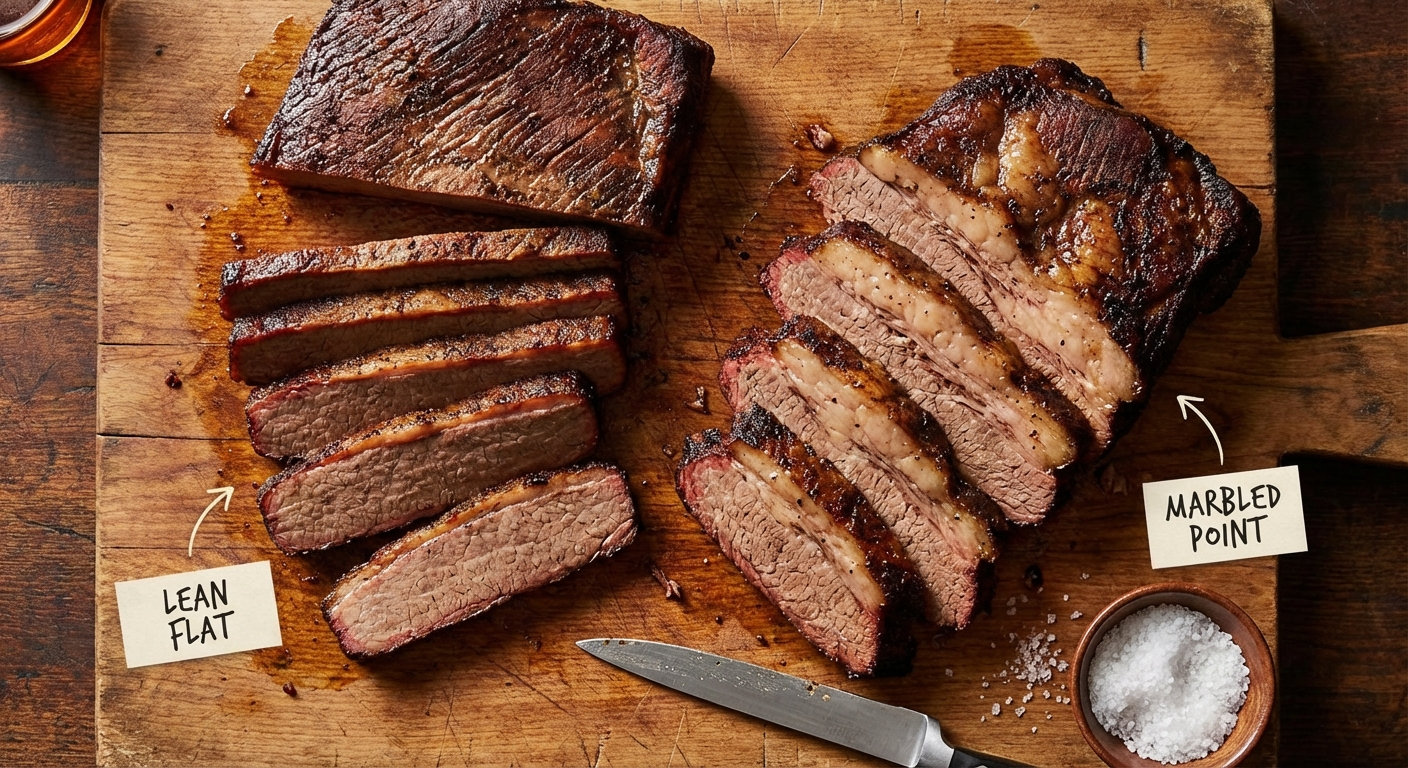
One of the most common mistakes I see from people starting out with brisket is not understanding that they're actually cooking two different muscles at the same time. A whole packer brisket — the kind you want for smoking — contains two distinct muscles: the flat and the point. They're connected by a fat seam but they cook differently, eat differently, and need different handling.
Understanding these two muscles — and how they interact during a long cook — is fundamental to producing great brisket. Let me break it down.
Anatomy of the Whole Packer
The brisket comes from the chest of the steer. The animal doesn't have a collarbone, so the chest muscles (pectorals) support about 60% of the animal's body weight. That means these muscles are heavily worked, full of connective tissue, and loaded with collagen. That collagen is what converts to gelatin during a long, slow cook — it's what makes properly cooked brisket impossibly tender.
The Flat (Pectoralis Profundus)
The flat is the larger, leaner, more uniform muscle. It's the part that most people think of when they picture sliced brisket — long, relatively thin, and rectangular. When you buy just a "brisket" at the grocery store (not a whole packer), you're usually getting a flat.
Characteristics:
- Leaner muscle with less intramuscular fat
- Covered by the fat cap on the bottom/exterior side
- More uniform thickness (though it tapers toward one end)
- Slices beautifully into uniform pieces
- More prone to drying out during cooking
- Makes up roughly 60-65% of the whole packer weight
The Point (Pectoralis Superficialis)
The point sits on top of the flat at one end of the brisket (the thicker end). It's a fattier, more irregularly shaped muscle with significantly more marbling and intermuscular fat. This is where burnt ends come from.
Characteristics:
- Higher fat content — much more marbling than the flat
- More connective tissue and collagen
- Irregular shape, thicker overall
- More forgiving during cooking (the fat keeps it moist)
- Richer, beefier flavor than the flat
- Makes up roughly 35-40% of the whole packer weight
The Fat Seam
Between the flat and the point, there's a thick layer of intermuscular fat called the deckle fat or the seam fat. During cooking, some of this renders, but a significant portion remains. When you separate the two muscles after cooking, this fat layer is clearly visible.
Why Cook Them Together?
You might ask — if they're so different, why not separate them and cook them individually? Some people do. But cooking the whole packer intact has advantages:
- The point insulates the flat. The point sits on top of the flat, and during cooking, rendered fat from the point drips down into the flat. The extra mass of the point also shields part of the flat from drying out.
- More thermal mass: A whole packer holds temperature more evenly than a separated flat, which is thinner and more prone to temperature swings.
- Bark surface area: The exterior surface of a whole packer develops bark beautifully. Separating the muscles doubles the surface area that needs bark development, which changes the seasoning and smoke dynamics.
How They Cook Differently
Here's the challenge: the flat and point reach different internal temperatures at different rates, and they're "done" at different points.
The flat, being leaner, relies more on collagen conversion for tenderness. It needs to reach about 200-205°F internal to be fully tender, but it has less fat to protect it from drying out at those temperatures. This is why brisket flat is so tricky — there's a narrow window between "tender" and "dried out."
The point, with its abundant fat and connective tissue, is much more forgiving. It can go to 210°F+ without drying out, and the extra fat keeps it moist and juicy. The point is almost always more tender and flavorful than the flat.
The Practical Implication
When you probe a whole packer for doneness, probe the flat — specifically the thickest part of the flat, away from the point. The flat is the limiting factor. If the flat probes tender at 203°F and slides in like butter, the point is definitely done too.
The most common problem with brisket is an overcooked flat and a perfect point. This usually happens because the cook ran too hot, too long, or the brisket wasn't rested long enough. A good rest (2+ hours in a Cambro) lets the flat reabsorb moisture and improves the texture significantly.
Slicing: The Grain Direction Changes
This trips people up. The flat and point have different grain directions — they run roughly perpendicular to each other.
For the flat, the grain runs lengthwise along the brisket. Slice across (perpendicular to) the grain in pencil-width slices, starting from the thin end.
When you reach the area where the point overlaps the flat, you'll notice the grain direction changing. Separate the two muscles at the fat seam, rotate the point about 90 degrees, and then slice the point across its grain. The point slices will be thicker and more irregular — that's normal.
Burnt Ends
If you want to make burnt ends — and you should, because they're incredible — here's how:
- When the whole brisket is done, separate the point from the flat at the fat seam.
- Cube the point into roughly 1-inch pieces.
- Toss the cubes with your rub and a thin coating of BBQ sauce.
- Place them back in the smoker in a foil pan at 250°F for 1-2 hours until the sauce caramelizes and the cubes are tender and sticky.
Good burnt ends are like meat candy — rich, smoky, sweet, tender, with caramelized edges. They're the pitmaster's snack. At Delgado's, we'd make burnt ends from the points and they'd sell out within 20 minutes of being put on the counter.
Should You Ever Buy Just a Flat?
If your smoker is too small for a whole packer, or you want leaner sliced brisket, you can buy just the flat. But know this: a flat-only brisket is significantly harder to cook well than a whole packer. Without the point's fat and insulation, the flat dries out faster and is less forgiving of temperature variations.
If you're cooking a flat only, consider these adjustments:
- Choose the highest grade you can afford — marbling is even more critical without the point's protection
- Don't trim the fat cap too thin — you need that moisture barrier
- Cook at 250°F, not hotter. Less margin for error.
- Wrap earlier — at 155-160°F internal instead of 165°F
- Pull at the lower end of the range — 195-200°F. A flat can go from tender to dry quickly at the upper temps.
- Rest longer — minimum 2 hours
- Start with quality — a wagyu or Prime brisket from The Meatery gives a lean flat much-needed extra marbling
Frequently Asked Questions
What is the difference between brisket flat and point?
The flat is the larger, leaner muscle that makes up 60-65% of the brisket. It slices uniformly but is prone to drying out. The point is smaller, fattier, and more forgiving — it has more marbling and connective tissue, resulting in a richer flavor. They're connected by a fat seam and cook at different rates.
Which is better — brisket flat or point?
The point is almost universally more flavorful and tender due to its higher fat content. It's what burnt ends are made from. The flat produces the classic clean slices people associate with brisket. For the best results, cook the whole packer intact so the point insulates and bastes the flat.
How do you make burnt ends from brisket?
After smoking the whole packer, separate the point from the flat at the fat seam. Cube the point into 1-inch pieces, toss with rub and BBQ sauce, then smoke in a foil pan at 250°F for 1-2 hours until caramelized and tender. Burnt ends are the best bite in BBQ.
Can you smoke just the flat without the point?
Yes, but it's harder. The flat is leaner and dries out faster without the point's insulation. Buy the highest grade available, don't over-trim the fat cap, wrap earlier (155-160°F), pull at the lower end of done (195-200°F), and rest for at least 2 hours.
More Charcuterie Guides
What Is Pink Curing Salt? Sodium Nitrite Explained for Home Charcuterie
Pink curing salt is the most essential — and most misunderstood — ingredient in meat curing. This guide explains what it is, why it's pink, how sodium nitrite prevents botulism, proper usage rates, and whether you can cure meat without it.
10 min readHow Long Does Charcuterie Last? Storage Guide for Cured Meats & Cheese
Understanding proper charcuterie storage ensures you enjoy it at peak quality while avoiding food safety risks.
10 min read