Bresaola vs Coppa: Key Differences Between These Italian Cured Meats
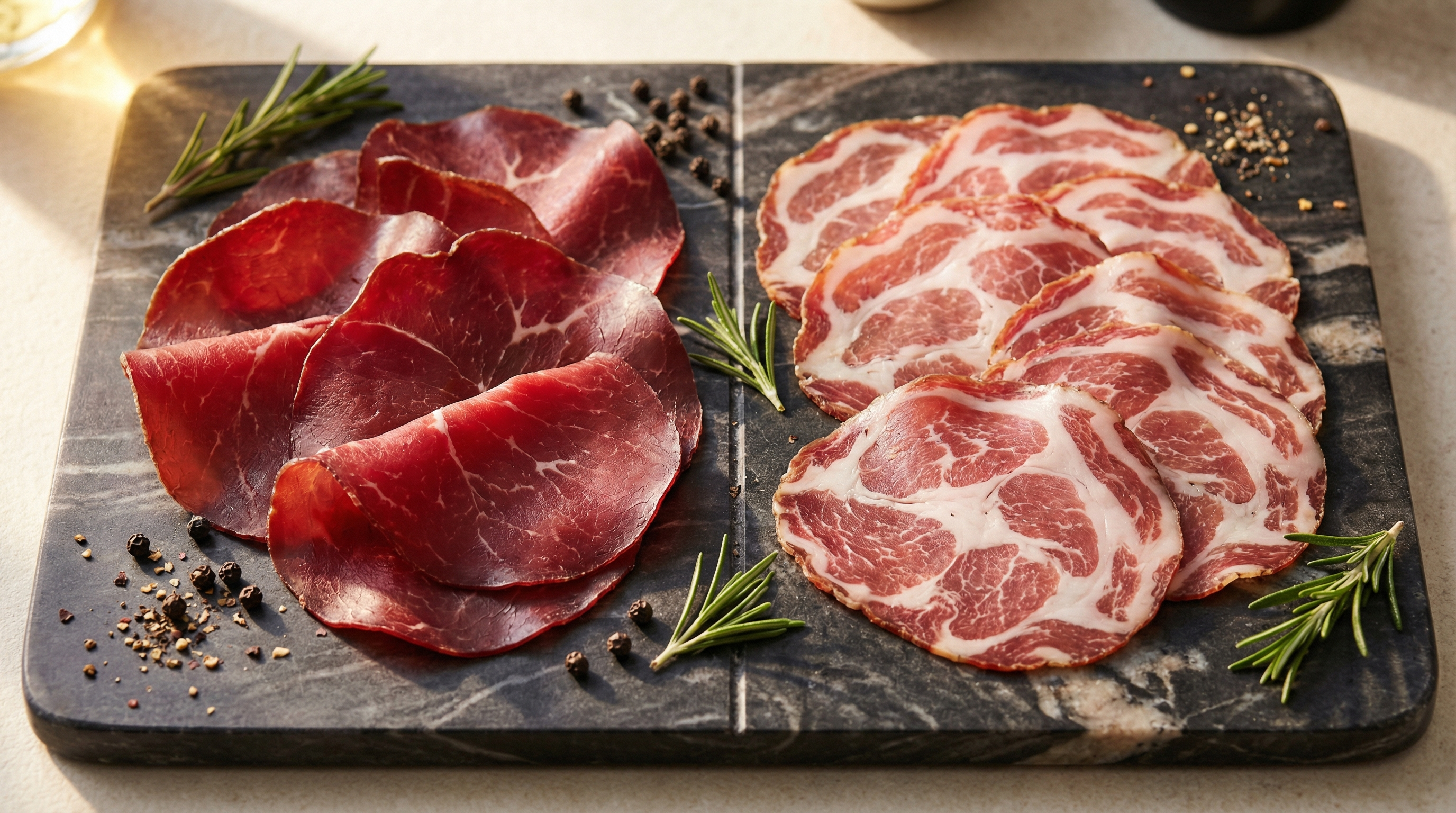
Bresaola and coppa sit next to each other on charcuterie boards all the time, but they could not be more different. One is lean, delicate, and made from beef. The other is rich, fatty, and made from pork. Understanding what separates them helps you choose the right one for your board, your recipe, or your next trip to the deli counter.
This guide breaks down bresaola vs coppa across every dimension that matters—the cut of meat, the curing process, flavor, texture, nutrition, price, and how to use each one.
What Is Bresaola?
Bresaola is an air-dried, salt-cured beef from the Valtellina valley in Lombardy, northern Italy. It holds IGP (Indicazione Geografica Protetta) status, meaning authentic Bresaola della Valtellina must be produced in that specific region following traditional methods.
The meat comes from the lean hindquarter muscles of beef—typically the eye of round, top round, or silverside. After trimming all visible fat, the beef is packed in a cure of salt, black pepper, garlic, cinnamon, and juniper berries. Some producers add cloves, nutmeg, or rosemary. The cured meat is then stuffed into a natural or synthetic casing and air-dried for one to three months at controlled temperature and humidity.
The finished product is deep ruby-red, almost burgundy, with virtually no visible fat. It is sliced paper-thin and has a delicate, slightly sweet, mildly gamy flavor. The texture is silky and tender—nothing like jerky, despite both being dried beef.
What Is Coppa?
Coppa (also called capocollo, capicola, or gabagool in Italian-American dialects) is a cured pork product made from the muscle running from the neck to the fourth or fifth rib of the pig—the coppa muscle. This cut sits between the shoulder and the head, and it is naturally well-marbled with intramuscular fat.
The coppa muscle is trimmed, rubbed with a spice cure that typically includes salt, black pepper, paprika, red pepper flakes, garlic, and sometimes wine, then stuffed into a natural casing. It is air-dried for three to six months, depending on the producer and regional tradition.
The finished coppa shows a beautiful cross-section of deep pink meat threaded with white fat. It is sliced thin but not as thin as bresaola—the fat content gives it enough body to hold a slightly thicker slice. The flavor is rich, porky, mildly spicy, and deeply savory, with the intramuscular fat melting on the tongue.
Side-by-Side Comparison
Here is how bresaola and coppa differ across the most important categories:
Animal and Cut
- Bresaola: Beef hindquarter (eye of round, top round)
- Coppa: Pork neck/shoulder (coppa muscle, 4th–5th rib)
Fat Content
- Bresaola: Extremely lean, less than 5% fat
- Coppa: Well-marbled, roughly 25–30% fat
Curing Time
- Bresaola: 1–3 months
- Coppa: 3–6 months
Color
- Bresaola: Deep ruby-red to burgundy
- Coppa: Pink with white fat marbling
Texture
- Bresaola: Silky, tender, delicate
- Coppa: Supple, rich, slightly chewy fat threads
Flavor Profile
- Bresaola: Mild, slightly sweet, subtle gamy notes
- Coppa: Rich, porky, mildly spicy, savory
Calories (per 100g)
- Bresaola: ~150 kcal
- Coppa: ~400 kcal
Protein (per 100g)
- Bresaola: ~32g
- Coppa: ~20g
Price Range
- Bresaola: $30–60 per pound (imported IGP can exceed $70)
- Coppa: $15–35 per pound
Flavor and Texture Deep Dive
The most important difference between bresaola and coppa is what happens in your mouth.
Bresaola is all about subtlety. Because the beef is so lean, the flavor comes almost entirely from the cure spices and the slow enzymatic changes during drying. You taste juniper, black pepper, and a gentle sweetness from the dried beef itself. There is a faint gamy quality—not strong, more like a whisper that reminds you this is not ordinary deli meat. The texture is remarkably silky. A properly made bresaola melts across your palate like prosciutto, but without the fatty richness.
Coppa hits completely differently. The intramuscular fat is the star. As a slice of coppa warms on your tongue, the fat softens and releases a wave of pork flavor that is richer and more complex than prosciutto. The spice cure—especially if the producer uses paprika and chili flakes—adds warmth and a slow heat that builds over several bites. The texture alternates between tender meat and small pockets of fat that create a satisfying, almost creamy mouthfeel.
If bresaola is a violin solo, coppa is a full brass section.
When to Choose Bresaola
Charcuterie boards that need a lean counterpoint. If your board already has prosciutto, soppressata, and coppa, adding bresaola introduces a completely different texture and flavor. It is the palate cleanser of the cured meat world.
Salads and light dishes. Bresaola with arugula, lemon juice, olive oil, and shaved Parmigiano-Reggiano is a classic Italian antipasto. The lean meat works as a protein component without weighing down the dish.
Health-conscious eating. With roughly 32 grams of protein and only 150 calories per 100 grams, bresaola is one of the most nutrient-dense cured meats available. It is a legitimate option for anyone watching fat intake but wanting real charcuterie.
Pairing with bold accompaniments. Because bresaola has a mild flavor, it pairs beautifully with strong cheeses (aged pecorino, blue cheese), peppery greens (arugula, watercress), and acidic elements (capers, cornichons, lemon).
When to Choose Coppa
When you want the meat to be the star. Coppa has enough flavor and richness to stand alone. A few slices with crusty bread and nothing else is a perfect snack.
Sandwiches and panini. Coppa’s fat content makes it ideal for hot sandwiches. The fat renders slightly when pressed in a panini, creating a richness that bresaola cannot match. The classic Italian sub relies on capocollo for this exact reason.
Charcuterie boards that need richness. If your board is skewing lean—bresaola, turkey, lean salami—coppa provides the fatty anchor that makes the whole spread feel indulgent.
Cooking applications. Diced coppa renders beautifully in pasta dishes, soups, and bean stews. It works anywhere pancetta or guanciale would go, adding a spiced, porky depth. Bresaola, being so lean, does not perform well in cooked applications.
Wine pairing. Coppa’s fat and spice profile pairs exceptionally well with medium-bodied Italian reds—Barbera d’Asti, Chianti Classico, Montepulciano d’Abruzzo. The fat tempers tannins while the spice echoes the wine’s fruit.
Regional Variations
Both bresaola and coppa have significant regional diversity within Italy.
Bresaola della Valtellina (IGP) is the gold standard—made exclusively in the Valtellina valley with specific beef cuts and traditional methods. Bresaola from other regions exists but cannot carry the IGP designation.
Coppa di Parma (IGP) and Coppa Piacentina (DOP) are the two most prestigious coppa designations. Coppa Piacentina has the higher DOP status, requiring pigs born, raised, and processed in the Piacenza province. The seasoning traditions differ—Piacenza coppa tends to be more delicately spiced, while versions from Calabria and Basilicata often include significant chili heat.
In the United States, domestic producers make both bresaola and coppa. Quality varies widely. For bresaola, look for producers who use eye of round and cure for at least 60 days. For coppa, look for visible marbling in the cross-section and a cure time of at least 90 days.
Storage and Shelf Life
Bresaola is more perishable than coppa because of its low fat content. Fat acts as a natural preservative in cured meats—it slows oxidation and moisture loss. Lean bresaola dries out and darkens faster.
Whole, unsliced bresaola: Keeps 2–3 weeks in the refrigerator wrapped in butcher paper. Do not use plastic wrap—it traps moisture and promotes mold.
Sliced bresaola: Best consumed within 3–5 days. Pre-sliced packages from the store often include a modified atmosphere that extends this, but once opened, the clock starts ticking quickly.
Whole coppa: Keeps 4–6 weeks in the refrigerator, thanks to the protective fat content. Wrap in butcher paper and store in the meat drawer.
Sliced coppa: Lasts 5–7 days after slicing. The fat marbling slows the drying process, giving you a wider window than bresaola.
For both products, if you see surface mold on a whole piece, it is usually harmless white mold (penicillium) that you can wipe off with a vinegar-dampened cloth. Green, black, or fuzzy mold means discard the piece.
How to Serve Both Together
The best charcuterie boards include both bresaola and coppa because they complement each other perfectly. Place them on opposite sides of the board to create visual contrast—the deep burgundy of bresaola against the pink-and-white marbled coppa.
Serve bresaola with lemon wedges, arugula, capers, and a hard aged cheese like Parmigiano-Reggiano. Serve coppa with crusty bread, roasted peppers, olives, and a semi-soft cheese like young Asiago or fontina.
The contrast is the point. Guests who start with the rich, fatty coppa will find the lean bresaola refreshing. Guests who start with the delicate bresaola will find the coppa indulgent. Either way, both meats get their moment.
The Bottom Line
Bresaola and coppa are not interchangeable, and that is exactly why both deserve a place in your repertoire. Bresaola is the lean, elegant option—high in protein, low in fat, subtle in flavor, and perfect for salads, light dishes, and boards that need a refined element. Coppa is the rich, bold option—well-marbled, deeply flavored, versatile in cooking, and the kind of cured meat that makes you close your eyes and chew slowly.
If you are building a charcuterie board, include both. If you are choosing one for a specific purpose, let the dish guide you: lean and light calls for bresaola, rich and indulgent calls for coppa. Neither is better—they simply serve different roles in the vast, delicious world of Italian salumi.
More Charcuterie Guides
What Is Pink Curing Salt? Sodium Nitrite Explained for Home Charcuterie
Pink curing salt is the most essential — and most misunderstood — ingredient in meat curing. This guide explains what it is, why it's pink, how sodium nitrite prevents botulism, proper usage rates, and whether you can cure meat without it.
10 min readHow Long Does Charcuterie Last? Storage Guide for Cured Meats & Cheese
Understanding proper charcuterie storage ensures you enjoy it at peak quality while avoiding food safety risks.
10 min read