The Ultimate Guide to Charcuterie Board Cheeses: 12 Best Cheeses + Pairing Tips
By Hank Delgado·12 min read·

Building a charcuterie board starts with one critical decision: which cheeses to include. The right cheese selection transforms a simple meat-and-cheese platter into a balanced tasting experience that keeps guests coming back.
After two decades crafting charcuterie boards for high-end events and teaching workshops, I've learned that cheese selection follows three rules: **variety in texture, contrast in flavor intensity, and strategic pairing with your cured meats**. This guide covers the 12 essential cheeses every charcuterie board should consider, organized by texture category and flavor profile.
## Understanding Cheese Categories for Charcuterie
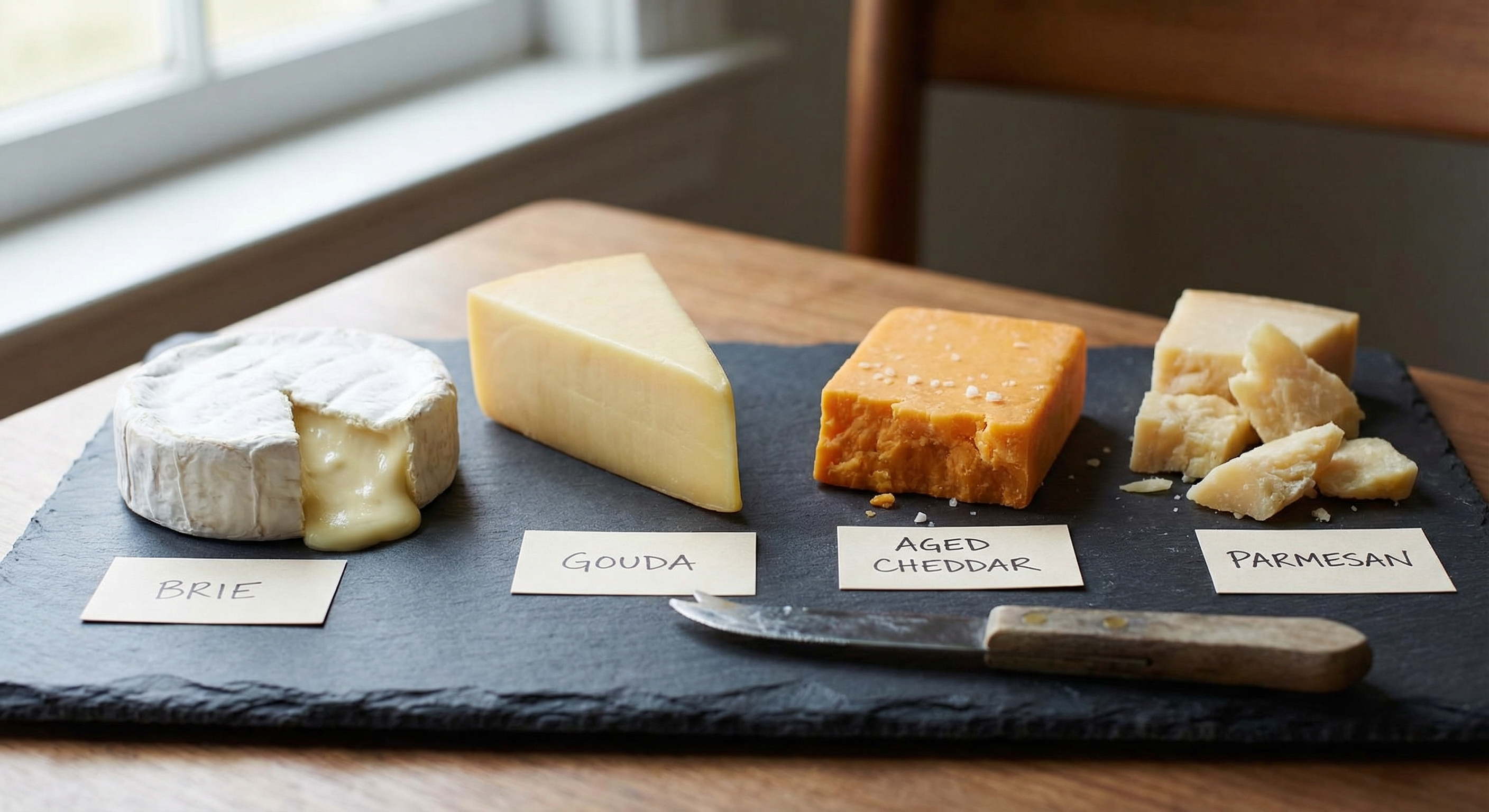
Before selecting specific cheeses, understanding the four texture categories helps you build balance:
**Soft-ripened cheeses** like Brie and Camembert offer creamy, spreadable textures with mild, buttery flavors. These anchor your board's approachable corner and pair beautifully with mild cured meats like prosciutto.
**Semi-soft cheeses** including Gouda and Havarti provide slight resistance when cut but remain creamy. They bridge the gap between delicate soft cheeses and firm aged varieties, making them crowd-pleasers.
**Semi-hard cheeses** such as Gruyère and aged Cheddar deliver robust flavor with crystalline texture from aging. These stand up to bold salamis and provide satisfying chew.
**Hard cheeses** like Parmigiano-Reggiano and aged Manchego offer intense, concentrated flavors and require shaving or breaking into shards. They're your board's flavor anchors and conversation starters.
A well-composed board includes at least one cheese from three categories, ensuring textural variety that keeps the tasting experience dynamic.
## The 12 Best Cheeses for Charcuterie Boards
### 1. Brie (Soft-Ripened)
Classic French Brie remains the most reliable soft cheese for charcuterie boards. The edible bloomy rind encases a creamy, mild interior with subtle mushroom notes.
**Why it works:** Brie's neutral profile won't compete with your cured meats while providing luxurious mouthfeel. It pairs especially well with sweet accompaniments like fig jam or honey.
**Pro tip:** Remove Brie from refrigeration 30-45 minutes before serving. Cold Brie tastes bland and feels rubbery; room temperature Brie becomes lusciously creamy.
**Best pairing:** Thinly sliced prosciutto di Parma, apricot preserves, water crackers.
### 2. Aged White Cheddar (Semi-Hard)
Sharp, aged white cheddar (minimum 12 months) provides the bold flavor punch many boards lack. Quality aged cheddar develops crunchy protein crystals and complex tangy notes.
**Why it works:** The sharpness cuts through fatty cured meats, cleansing the palate between bites. Cheddar's crystalline texture adds satisfying crunch.
**Selection note:** Choose cloth-bound cheddar when possible—traditional bandaging allows the cheese to breathe during aging, developing more complex earthy flavors than plastic-wrapped versions.
**Best pairing:** Spicy calabrese salami, whole-grain mustard, crisp apple slices.
### 3. Manchego (Semi-Hard)
Spanish Manchego, made from sheep's milk, delivers nutty sweetness with firm texture. Aged Manchego (12+ months) develops concentrated caramel notes and crumbly texture.
**Why it works:** Sheep's milk creates richer, sweeter flavor than cow's milk cheeses, providing contrast without overwhelming. The distinctive herringbone rind pattern makes it visually striking on your board.
**Regional note:** Look for PDO-certified Manchego from La Mancha—the protected designation ensures authentic production methods and flavor.
**Best pairing:** Ibérico ham, marcona almonds, quince paste (membrillo).
### 4. Camembert (Soft-Ripened)
Similar to Brie but with more assertive mushroom and garlic notes, Camembert offers soft-cheese luxury with deeper flavor.
**Why it works:** Camembert's stronger flavor profile pairs beautifully with herb-crusted salamis and pungent accompaniments. The smaller wheel format (versus Brie's larger rounds) makes it easier to serve completely without waste.
**Temperature matters:** Like Brie, Camembert needs 45-60 minutes at room temperature. The center should feel soft when gently pressed—this indicates proper serving temperature.
**Best pairing:** Herb-crusted saucisson sec, cranberry chutney, sourdough crisps.
### 5. Gouda (Semi-Soft to Semi-Hard)
Aged Gouda transforms from mild and creamy (young) to caramel-sweet and crystalline (aged 2+ years). Including both young and aged Gouda demonstrates the aging spectrum.
**Why it works:** Gouda's butterscotch sweetness complements smoky cured meats without competing. The progressive aging shows guests how time transforms flavor—a great conversation starter.
**Smoked option:** Smoked Gouda adds another dimension but use sparingly—its assertive smokiness can dominate delicate meats.
**Best pairing:** Young Gouda with mild coppa; aged Gouda with peppered salami, dark chocolate pieces.
### 6. Blue Cheese (Gorgonzola or Roquefort)
Bold, veiny blue cheese polarizes guests, but no charcuterie board is complete without this intensity. Gorgonzola dolce offers milder introduction; Roquefort brings maximum pungency.
**Why it works:** Blue cheese's sharp, salty tang provides the strongest flavor contrast on your board. Those who love it will seek it out; those who don't can easily avoid it.
**Portion size:** Blue cheese goes far—include smaller portions than other cheeses since its intensity means guests eat less per serving.
**Best pairing:** Mild prosciutto (to balance intensity), honeycomb or honey drizzle, candied walnuts.
### 7. Gruyère (Semi-Hard)
Swiss Gruyère delivers complex nutty, fruity notes with firm texture and scattered eyes (holes). Well-aged Gruyère (12+ months) develops crystalline crunch.
**Why it works:** Gruyère's sophisticated flavor profile elevates your board beyond basic cheese selections. Its slightly sweet, nutty character pairs with almost any cured meat.
**Quality marker:** Look for wheels stamped "Switzerland"—genuine Gruyère AOP must be produced in specific Swiss cantons following traditional methods.
**Best pairing:** Bresaola, cornichons, grainy mustard, baguette slices.
### 8. Fresh Chèvre (Soft)
Tangy, spreadable goat cheese provides bright acidity that cuts through rich meats. Fresh chèvre (unaged) offers pure, clean flavor; herb-rolled versions add visual appeal.
**Why it works:** Goat cheese's characteristic tang and lighter body refresh the palate. Its pure white color provides visual contrast against deeper-hued aged cheeses.
**Presentation option:** Form chèvre into small balls and roll in herbs, cracked pepper, or edible flowers for elegant presentation.
**Best pairing:** Mild ham, cherry tomatoes, olive tapenade, water crackers.
### 9. Parmigiano-Reggiano (Hard)
Authentic Italian Parmigiano-Reggiano (minimum 24 months) offers intense umami, crystalline texture, and concentrated savory notes. This is a shaving cheese, not a slicing cheese.
**Why it works:** Parmigiano's powerful flavor punch means a small amount satisfies. The crystalline crunch provides textural interest, and pre-breaking chunks into irregular shards creates rustic presentation.
**Authentication:** Look for the pin-dot pattern stamped on the rind spelling "PARMIGIANO-REGGIANO"—this guarantees authentic production in the designated Italian region.
**Best pairing:** Mortadella, aged balsamic drizzle, fresh arugula, ciabatta.
### 10. Havarti (Semi-Soft)
Buttery Danish Havarti offers mild, creamy flavor with slight tang. Its approachable profile makes it perfect for guests unfamiliar with artisan cheeses.
**Why it works:** Havarti's mellow character won't intimidate cautious eaters while still providing genuine flavor. Infused versions (dill, jalapeño) add interest without overwhelming.
**Crowd consideration:** Include Havarti when serving guests with varying cheese experience levels—it's a reliable crowd-pleaser that won't polarize.
**Best pairing:** Honey ham, sweet pickle relish, rye crackers.
### 11. Aged Pecorino Romano (Hard)
Sharp, salty Italian sheep's milk cheese aged 8-12 months. Pecorino Romano brings more aggressive saltiness than Parmigiano, with crumbly texture.
**Why it works:** The pronounced saltiness enhances fatty, rich cured meats through contrast. Like Parmigiano, break into irregular chunks rather than slicing.
**Serving amount:** Pecorino's intensity means less is more—include smaller portions and let guests discover it.
**Best pairing:** Spicy soppressata, oil-cured olives, fig jam, rustic bread.
### 12. Fontina Val d'Aosta (Semi-Soft)
Italian Fontina from Val d'Aosta offers earthy, mushroom-forward flavor with supple, semi-soft texture. This is not the mild, rubbery Danish Fontina—seek authentic Italian versions.
**Why it works:** Fontina's earthy complexity pairs beautifully with herb-rubbed salamis and truffle accompaniments. It bridges the gap between assertive aged cheeses and mild soft varieties.
**Quality distinction:** Authentic Fontina Val d'Aosta DOP costs more but delivers incomparably richer flavor. Avoid generic "Fontina" substitutes that lack the original's character.
**Best pairing:** Truffle salami, roasted garlic cloves, grissini breadsticks.
## Cheese Pairing Rules for Charcuterie Success
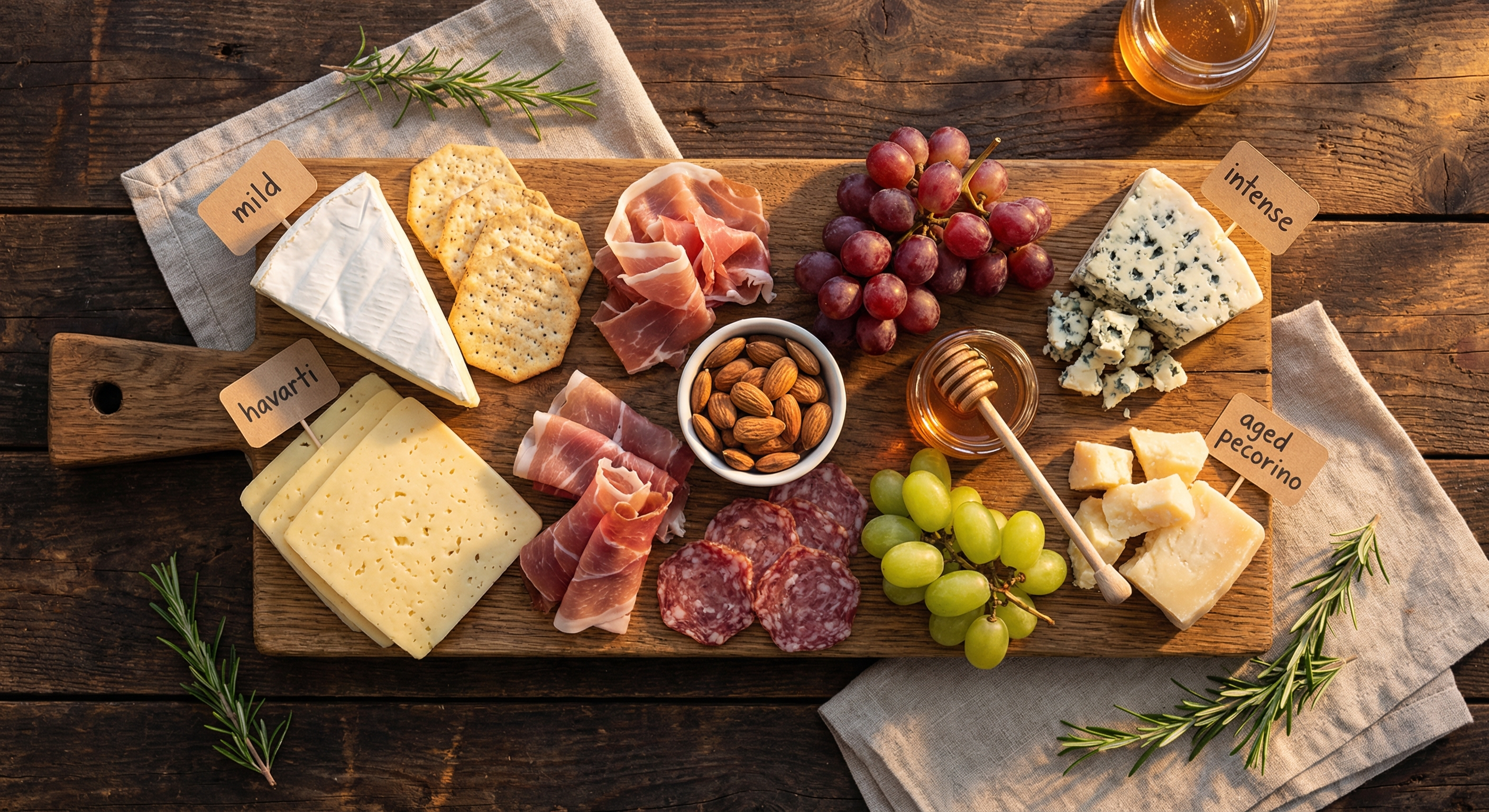
Beyond selecting individual cheeses, strategic pairing principles ensure your board flows cohesively:
**The Three-Texture Rule:** Include at least one soft, one semi-hard, and one hard cheese. This creates progressive tasting experiences as guests move around the board.
**Intensity Progression:** Arrange cheeses from mild to bold, allowing guests to build flavor gradually. Start with Brie or Havarti; end with blue cheese or aged Pecorino.
**Milk Variety:** Include cow, sheep, and goat milk cheeses when possible. Different milk types provide distinct flavor profiles that showcase cheese diversity.
**Temperature Matters:** All cheeses should rest at room temperature 45-60 minutes before serving. Cold cheese tastes muted and feels firm; properly warmed cheese releases aromatic compounds and achieves ideal texture.
**Portion Calculation:** Plan 2-3 ounces total cheese per person for appetizer boards, 4-6 ounces for main course boards. Err on the side of variety over volume—eight cheeses in smaller amounts beats three cheeses in large portions.
## Building Your Charcuterie Board: Cheese Placement Strategy
Cheese placement isn't arbitrary—thoughtful positioning guides the tasting experience:
**Create Flavor Zones:** Group mild cheeses together and intense cheeses together, preventing flavor cross-contamination. Place blue cheese and aged Pecorino at opposite corners.
**Leave Space:** Cheese should occupy 40-50% of board real estate, leaving room for meats, accompaniments, and negative space. Crowded boards look cluttered and make serving difficult.
**Pre-Cutting Protocol:** Pre-cut semi-hard and hard cheeses into 1/4-inch slices or irregular chunks. Leave soft cheeses whole with dedicated spreading knives. This removes serving barriers and encourages tasting.
**Color Distribution:** Distribute white cheeses (Brie, chèvre, Havarti) and yellow/orange cheeses (cheddar, Gouda, Fontina) evenly across the board for visual balance.
**Height Variation:** Stack harder cheeses to create vertical interest; allow soft cheeses to sprawl naturally. Three-dimensional boards photograph better and look more abundant.
## Seasonal Cheese Selection Adjustments
Optimal cheese choices shift with seasons and occasions:
**Summer Boards:** Emphasize lighter, fresher cheeses—chèvre, young Gouda, mild Havarti. Skip heavy, pungent blues that taste cloying in heat.
**Winter Boards:** Feature aged, intense cheeses—24-month Manchego, aged cheddar, Gorgonzola. Rich flavors suit cold weather gatherings.
**Holiday Boards:** Include at least one conversation-starter cheese (truffle-infused, wine-soaked, or unique aged variety) that prompts questions and discussion.
**Large Gatherings:** Favor semi-soft crowd-pleasers (Gouda, Havarti, young cheddar) over polarizing blues and aged sheep cheeses. Play to the middle of the palate preference range.
## Common Cheese Selection Mistakes
Avoid these frequent errors that compromise board quality:
**Too Much Blue:** More than one blue cheese overwhelms the board. Choose either Gorgonzola or Roquefort, not both.
**All Cow's Milk:** Boards featuring only cow's milk cheeses lack dimension. Include at least one sheep or goat milk cheese.
**Pre-Shredded Products:** Never include pre-shredded cheese—preservative coatings prevent proper melting and taste stale. Buy blocks and cut fresh.
**Flavored Cheese Overload:** Limit flavored cheeses (herb-crusted, pepper-infused) to one per board. Too many compete rather than complement.
**Wrong Temperature:** Serving cheese directly from refrigeration is the single biggest flavor killer. Room temperature cheese tastes exponentially better.
## Storing Leftover Charcuterie Board Cheese
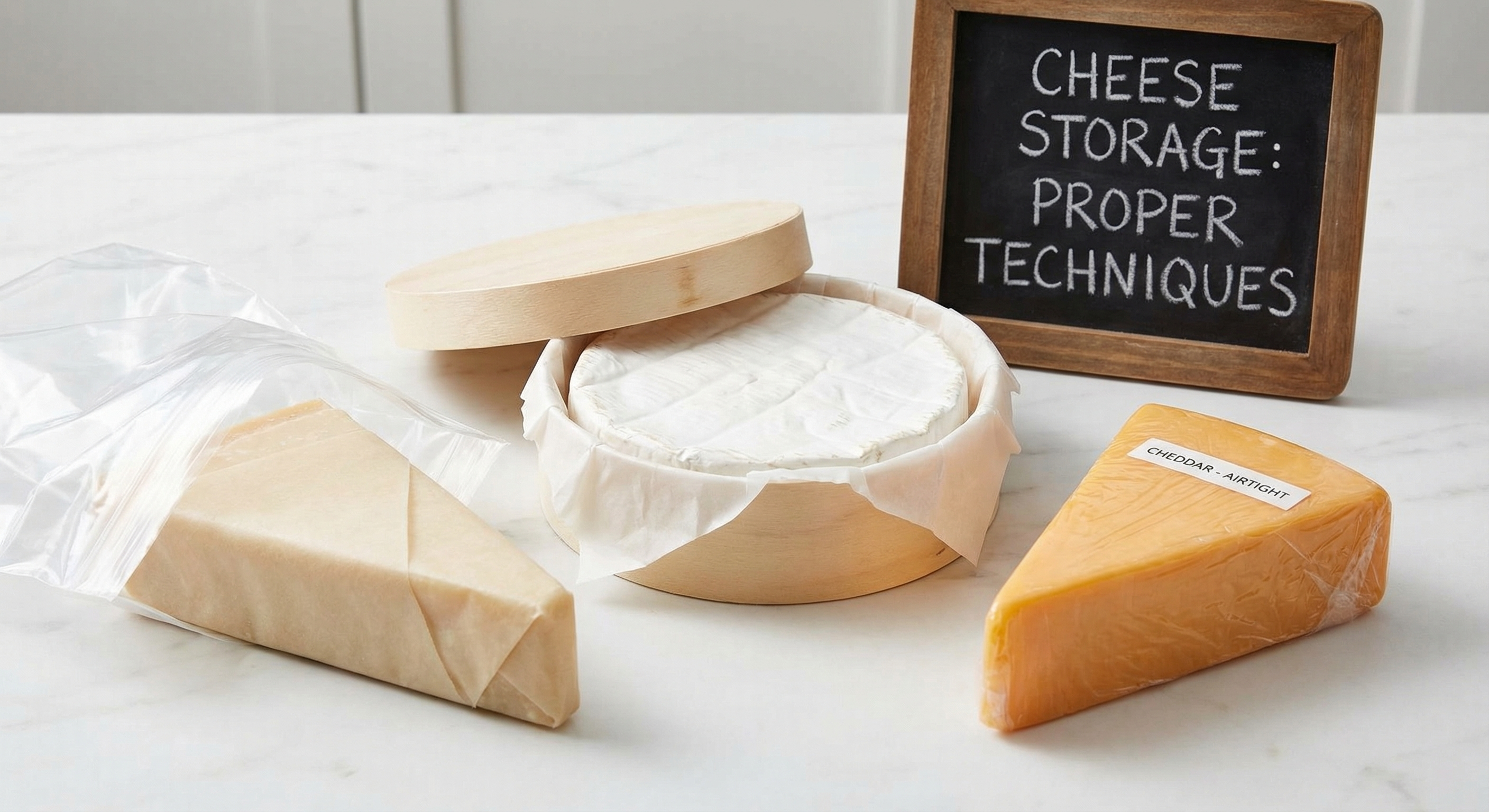
Proper storage preserves flavor and texture after your event:
**Individual Wrapping:** Wrap each cheese separately in wax paper or cheese paper, then place in loose plastic wrap. This allows cheese to breathe while preventing drying.
**Avoid Plastic Contact:** Direct plastic wrap contact creates "plastic taste" and promotes moisture accumulation. Always use wax or cheese paper as the first layer.
**Soft Cheese Care:** Store soft-ripened cheeses (Brie, Camembert) in their original wooden boxes when possible—the wood regulates humidity better than plastic containers.
**Hard Cheese Longevity:** Properly wrapped hard cheeses (Parmigiano, Pecorino, aged Manchego) keep 4-6 weeks refrigerated. Remove and discard any surface mold that develops; the interior remains safe.
**Freezing Protocol:** Only hard and semi-hard cheeses freeze successfully. Wrap tightly and freeze up to 3 months; thaw in refrigerator overnight before serving.
## Building Your First Charcuterie Board: Essential Cheese Trio
If you're building your first charcuterie board, start with this foolproof three-cheese foundation:
**Soft:** Brie provides creamy, mild approachability that appeals to most palates.
**Semi-Hard:** Aged white cheddar delivers bold flavor contrast and satisfying texture.
**Hard:** Parmigiano-Reggiano offers intense umami and impressive presentation when broken into chunks.
This trio covers texture range, flavor intensity progression, and crowd appeal. As you develop confidence, expand to five, then seven, then twelve cheese boards that showcase deeper variety.
## The Path to Charcuterie Excellence
Selecting the best cheese for charcuterie transforms simple entertaining into memorable tasting experiences. Focus on texture variety, flavor progression, and strategic pairing with your cured meats. Start with the essential twelve cheeses outlined here, adjust for seasonality and occasion, and always serve at proper temperature.
Great charcuterie boards aren't about expense or exotic selections—they're about thoughtful curation that guides guests through balanced, progressive flavor discoveries. Master these fundamentals, and your boards will disappear faster than you can replenish them.
## Related Guides
- [How to Build a Charcuterie Board: Complete Assembly Guide](/guides/charcuterie-board-assembly)
- [Best Cured Meats for Charcuterie: Salami, Prosciutto & More](/guides/best-cured-meats-charcuterie)
- [Charcuterie Board Accompaniments: Jams, Nuts & Crackers](/guides/charcuterie-accompaniments)
- [Wine Pairing for Charcuterie Boards: Expert Matching Guide](/guides/wine-pairing-charcuterie)
More Charcuterie Guides
11 min read
What Is Pink Curing Salt? Sodium Nitrite Explained for Home Charcuterie
Pink curing salt is the most essential — and most misunderstood — ingredient in meat curing. This guide explains what it is, why it's pink, how sodium nitrite prevents botulism, proper usage rates, and whether you can cure meat without it.
10 min readHow Long Does Charcuterie Last? Storage Guide for Cured Meats & Cheese
Understanding proper charcuterie storage ensures you enjoy it at peak quality while avoiding food safety risks.
10 min read